
My family ignored me for 7 years — then showed up at my hotel uninvited. Dad leaned across the table: “Give us $60k… or I call your landlord tonight.” 091
My family ignored me for 7 years — then showed up at my hotel uninvited. Dad leaned across the table: “Give us $60k… or I call your landlord tonight.”
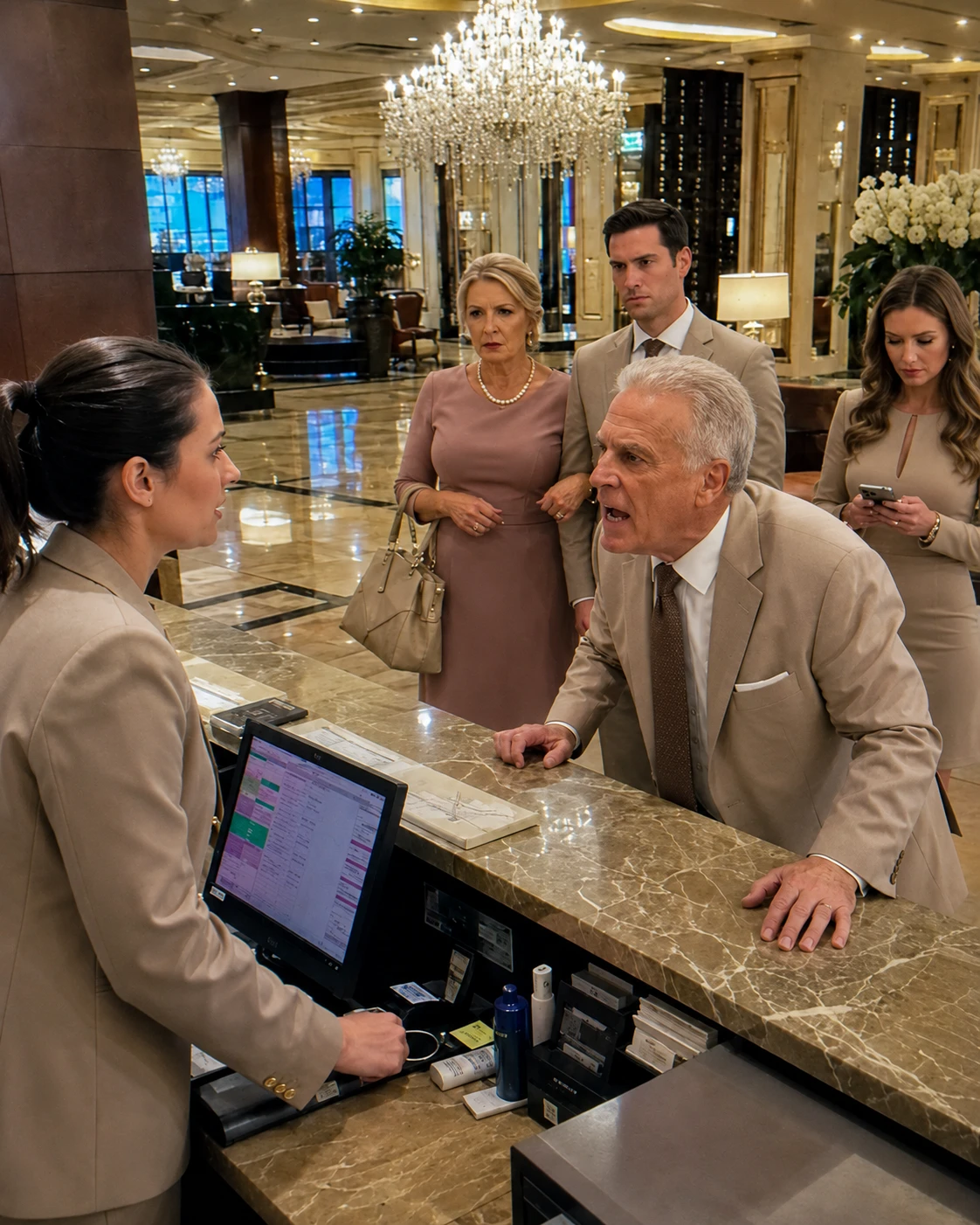
The family who erased me for seven years walked into my hotel like they still owned a piece of my future.
My father didn’t say hello.
He didn’t ask how I had been.
He stepped across the polished marble lobby, looked around at the brass lights, the fresh flowers, the guests checking in for the weekend, and said, loud enough for my front desk manager to hear, “So, you think owning a little hotel makes you better than us now?”
The lobby went still.
Behind him stood my mother, dressed carefully in a navy wrap dress, her hands folded around a small clutch like she had practiced looking gentle. My brother Derek stood beside her in a stiff collared shirt, his wife Cassandra scrolling on her phone as if this were already beneath her.
Seven years.
Not one birthday call.
Not one message after I graduated.
Not one word when I built my first property, sold it, reinvested, failed, tried again, and finally came back to Savannah as the owner of the Aldren.
And now they were standing in my lobby on a Friday night, under warm chandelier light, expecting me to shrink.
I kept my voice calm.
“Welcome to the Aldren,” I said. “Do you have a reservation?”
My father laughed.
It was the same laugh from my childhood. The one that made every room feel smaller. The one that always told me the joke was me.
“A reservation?” he said, turning toward my mother. “She’s asking if we have a reservation.”
My mother gave me that soft smile she used when she wanted something.
“Maya, sweetheart,” she said, “we didn’t even know this was your place. We’re here for Derek’s company dinner. He’s being recognized tonight.”
Derek glanced at me once and looked away.
That glance told me everything.
I stepped behind the front desk and checked the event list. The rooftop had been bought out by Hollis Group for a private client dinner. Derek’s name was there.
One seat.
Not four.
No family guests.
No plus-three.
I looked back up at them.
“I’m seeing one confirmed seat under Derek Lawson,” I said. “The rooftop is a private event tonight, so I can’t add anyone without authorization from the host company.”
Derek’s jaw tightened.
“Can you just call up there and get it sorted?”
“I can contact the event coordinator,” I said, “but the guest list is controlled by the host.”
My father stepped closer.
“Maya,” he said, lowering his voice just enough to make it feel personal. “We drove three hours. Your mother is tired. Surely you can find your family a table somewhere.”
Your family.
The words landed strangely after seven years of silence.
Still, I nodded.
“Of course. The dining room has availability.”
I had Celia seat them near the window, at one of the better tables, because I run my hotel professionally. I sent over the bread course. I checked on the rehearsal dinner. I handled a room-key issue. I approved a last-minute dessert change for the rooftop.
For thirty minutes, I let myself believe that would be the end of it.
Then Celia found me outside the kitchen.
“They’re asking for you again,” she said quietly.
When I reached the table, my father was sitting with his arms crossed. My mother’s bread roll sat untouched on the plate. Cassandra’s phone was face down now.
Derek was gone.
Of course he was.
Upstairs, where the important people were.
“Sit down,” my father said.
I stayed standing.
“Is there something wrong with the service?”
His mouth tightened.
“You can help us by acting like a daughter instead of a hotel employee.”
A server passed behind me carrying two plates. The silverware on the table caught the candlelight. My mother reached out and touched my wrist like she still had permission.
“We just want to talk, baby. We’ve missed you.”
Seven years, and the lie arrived wrapped in sweetness.
I gently moved my hand away.
“I’m working.”
My father leaned forward.
“Derek is being made partner next month.”
I said nothing.
“That changes things for this family,” he continued. “Socially. Professionally. People will be watching how we present ourselves.”
Cassandra lifted her chin slightly, as if the sentence had been written for her.
“They’re looking at a house in Ardsley Park,” my father said. “A real house. The kind that fits this next stage.”
There it was.
Not an apology.
Not a reunion.
A bill.
My mother rushed in softly. “We only need help bridging the gap until Derek’s bonus comes through.”
“How much?” I asked.
My father didn’t blink.
“Sixty thousand.”
The table went quiet.
Outside the window, Savannah moved on without us. A couple walked past under the streetlamps. A valet opened the door for a guest. Somewhere upstairs, a room full of strangers laughed over drinks.
I looked at my father.
“No.”
The word came out clean.
His expression changed first in the eyes.
“You own a hotel, Maya. Don’t tell me you don’t have it.”
“What I have isn’t the point.”
“Then what is the point?”
“The last major financial decision this family made involving me was when my college fund disappeared without my knowledge,” I said. “Forty-two thousand dollars that had been meant for my education went to fix Derek’s situation. I worked my way through school after that. I built everything from there myself.”
My mother looked down.
Cassandra stopped pretending not to listen.
My father’s face hardened.
“That was years ago. You clearly landed on your feet.”
“I landed on my feet because I refused to stay where you left me.”
His hands flattened against the table.
“You chose to cut off your family.”
I almost smiled.
“No. I chose to stop standing at a locked door.”
For the first time that night, my father stopped performing.
His voice dropped.
“Let me be clear with you,” he said. “Derek’s firm has relationships with people connected to this property. I happen to know someone who handles commercial leases in this area.”
Celia, across the room, froze near the host stand.
My father kept his eyes on me.
“It would be very easy for a concern to be raised when renewal comes around. Operators can be replaced. Buildings can change hands. You should think carefully about which relationships matter.”
My mother whispered, “Maya, don’t make this difficult.”
The candle between us flickered.
For a second, all I could hear was the old kitchen refrigerator from my childhood, humming while my father told me my future had already been spent.
Then I looked at the man across the table.
Calmly.
Directly.
And I asked, “Dad… who do you think owns this building?”
His mouth opened.
Nothing came out.
Behind him, Cassandra slowly lifted her eyes from the table.
My father recovered first.
“What?”
“The building,” I said.
I reached down, pinched the candle snuffer between two fingers, and extinguished the flame.
A thin ribbon of smoke curled between us.
“You said you’d call my landlord.”
His chair gave a tiny scrape against the hardwood.
“I know what I said.”
“So I’m asking you again. Who do you think owns the Aldren?”
My mother looked at him.
Not at me.
At him.
That was when I knew he had told them a different version.
My father leaned back, trying to recover the shape of the man who had walked in here expecting obedience.
“You own the business,” he said. “That doesn’t mean you own the real estate.”
“No,” I said. “It doesn’t.”
His eyes sharpened, sensing an opening.
Then I finished.
“But I own both.”
Silence.
Real silence.
The kind that has weight.
A fork touched porcelain at a nearby table and sounded unnaturally loud.
Cassandra blinked.
My mother’s lips parted.
My father stared at me for several seconds, waiting for the punch line.
I gave him none.
“The Aldren property is owned by Mercer House Holdings,” I continued. “Single-member LLC. Mine. No investors. No landlord. No lease renewal. The mortgage was retired fourteen months ago.”
His face changed by degrees.
Disbelief.
Calculation.
Then anger.
“You paid off a building like this?”
“Yes.”
“With what?”
I almost laughed.
There it was again.
Not congratulations.
Not pride.
An audit.
“With money I earned.”
His nostrils flared.
“You expect me to believe—”
“You don’t have to.”
I turned slightly.
“Celia?”
She was already moving.
My father’s eyes followed her as she approached carrying the slim black portfolio I kept in the office for vendor meetings.
I opened it, took out a copy of the property summary from our insurer, and placed it beside his untouched water glass.
He didn’t pick it up.
He read it upside down.
His expression went still.
My mother reached toward the page, but he put his hand over it.
A reflex.
Control first.
Always.
“You made your point,” he said.
“No,” I said quietly. “I corrected your threat.”
His eyes lifted.
“And now you’re going to leave.”
My mother inhaled sharply.
“Maya.”
“I comped the bread. Your entrées will be boxed. You’re not being charged.”
My father gave a short, humorless laugh.
“You’re throwing your parents out of your hotel?”
“I’m removing someone who just tried to extort me in my dining room.”
That word hit him.
Extort.
His shoulders went rigid.
“Watch yourself.”
“No,” I said. “You should have done that before threatening the owner of a hotel with thirty-two cameras and full audio coverage in the public dining areas.”
His color drained so quickly that for one wild second I saw the older man underneath him.
Not powerful.
Not untouchable.
Just frightened.
My mother turned toward the ceiling as if she could suddenly see the cameras hidden inside the smoke detectors and decorative molding.
Cassandra whispered, “Oh my God.”
My father’s eyes snapped to her.
“Don’t.”
Something in the way he said it made her recoil.
Then the elevator doors opened across the room.
Derek stepped out.
And one look at his face told me the night was about to get worse.
He crossed the dining room fast, shoulders stiff beneath his suit jacket.
“What happened?”
My father stood.
“We’re leaving.”
Derek ignored him.
He looked at Cassandra.
She didn’t move.
Then he looked at me.
“Maya, did Dad ask you for money?”
Nobody answered.
His face collapsed anyway.
Not dramatically.
Just a tiny loosening around the mouth.
Like a man watching the floor disappear under him.
“Jesus Christ.”
My father grabbed his arm.
“Not here.”
Derek pulled away.
“You said you were going to talk to her.”
“I did.”
“You said you were going to apologize.”
My mother whispered his name.
“Derek.”
He looked at her, and something in him broke open.
“No. No more.”
A few diners had begun pretending very hard not to watch us.
Celia appeared at my side.
I murmured, “Please move the tables closest to us to the courtyard. Dessert on the house.”
She nodded once.
Within minutes, practiced hospitality turned the room around us into a small island.
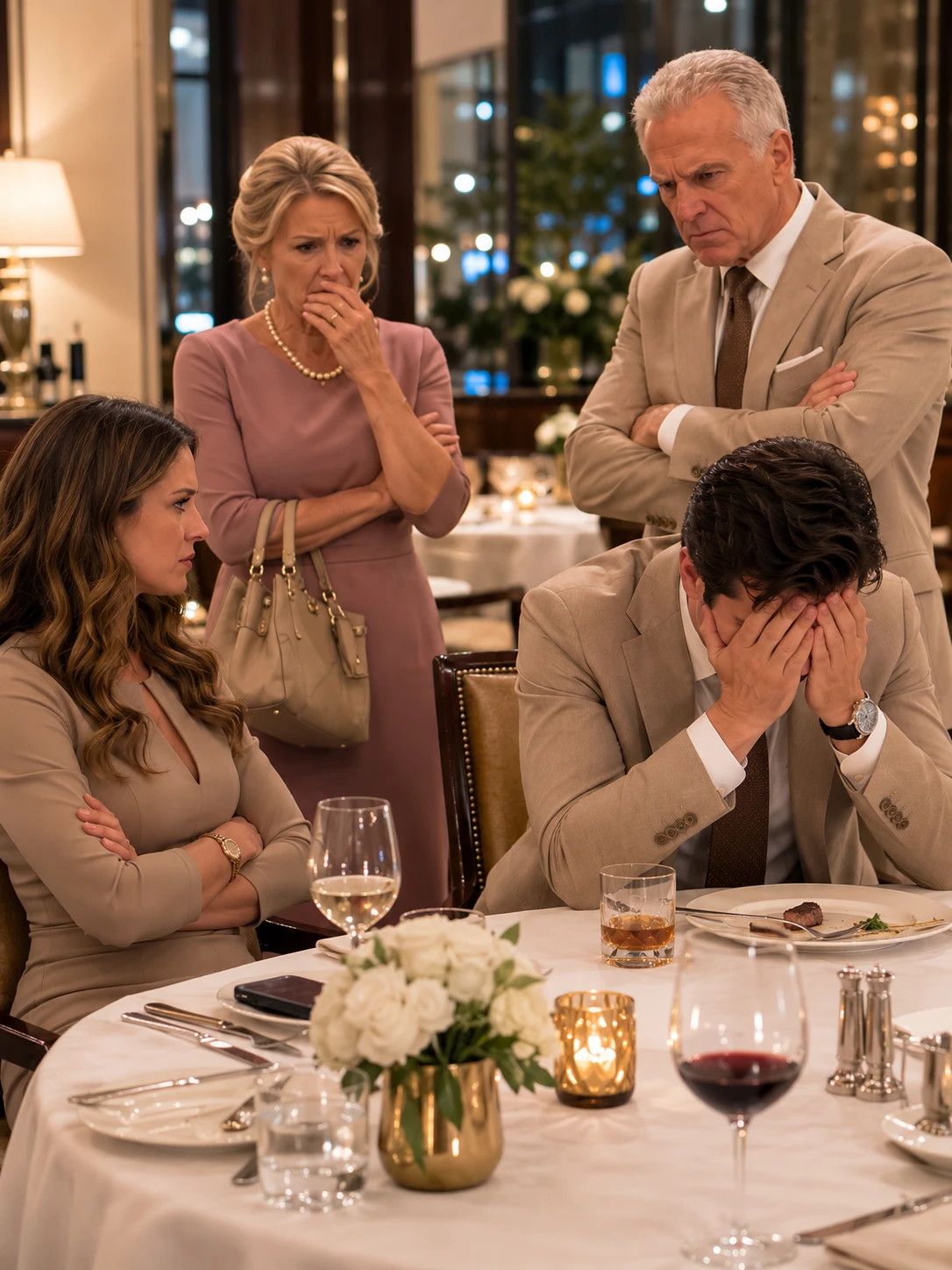
Then Derek did something I had never seen him do in my entire life.
He sat down without my father’s permission.
He pressed both hands over his face.
Cassandra stared at him.
“Tell her,” she said.
His hands stopped moving.
My father’s voice sharpened.
“Cassandra.”
She stood.
Her chair slid backward.
“No.”
One word.
Quiet.
But different from mine.
Mine had been seven years in the making.
Hers sounded like seven months.
She looked at me.
“Maya, Derek isn’t being made partner.”
My mother shut her eyes.
There it was.
The hidden blade.
I looked at Derek.
He couldn’t meet my gaze.
Cassandra’s voice shook now.
“He was told last week that his promotion was being deferred.”
“Why?” I asked.
Derek swallowed.
My father cut in.
“It’s internal politics. It happens.”
Cassandra laughed once.
It sounded almost like a sob.
“No, Richard. Tell the truth for once.”
My father moved toward her.
She stepped back.
“The firm found discrepancies in several business-development reimbursements,” she said. “Expenses Derek submitted over the last year.”
My eyes went to my brother.
“How much?”
“Not sixty thousand,” he said quickly.
That answer told me sixty thousand mattered.
“How much, Derek?”
He rubbed both palms down his trousers.
“Forty-eight.”
“Thousand?”
He nodded.
My mother made a small sound.
Cassandra stared at the linen tablecloth.
“He spent money he thought he’d replace after the bonus,” she said. “Private dinners. Travel. Club dues. Deposits. Things meant to make him look like he already belonged at the level he was trying to reach.”
I thought of my father saying people would be watching how we present ourselves.
Suddenly the sentence looked different.
Not family pride.
Panic.
“The house?” I asked.
Cassandra’s mouth trembled.
“There is no house.”
My father slammed his palm against the table.
“That’s enough.”
A water glass jumped.
Every head in the dining room turned.
For once, he noticed.
For once, shame reached him before rage could cover it.
He lowered his voice.
“We were trying to solve a family matter privately.”
I stared at him.
“You came here because you needed sixty thousand dollars to hide Derek’s financial misconduct.”
“No,” Derek said.
My eyes went to him.
He looked sick.
“I came because Dad told me he wanted to make things right with you.”
My father laughed harshly.
“You’re going to blame me now?”
Derek stood.
“No. I’m going to blame myself for forty-eight thousand dollars. I did that.”
His voice cracked.
He drew in a breath.
“But this?”
He pointed at me.
“This was you.”
My father stepped toward him.
“You’d be nothing without what I did for you.”
And that was the sentence that finally changed the room.
Because Derek stopped.
My mother stopped.
Even Cassandra stopped breathing.
My father seemed to hear it only after it had left his mouth.
Derek turned slowly.
“What you did for me?”
His eyes were wet.
“You mean Maya’s college fund.”
My father said nothing.
Derek looked at me.
For seven years I had imagined a hundred versions of this moment.
In some, he apologized.
In others, I destroyed him.
In most, he looked like the golden son I remembered: protected, polished, comfortable inside the space my sacrifices had purchased for him.
But the man standing in front of me looked hollowed out.
“I didn’t know,” he said.
I felt something cold move through my chest.
“What?”
“The money.”
My voice came out sharper.
“You knew they used my college fund.”
“I knew later.”
“When?”
His eyes closed.
“Two years after.”
The room tilted slightly.
Not enough for anyone else to see.
Enough for me.
“You found out two years after they took it?”
“Yes.”
“And then you let five more years pass.”
He nodded.
That hurt more than if he had lied.
My mother began crying silently.
I looked at her.
“Did you know he knew?”
She wiped at her cheek.
“Yes.”
A laugh left me before I could stop it.
Small.
Broken.
“Of course.”
“Maya—”
“No.”
I backed away from the table.
Suddenly the hotel felt too warm.
The chandeliers too bright.
The air too perfumed.
Seven years of silence crowded around me until I could barely hear.
Derek moved toward me.
I raised one hand.
He stopped immediately.
“At least you learned something,” I said. “You finally know what a boundary looks like.”
His face folded.
My father muttered, “This is ridiculous.”
My mother turned on him.
“Stop.”
He stared at her.
I did too.
I had heard my mother disagree with my father before.
About dinner.
About paint colors.
About whether Derek should wear a tie.
I had never heard that voice.
She stood slowly.
Her hands shook against the edge of the table.
“Just stop, Richard.”
“What exactly do you think you’re doing?”
“Something I should have done twenty years ago.”
He went perfectly still.
She looked at me.
Then she opened her clutch.
Inside was a folded envelope.
Old.
Soft at the edges.
My name was written across the front in handwriting I recognized immediately.
My grandmother’s.
The breath left my body.
My mother held it out.
“I brought this because I thought if things went badly tonight, I might finally be brave enough to give it to you.”
I didn’t take it.
“What is that?”
Her hand trembled harder.
“A letter your grandmother wrote before she died.”
My father said, “Linda.”
She ignored him.
“She left instructions with the college account.”
My skin prickled.
“What instructions?”
My mother’s eyes filled.
“That the money was yours. Only yours. For school, or if you chose another path, for whatever helped you build an independent life.”
I looked at my father.
He wouldn’t look back.
My mother continued.
“Your father told me we had no choice when Derek got into trouble. He said if we didn’t clear the debt, Derek would lose his placement, his references, everything.”
“What trouble?”
Derek answered.
“I wrecked Dad’s car after drinking.”
The words landed like stones.
“I was nineteen. There was another car. No one died, thank God, but there were medical bills and a settlement. Dad wanted it handled quietly.”
Forty-two thousand dollars.
My future had not paid for Derek’s education.
It had purchased silence.
I gripped the back of the chair beside me.
My father’s voice became defensive.
“I saved my son’s life from being ruined over one stupid mistake.”
“And ruined mine instead,” I said.
“You survived.”
The words were barely out before my mother slapped him.
The sound cracked through the dining room.
Nobody moved.
My father stared at her.
She stared at her own hand as though it belonged to someone else.
Then she whispered, “She should never have had to survive us.”
I had spent years wanting someone in my family to say something like that.
When it finally came, it didn’t heal me.
It made me mourn the girl who had needed it.
My mother placed the envelope on the table.
“There’s more.”
Of course there was.
She took a breath.
“Your grandmother suspected Richard would try to control the money.”
My father barked a laugh.
“Your mother hated me.”
“No,” Mom said. “She understood you.”
Then she looked at me.
“She opened a second account.”
My heartbeat changed.
“What?”
“Small. Nothing like the college fund. She deposited money from selling some jewelry. She told me it was for you if the first account ever became inaccessible.”
“Where is it?”
My mother looked down.
“I found the paperwork after she died. Richard never knew.”
Dad’s face altered.
For the first time all night, he looked genuinely blindsided.
Mom continued.
“I was afraid he’d find it. So I closed it.”
Something inside me hardened again.
“Of course you did.”
“No.”
She shook her head.
“I moved it.”
She reached into the clutch again and pulled out a faded bank statement.
“I put it into a custodial account in your name. I never touched it.”
I stared at her.
“You had money for me.”
“Yes.”
“And you never told me.”
“No.”
“Why?”
Her answer took too long.
“Because I was ashamed.”
I almost turned away.
She caught herself.
“No. That’s not enough.”
Her fingers curled around the statement.
“I was a coward. After you left, every month that passed made calling harder. I kept telling myself I would reach out when Richard was calmer, when Derek’s situation was settled, when you were less angry, when I could explain it perfectly.”
Tears slipped down her cheeks.
“And then I realized there was no explanation that made me innocent.”
The silence that followed was different.
No manipulation.
No soft baby.
No demand that I make her confession easier to carry.
Just truth.
Finally.
“How much?” I asked.
“Seventeen thousand originally.”
She swallowed.
“I left it invested. It’s a little over thirty-one now.”
I closed my eyes.
Thirty-one thousand dollars.
There had been a time when thirty-one thousand dollars would have changed my life.
When I ate crackers for dinner because tuition was due.
When my car broke down and I walked two miles to class.
When I slept on the office floor of my first failing property because I had rented out my apartment to cover payroll.
Thirty-one thousand dollars had existed.
Waiting.
And she had let me struggle because she could not endure hearing my anger.
I opened my eyes.
“You don’t get forgiveness for preserving money while abandoning me.”
She nodded immediately.
“I know.”
That almost hurt worse.
My father scoffed.
“This melodrama has gone far enough.”
I looked at him.
And whatever part of me had once been afraid of him was gone.
Not healed.
Gone.
“You’re right,” I said.
He straightened.
“It has.”
I turned to Celia.
“Call security.”
My father’s face darkened.
“Maya.”
“And save the dining-room footage beginning from the moment they sat down.”
“Maya.”
“Especially the threat.”
He stepped toward me.
Derek moved between us.
It happened so fast that my father nearly walked into his chest.
The two men stared at each other.
Father and son.
Golden child and architect.
Derek’s voice was low.
“Don’t.”
My father looked almost offended.
“You’re taking her side?”
Derek shook his head.
“No.”
Then he looked back at me.
“I’m finally taking responsibility for mine.”
Security arrived.
Two people I knew by name.
Marcus and Elena.
I did not enjoy watching my father escorted from my hotel.
That surprised me.
For years I had imagined justice as something bright.
Hot.
Triumphant.
Instead, it felt quiet.
He passed me without looking at me.
My mother followed several steps behind him, then stopped.
“Do you want me to go too?”
The question nearly undid me.
Because nobody in that family had asked me what I wanted in a very long time.
“Yes,” I said.
Her eyes closed.
Then opened.
“All right.”
She set the letter and bank statement on the table.
“I’ll go.”
No argument.
No tears deployed as weapons.
She simply left.
Cassandra went next.
Derek remained.
“You too,” I said.
He nodded.
At the elevator, he turned.
“I’m going to tell Hollis everything Monday.”
“About the reimbursements?”
“Yes.”
“You could lose your job.”
“I know.”
His mouth twisted.
“I should.”
Then he disappeared behind the closing doors.
I stood in the middle of my dining room and realized my hands were shaking.
Celia came beside me.
She didn’t hug me.
She knew me better than that.
She simply slid a glass of water into my hand.
“The rooftop wants to know if they can push speeches twenty minutes.”
I stared at her.
Then I laughed.
A real laugh.
Thin at first.
Then helpless.
Because of course.
Because somewhere above the wreckage of my family, sixty-four people were waiting for crème brûlée and corporate awards.
“Tell them ten,” I said.
Celia smiled.
“There she is.”
I worked until midnight.
Not because I was avoiding what happened.
Because the Aldren was mine.
Every hallway.
Every payroll cycle.
Every repaired pipe and negotiated linen contract.
Mine.
At twelve-thirty, the last rooftop guest left under a warm August drizzle.
I walked through the empty dining room alone.
The envelope was still on the table.
I carried it upstairs to my office.
For almost an hour, I didn’t open it.
Then I slid one finger beneath the old paper seam.
My grandmother’s handwriting covered three pages.
She wrote about independence.
About women in our family being taught to make themselves smaller so men could feel taller.
About my stubbornness when I was eight.
About the summer I charged neighborhood kids twenty-five cents for lemonade and refused to give Derek free refills.
Then, near the bottom of the last page, I found a sentence that made me stop breathing.
Someday, Maya, I hope you build a place with enough doors that you never again mistake a locked one for the end of the road.
I read it three times.
Then I looked through the office window at the hotel corridor beyond.
Doors.
Dozens of them.
Something inside me gave way.
I lowered my forehead onto my hands and cried so hard I made no sound.
Not for my father.
Not for the money.
Not even for seven years.
For the twenty-two-year-old girl who had stood outside her parents’ house with two suitcases after being told she was ungrateful.
For the girl who kept wondering what sentence she could have said differently.
For the woman who built rooms for strangers because somewhere deep down she understood what it meant to need a safe place to stay.
The next morning, I transferred the thirty-one thousand dollars into a new account.
Not mine.
A fund.
Six months later, the Aldren Opportunity Grant paid its first tuition bill for a hospitality student whose family had cut her off after she chose school over an arranged future.
I never advertised where the money came from.
I didn’t need to.
Derek confessed to Hollis Group on Monday.
They terminated him.
The firm chose not to pursue criminal charges after he repaid the expenses, but his partnership track was permanently over, and the professional network my father had spent decades helping him cultivate vanished almost overnight.
Cassandra left him three weeks later.
Not because he lost the job.
She told me that herself when she came by the hotel to return a bracelet my mother had mistakenly packed into her suitcase.
“I could have stayed through broke,” she said. “I couldn’t stay through dishonest.”
She paused at the lobby doors.
“For what it’s worth, he’s trying.”
“I hope he succeeds.”
She studied me.
“You don’t hate him?”
I looked across the lobby at a little girl spinning beneath the chandelier while her father checked in.
“No,” I said. “I just don’t trust him yet.”
Those were different things.
My father’s consequences were slower.
And worse.
The security footage never went online.
I could have humiliated him publicly.
I didn’t.
Instead, when the commercial broker he had named called two weeks later asking whether Richard Lawson had attempted to invoke his name while threatening me, I told the truth.
The broker cut contact.
Then another associate called.
Then another.
It turned out my father had been borrowing other people’s reputations for years, turning proximity into power and favors into implied debts.
My recording gave one of them proof.
Once the first person stepped away, the rest stopped pretending.
Within a year, his consulting business was gone.
Not because I destroyed him.
Because the fear holding his world together finally stopped working.
He sent me six emails.
I answered none.
The seventh contained two sentences.
I was wrong.
I don’t expect you to answer.
So I didn’t.
My mother was harder.
She wrote letters.
One every month.
Never asking me to forgive her.
Never asking me to visit.
She told me small things.
That she had started therapy.
That she had moved into an apartment.
That she had filed for divorce.
That she had begun volunteering twice a week at a literacy center because she had spent too many years confusing usefulness with obedience and wanted to discover the difference.
I kept every letter unopened in a drawer.
Then, eleven months after the night at the Aldren, I opened one.
Just one.
Three months later, I agreed to coffee.
We met nowhere near the hotel.
Neutral ground.
A small café off Forsyth Park.
She was already seated when I arrived.
No navy wrap dress.
No careful makeup.
No clutch.
Just jeans, a white blouse, and hands wrapped around a coffee cup.
She stood when she saw me.
Then seemed to remember herself and sat back down.
“Hi.”
“Hi.”
For ten minutes we talked about nothing.
Weather.
Construction downtown.
A book she had read.
Then she set her cup down.
“I practiced an apology.”
I looked at her.
“I’m not going to give it.”
“Why?”
“Because every version sounded like I wanted something from you afterward.”
Her thumb moved slowly along the rim of the cup.
“I’m sorry I chose comfort over you.”
I said nothing.
“I’m sorry I watched your father punish you for needing fairness and called it keeping the peace.”
Her voice shook.
“I’m sorry I let you think nobody missed you.”
My throat tightened.
She looked directly at me.
“I missed you every day.”
I looked away toward the window.
A dog pulled its owner across the sidewalk.
A cyclist rang a bell.
Normal life kept moving.
“You still didn’t call.”
“I know.”
“You still chose him.”
“Yes.”
“You still let me think I wasn’t worth choosing.”
Her face crumpled.
“Yes.”
There was no defense.
That was the first brick.
Not forgiveness.
Not reconciliation.
A brick.
We built slowly.
Derek took longer.
Eighteen months after that night, he came to the Aldren alone.
He had a reservation.
That mattered.
One person.
One night.
Paid in advance.
He stood at the front desk while Celia checked him in.
When she handed him his key, he asked, “Is the owner available?”
She looked at me across the lobby.
I nodded.
We sat in the courtyard.
He looked older.
Better, somehow.
Not happier.
More real.
He worked for a small accounting firm outside Charleston now.
No partnership track.
No club.
No expensive suit.
He placed an envelope on the table.
I didn’t touch it.
“What is that?”
“Forty-two thousand dollars.”
I stared at him.
He nodded toward it.
“Cashier’s check.”
“I don’t need your money.”
“I know.”
“Then why?”
“Because needing it was never the point.”
The words hit me.
My own words.
From the restaurant.
He remembered.
“I can’t repay what it cost you,” he said. “I can’t repay five years of knowing and saying nothing.”
His eyes reddened.
“But I can refuse to keep benefiting from the first thing.”
I pushed the envelope back.
He pushed it toward me again.
“Give it away.”
I stopped.
He took a breath.
“Add it to the scholarship.”
I had never told him about the grant.
Mom must have.
For a long moment, neither of us spoke.
Then I took the envelope.
Not for me.
For the next girl.
Derek looked down at his hands.
“Do you think we’ll ever be okay?”
I considered lying.
I didn’t.
“I think we might be different.”
He nodded slowly.
“Different would be good.”
It was.
Two years after my family walked into the Aldren demanding sixty thousand dollars, my mother sat in the courtyard on a Sunday morning helping me fold place cards for the hotel’s anniversary dinner.
Derek was due later.
Cassandra had remarried, and from what little I heard, she was happy.
My father lived alone outside Macon.
We had not spoken.
Maybe one day we would.
Maybe we wouldn’t.
Peace, I learned, does not require every door to reopen.
Sometimes peace is knowing you have the key and choosing not to use it.
That evening, the Aldren glowed under strands of courtyard lights.
Staff brought out champagne.
Celia cried during her speech despite swearing she wouldn’t.
Marcus pretended not to.
The first recipient of the Opportunity Grant, now a junior, stood beside me and announced she had accepted a summer internship at one of the best hotels in Atlanta.
My mother squeezed my hand.
I let her.
Derek stood on my other side.
Not close enough to presume.
Close enough to stay.
When the applause faded, Celia handed me a small framed piece of paper.
My grandmother’s sentence.
Someday, Maya, I hope you build a place with enough doors that you never again mistake a locked one for the end of the road.
I looked up.
Across the courtyard, every French door of the Aldren stood open.
Warm light spilled onto the brick.
Guests laughed inside.
Someone dropped a fork.
A server hurried past carrying champagne.
My mother was crying.
Derek was too.
I felt the old ache inside me.
It was still there.
Maybe it always would be.
But it no longer felt like an empty room.
It felt like a scar beneath a life that had grown around it.
I lifted my glass.
“To open doors,” I said.
Celia smiled.
“To owning the building,” she added.
Everyone laughed.
Even me.
Especially me.
Later, long after the guests had gone, I walked through the lobby alone.
The chandelier was dimmed.
Rain whispered against the tall windows.
At the front desk sat a vase of fresh magnolias, replaced that morning.
I stopped beneath the brass lights where my father had stood two years earlier and asked if owning a little hotel made me think I was better than them.
I understood the answer now.
No.
Owning the Aldren had never made me better than anyone.
Building it had simply taught me that love without respect was not love I had to accept.
That family could regret what it had done and still owe you patience.
That forgiveness could arrive without surrender.
That reconciliation was not returning to the old table and taking the same seat.
It was building a different table entirely.
I turned off the last lobby lamp.
Upstairs, a hundred doors waited behind me.
Some occupied.
Some empty.
Some opening onto honeymoons, funerals, reunions, interviews, anniversaries, fresh starts.
And somewhere in the hotel office, beneath a framed letter from a woman who had believed in me before I understood what belief could build, sat two scholarship applications waiting for my review in the morning.
I smiled in the darkness.
Then I locked the front doors of the Aldren for the night.
Not because I was afraid of who might come back.
Because they were mine to open again in the morning.