
MY SON SERVED ME DOG FOOD AT MY OWN 70TH BIRTHDAY DINNER… THEN I CANCELED THE CARDS AND EXPOSED HIS SECRET. 091
MY SON SERVED ME DOG FOOD AT MY OWN 70TH BIRTHDAY DINNER… THEN I CANCELED THE CARDS AND EXPOSED HIS SECRET
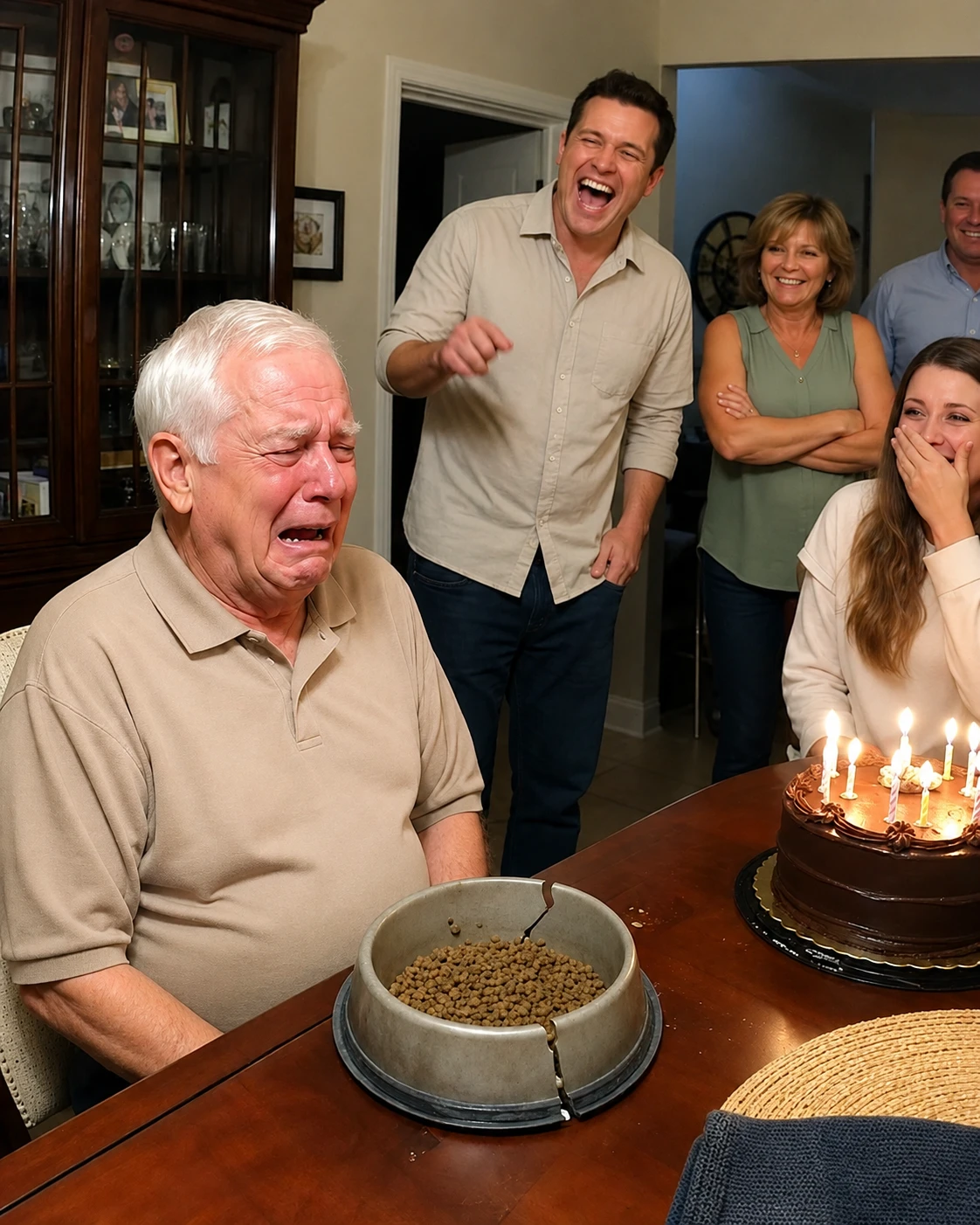
My son put a bowl of dog food in front of me at my own birthday dinner.
Then he laughed and said, “There’s dinner for freeloaders too.”
In front of the whole family.
In my own house.
On my 70th birthday.
My name is Ernest Harris. I live in the same home my late wife, Lucy, and I bought when we were young, broke, and still believed we had forever.
She died nine years ago.
After that, my only son, Louis, became my whole world.
Maybe that was my mistake.
Maybe I loved him so much that I stopped seeing what he was becoming.
Louis was thirty-six, with half a degree, no steady job, big dreams, and very little discipline.
Four years ago, he asked if he could stay with me “for a few weeks” while he got back on his feet.
A few weeks became a month.
A month became a year.
Then his girlfriend, Carla, moved in with suitcases, expensive perfume, fake lashes, and the kind of smile that made you feel like she was already spending money that wasn’t hers.
They never paid rent.
Never paid utilities.
Never bought groceries.
Never helped with repairs.
And I said nothing.
Because he was my son.
Because I kept telling myself, “He’ll figure it out.”
That Saturday, I woke up early to cook for my birthday.
Yes, my birthday.
I made everything myself.
Roast chicken, rice, salad, potatoes, and a three-milk cake from the little bakery my wife used to love.
I thought we would have a quiet family dinner.
I thought my son would sit with me.
Maybe say thank you.
Maybe remember his mother.
Maybe remember me.
Instead, I fell asleep upstairs for a little while, and when I woke up, I heard laughter downstairs.
A lot of laughter.
I walked down slowly and stopped at the dining room entrance.
There were more than twenty people in my house.
Cousins.
Neighbors.
Louis’s friends.
Carla’s friends.
People I barely knew.
They were eating the food I had paid for.
The food I had cooked.
And nobody had called me down.
I forced a small smile.
“You started without me?”
The room got quiet for half a second.
Then Louis looked up from the head of the table.
My seat.
He was sitting in my seat.
Carla was sitting in the chair where my wife used to sit.
That hurt more than I expected.
Louis laughed.
“Oh, Dad, we forgot you were upstairs. You’re so quiet these days, you’re basically a ghost.”
Some people laughed.
Others looked down at their plates.
I should have left right then.
But I stood there, trying to swallow the lump in my throat.
Then Louis walked into the kitchen.
When he came back, he was holding an old dog bowl.
Our dog Rocky’s bowl.
Rocky had been gone for years.
Louis opened a bag of dry dog food, poured it into the bowl, and placed it in front of me on the dining table.
“There you go, old man,” he said. “Dinner for you too. Since everyone in this house contributes… except you.”
The room froze.
My blood went cold.
I looked at the bowl.
Then at my son.
Then at the people watching me like my humiliation was entertainment.
I said quietly, “This house?”
Louis smirked.
Carla pulled out her phone and started recording.
“Don’t be so sensitive, Mr. Harris,” she said. “It’s just a joke. Besides, he’s kind of right. You do live here for free.”
For free.
In the house I bought.
With the wife I buried.
With the money I earned over forty years of work.
Something inside me stopped hurting in that moment.
Not because it didn’t matter.
Because I was finally done begging my own child to respect me.
I didn’t yell.
I didn’t cry.
I didn’t throw the bowl.
I simply picked it up, walked to the front door, and placed it on the floor.
Then I went upstairs.
Behind me, Louis shouted, “Keep eating, everybody! I paid for dinner!”
That was a lie.
I had paid for all of it.
Just like I paid for the house.
The electricity.
The water.
The gas.
The groceries.
The streaming accounts.
Carla’s “emergency” credit card charges.
Louis’s car repairs.
Their entire fake adult life.
I went into my bedroom and locked the door for the first time in years.
Then I opened my laptop.
Louis forgot one thing about me.
I was an accountant for forty years.
I kept records.
Receipts.
Bank statements.
Credit card charges.
Transfers.
Screenshots.
Every payment.
Every lie.
Every time my son told someone he was “taking care of me” while using my money to take care of himself.
And that night, while they laughed downstairs and ate my birthday dinner…
I started adding everything up.
By the time I finished, my hands were no longer shaking.
Then I logged into the bank.
One by one, I canceled every card.
Froze every authorized user.
Blocked every transfer.
Changed every password.
And when I saw one charge I had never approved…
A charge linked to Carla’s name…
I realized this was much bigger than disrespect.
My son and his girlfriend weren’t just using me.
They were hiding something.
Something they never thought an old man would find.
And by morning, every person who laughed at me at that table was going to learn exactly whose house they were sitting in.
The first scream came from downstairs at 12:17 in the morning.
“LOUIS!”
Carla.
I sat at my desk beneath the yellow pool of my reading lamp and watched the cursor blink beside a spreadsheet I had spent three hours building.
Her heels struck the staircase.
Fast.
Angry.
Then Louis’s voice rose beneath hers.
“What do you mean declined?”
“My card!”
“That’s Dad’s card.”
“I know whose card it is!”
I leaned back.
For the first time all evening, I smiled.
Not because I enjoyed hearing them panic.
Because numbers do something emotions cannot.
They make excuses measurable.
On my screen were four years of them.
Car repairs.
Restaurants.
Clothes.
Flights.
Hotel rooms.
Furniture.
Cash withdrawals.
Subscriptions.
Online purchases.
A cosmetic procedure Carla had called “medical.”
A $4,800 deposit Louis had told me was for a certification program.
There had been no certification program.
And then there was the charge that had changed everything.
$9,750.
Paid three weeks earlier.
Recipient: Meridian Residential Solutions.
Reference line: OPTION DEPOSIT—HARRIS PROPERTY.
I had stared at those three words for almost a minute.
Harris property.
My house.
I had never heard of Meridian Residential Solutions.
So I searched the company.
Property acquisitions.
Investor financing.
Quick-close residential purchases.
Then I found the email confirmation buried in the inbox of an account Louis had once asked me to help set up.
He had never changed the recovery address.
Mine.
There were attachments.
Photos of my house.
A preliminary valuation.
A proposed sale agreement.
And something labeled:
POWER OF ATTORNEY—DRAFT.
My chest had gone cold.
That was when the humiliation downstairs stopped being the most important thing that had happened to me that night.
A knock hit my bedroom door.
Hard.
“Dad.”
I didn’t answer.
Another knock.
“Dad, open up.”
I saved the files to two external drives.
Then emailed copies to myself, my attorney, and my former colleague Martin Delaney, who had handled forensic accounting cases for thirty years.
The doorknob twisted.
Locked.
Louis knocked again.
“What did you do to the cards?”
I looked at the old framed photograph beside my computer.
Lucy at fifty-two.
Standing on a beach.
Wind in her hair.
Laughing at me because I had forgotten sunscreen again.
For four years after she died, I spoke to that photograph more than I spoke to anyone else.
Then Louis moved in.
I thought the silence would end.
Instead, I simply became lonely in a louder house.
“Dad.”
This time his voice softened.
The voice he used whenever anger failed.
“Come on. It’s your birthday. Don’t do this tonight.”
I almost admired the sentence.
He had fed me dog food three hours earlier.
Now I was ruining my birthday.
I stood.
Walked to the door.
But I didn’t open it.
“Everyone needs to leave.”
Silence.
“What?”
“Everyone who doesn’t live here needs to leave now.”
“Dad, people have been drinking.”
“Then they can call rides.”
He exhaled loudly.
“You’re overreacting to a joke.”
“No.”
My voice surprised even me.
Steady.
“I’m reacting to four years.”
Nothing on the other side.
Then Carla said quietly, “Ask him about the card.”
Louis hissed something I couldn’t hear.
I stepped closer to the door.
“And Louis?”
“Yeah?”
“Don’t touch my office.”
Another pause.
Longer.
“What office?”
The lie arrived too quickly.
“The downstairs room where you used my scanner.”
The hallway went silent.
I could almost hear them looking at each other.
I opened the door.
Louis stood three feet away wearing the shirt I had bought him for Christmas.
Carla stood behind him clutching her phone.
The party noise downstairs had faded.
Several guests were gathered at the bottom of the stairs pretending not to listen.
Louis forced a laugh.
“I used your scanner months ago.”
“No.”
I looked directly at Carla.
“Three weeks ago.”
Her face changed.
Barely.
But I had spent forty years watching people lie over ledgers.
A tiny freeze in the eyes.
A delayed breath.
The body usually tells the truth before the mouth catches up.
Louis stepped between us.
“Why are you interrogating her?”
“I’m not.”
I held his gaze.
“I’m giving you one chance to tell me what Meridian Residential Solutions is.”
His skin went gray.
Carla’s phone lowered.
Downstairs, somebody whispered, “What’s Meridian?”
Louis stared at me.
Then he laughed.
It was weak.
“Some real estate thing.”
“Correct.”
“So?”
“Why did $9,750 of my money go to them?”
No answer.
“Why do they have photographs of this house?”
His eyes flicked toward Carla.
There it was.
I looked at her.
She suddenly found the floor fascinating.
“And why,” I continued, “is there a draft power of attorney in my name?”
Carla looked at Louis.
Louis looked at me.
The temperature in the hallway seemed to drop.
One of his friends at the bottom of the stairs quietly put on his jacket.
Louis rubbed both hands over his face.
“Dad, it’s not what you think.”
That sentence has probably cost more people their savings than any sentence in history.
“What do I think?”
“We were exploring options.”
“For my house?”
“For us.”
He immediately knew he had chosen the wrong word.
My eyebrows lifted.
“Us?”
He swallowed.
“You keep saying you don’t want to deal with this place forever. It’s too big for you.”
“I have never said that.”
“You complain about the stairs.”
“I’m seventy. Stairs are allowed to annoy me.”
A nervous laugh came from downstairs.
Louis turned sharply.
“Everybody leave!”
That cleared the house.
People moved quickly.
Chairs scraped.
Bags disappeared.
Within two minutes, the front door opened and closed repeatedly until only family remained.
My niece Rachel had stayed.
She was Lucy’s sister’s daughter.
Forty-one.
A nurse.
She had been sitting near the end of the birthday table and had not laughed when Louis brought out the dog food.
She stood beside the front door with her coat over one arm.
“Uncle Ernest, do you want me to stay?”
Louis snapped.
“No.”
I looked at him.
Then at Rachel.
“Yes.”
Louis’s jaw tightened.
“This is family business.”
Rachel’s face hardened.
“He is my family.”
I watched something ugly move through Louis’s expression.
Entitlement hates witnesses.
Carla folded her arms.
“Can everyone stop acting like we tried to murder him?”
Nobody had said anything about murder.
The word hung in the air anyway.
Rachel looked at her.
I looked at her.
Even Louis turned.
Carla’s eyes widened.
“Oh, please. You know what I mean.”
I walked downstairs.
Slowly.
My knees ached.
The house smelled of roast chicken, spilled wine, perfume, and the faint sour odor of dog food from the bowl still sitting by the front door.
My birthday cake was half destroyed.
Someone had eaten directly from one side with a fork.
A candle shaped like a seven lay beside a tipped glass.
The zero was missing.
I stopped at the dining table.
My chair was still pulled out where Louis had been sitting.
I put my hand on its back.
Then I looked at my son.
“Sit down.”
His face tightened.
“You just said everybody had to leave.”
“You live here.”
He didn’t know whether that was reassurance.
It wasn’t.
Carla sat first.
Louis followed.
Rachel took the chair beside me.
I remained standing.
“Four years ago,” I said, “you told me you needed three weeks.”
Louis looked away.
“I know.”
“You stayed four years.”
“I know.”
“I paid every major expense.”
He sighed.
“Dad—”
“No. You’ve had four years to talk.”
He stopped.
I pointed toward the kitchen.
“Tonight, you served me dog food in my own home and told twenty people you support me.”
His cheeks reddened.
“It was a joke.”
Rachel’s voice came low.
“Nobody laughed after they saw his face.”
Louis looked at her.
“I didn’t ask you.”
“No,” she said. “That seems to be a pattern tonight.”
I raised one hand.
She stopped.
I turned toward Carla.
“You recorded it.”
She lifted her chin.
“For fun.”
“Delete it.”
Her eyes narrowed.
“It’s my phone.”
“My humiliation.”
“No.”
Louis whispered, “Carla.”
She stared at him.
Then at me.
“You can’t make me.”
She was right.
I couldn’t.
So I nodded.
“No problem.”
Something about that answer unsettled her more than arguing would have.
I continued.
“The cards are canceled permanently.”
Louis’s chair moved.
“What?”
“The bank transfers are blocked. Your phone bill comes off my account tomorrow. The car insurance ends at the next renewal. Streaming services are already changed.”
His face transformed.
“You can’t just cut me off.”
I stared at him.
At thirty-six years old.
Sitting beneath the light fixture I had installed with Lucy in 1988.
“I just did.”
His mouth opened.
Closed.
Carla leaned forward.
“What about groceries?”
I almost laughed.
“You are both adults.”
“So you’re starving us now?”
Rachel stared at her.
“There are two people at this table who served a seventy-year-old man dog food tonight, and somehow you found a way to become the victim.”
Carla shoved back from the table.
“This is insane.”
“No,” I said. “This is accounting.”
I slid a printed sheet toward Louis.
He looked down.
Four-year total.
$118,643.27.
His breathing stopped.
“What is this?”
“What you cost me.”
His eyes moved down the categories.
Housing contribution.
Utilities.
Food.
Transportation.
Direct transfers.
Credit card charges.
Personal expenses.
Emergency payments.
Carla leaned over his shoulder.
Her mouth fell open.
“There’s no way.”
“There is.”
“You’re charging us rent retroactively?”
“No.”
I tapped the page.
“I’m showing you reality.”
Louis looked up.
I had expected anger.
What I saw first was shame.
That almost made this harder.
Almost.
“Dad…”
“You told people you were taking care of me.”
His eyes dropped.
“You weren’t.”
“I know.”
The words were so soft that Carla snapped toward him.
“Louis.”
He ignored her.
I placed a second sheet on the table.
“Now explain Meridian.”
Carla stood.
“I’m going upstairs.”
“No.”
My voice stopped her.
“You are not touching anything upstairs until this conversation is finished.”
Her face hardened.
“You don’t control me.”
“You’re right.”
I nodded toward the front door.
“That’s why you’re free to leave.”
Louis pushed back from the table.
“Don’t talk to her like that.”
I looked at him.
“What part offended you?”
He had no answer.
I slid the draft power of attorney onto the table.
The first page made a soft whisper against the wood.
Louis looked at it.
Then Carla.
Rachel leaned forward.
“What is that?”
“A document giving Louis authority to handle my real estate and financial affairs.”
Rachel’s head snapped toward him.
“Ernest never signed this.”
“No,” I said.
“Because it was only a draft,” Louis said quickly.
I looked at him.
“Then why is there a scanned image of my signature on page six?”
Nobody moved.
Rachel’s face emptied.
Carla sat down again.
Very slowly.
Louis stared at the document.
“What?”
That was the first moment I believed he genuinely did not know.
I turned the page around.
There it was.
My signature.
Almost.
A copy from an old tax authorization.
Cleaned up.
Resized.
Placed above my printed name.
Louis stared at it.
Then at Carla.
“Where did that come from?”
She blinked.
“I don’t know.”
“Carla.”
“I said I don’t know.”
He picked up the paper.
“You told me the attorney would prepare everything if Dad agreed.”
“I thought he would agree.”
“So why is his signature already there?”
Her breathing changed.
I watched Louis understand the situation one layer at a time.
He had been part of something dishonest.
But perhaps not all of it.
That did not absolve him.
It changed the shape of the betrayal.
Carla stood again.
“I’m not doing this.”
She grabbed her purse.
Rachel moved slightly toward the doorway.
Not blocking her.
Just watching.
Carla pointed at Louis.
“You wanted the house too.”
I looked at him.
His shoulders sank.
“I wanted to sell it.”
There.
Truth.
Ugly, but useful.
“Why?”
He swallowed.
“We’re in debt.”
“How much?”
Carla said, “Don’t.”
Louis closed his eyes.
“Seventy-six thousand.”
I felt nothing for a moment.
Then everything.
“From what?”
“Credit cards. Personal loans. Carla’s business.”
Carla laughed bitterly.
“My business?”
“The boutique.”
“You spent money too.”
“I know.”
He rubbed his forehead.
“We thought if you sold this place, you could get something smaller. A condo. Something easier.”
“And the rest?”
His eyes stayed on the table.
“We’d use some to clear the debt.”
“How much is some?”
Silence.
“Louis.”
He whispered, “One hundred and fifty.”
Rachel inhaled sharply.
I sat down.
Not because I wanted to.
Because my knees suddenly felt unreliable.
My son had been planning to convince me to sell the house where I had spent forty-three years.
The house where his mother had died.
The house I had already paid off.
So he could take $150,000 to erase debts I had not created.
And somewhere along the way, Carla had apparently decided persuasion was too slow.
I looked at her.
“Did you put my signature there?”
“No.”
I held her eyes.
“Did you?”
“No.”
“Then you won’t mind if I have a document examiner look at it.”
Her nostrils flared.
“Do whatever you want.”
“I will.”
She grabbed her coat.
Louis stood.
“Where are you going?”
“A hotel.”
“With what card?”
He looked at her.
That was cruel.
But it was true.
Carla’s face twisted.
Then she reached into her purse.
Pulled out a different credit card.
Not mine.
Black.
Louis stared at it.
“What is that?”
“My card.”
“You told me they were all maxed.”
She looked away.
He moved around the table.
“Carla.”
“Not now.”
“How much credit do you have?”
She shoved the card back into her purse.
“Enough.”
“For what?”
“To leave.”
He stared at her.
Then something else clicked.
“The Meridian deposit.”
His face changed.
“That was Dad’s money.”
I answered quietly.
“Yes.”
Louis looked sick.
“I thought you paid it.”
Carla froze.
“You told me you paid the option deposit from your savings.”
She said nothing.
Louis turned toward me.
“I swear to God, Dad. I didn’t know she used your card.”
I believed him.
And hated that I believed him.
Because it would have been easier if he were a monster.
Instead, he was weak.
Entitled.
Cowardly.
And now shocked to discover that someone he trusted had treated him the same way he had treated me.
Carla backed toward the front door.
“This is ridiculous.”
I stood.
“No.”
I picked up the dog bowl.
Still half full.
The dry pieces rattled against the metal.
“This was ridiculous.”
I set it on the dining table between us.
“This?”
I tapped the forged signature.
“This is potentially criminal.”
Her face went pale.
I continued.
“I have already sent copies to my attorney.”
Louis looked at me.
“You called somebody?”
“I emailed three people.”
Carla stared at me.
“At midnight?”
“I was an accountant for forty years.”
I looked directly at her.
“We don’t stop being accountants because the banks close.”
Rachel almost smiled.
Carla did not.
She opened the front door.
Cold air entered the hallway.
Then she looked back at Louis.
“You coming?”
He stared at her.
For years, I had watched him follow stronger personalities.
Friends.
Bosses.
Women.
Me, when he needed rescue.
His mother, when she was alive.
Louis had always mistaken choosing the easiest person to follow for making a decision.
Now Carla waited.
He looked at me.
At the papers.
At the dog bowl.
Then back at her.
“No.”
Carla blinked.
“What?”
“I said no.”
“You’re choosing him?”
Louis looked at me.
“No.”
Then at her.
“I’m choosing not to run.”
For the first time that night, my son looked like a man instead of a boy wearing one’s face.
Carla laughed.
“Fine.”
She stepped outside.
Then turned.
“You’re both going to regret this.”
The door slammed.
The framed photograph in the hallway shook.
Nobody spoke.
At 8:06 the next morning, my attorney called.
By 9:30, he was sitting at my kitchen table with Martin Delaney.
By 10:15, we knew the truth was worse than I thought.
Meridian had received a preliminary purchase packet.
The packet listed Louis as my designated agent.
The electronic submission originated from Carla’s laptop.
The signature had been copied from a prior document.
But there was more.
A bank account had been opened in my name six months earlier.
Not at my regular bank.
At an online institution.
My Social Security number.
My date of birth.
My address.
A scanned copy of my driver’s license.
The account had received three small verification deposits from a credit platform.
Then one personal loan.
$22,000.
I stared at the screen.
“I never borrowed that.”
Martin’s face was grim.
“I know.”
“Where did it go?”
He clicked.
Transfer.
Recipient account.
Carla Mendez.
Louis made a sound behind me.
Not a word.
Something hollow.
He had been sitting at the far end of the kitchen table since seven that morning, wearing the same clothes from the party.
He looked at Carla’s name on the screen.
Then put both hands over his mouth.
I turned toward him.
“Did you know?”
He shook his head violently.
“No.”
“Did you give her my driver’s license?”
His hands lowered.
His face broke.
“I scanned it.”
“When?”
“She said we needed proof of residency for the Meridian consultation.”
I closed my eyes.
Of course.
One small compromise becomes the door for a larger one.
Louis whispered, “Dad, I’m sorry.”
I looked at him.
“Not yet.”
He stopped.
“I can’t hear that yet.”
His eyes filled.
He nodded.
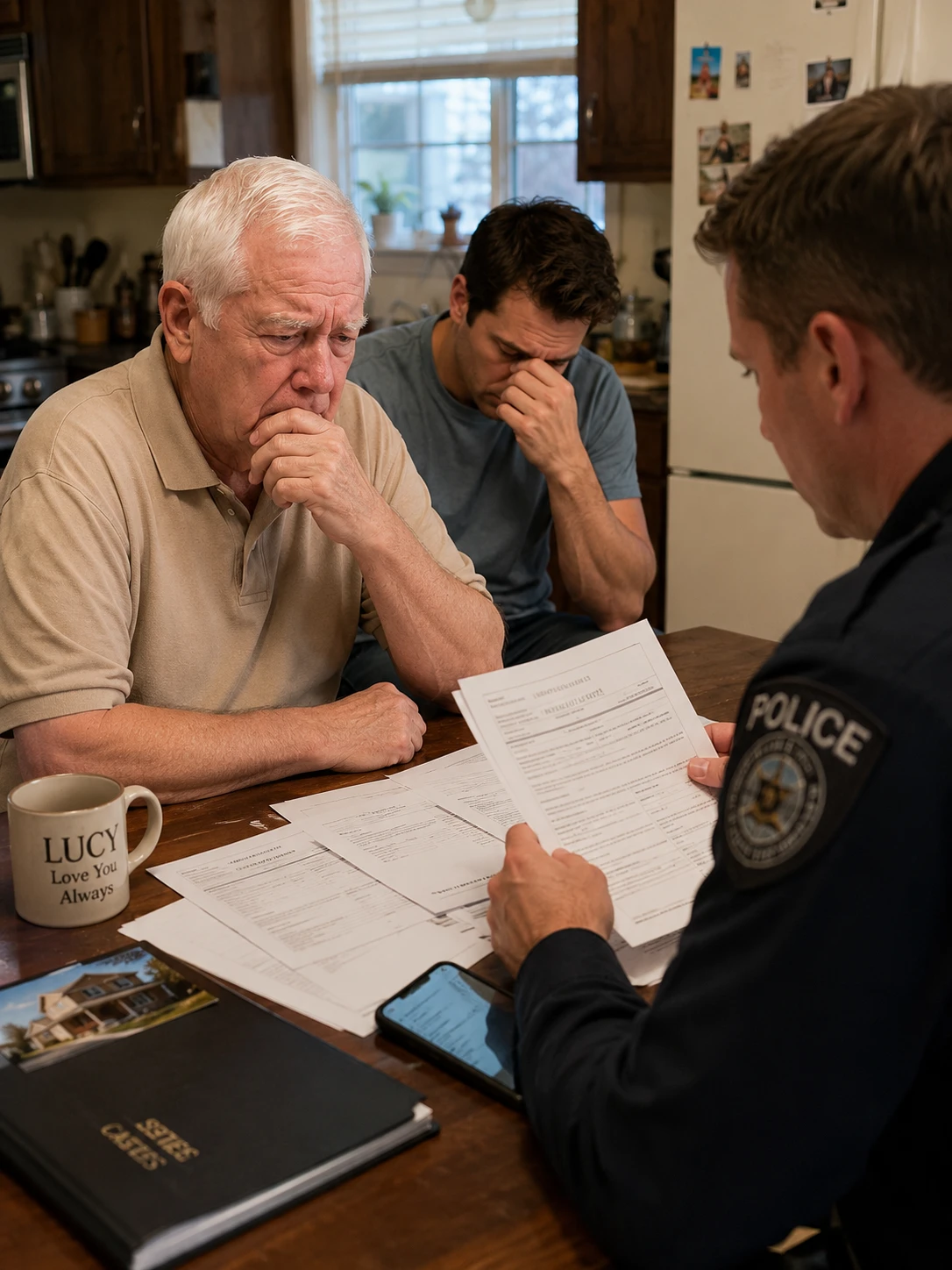
That afternoon, I made the hardest phone call of my life.
Not because I was afraid of the police.
Because calling them meant admitting something final.
My family problem was no longer a family problem.
It was fraud.
Identity theft.
Forgery.
Attempted financial exploitation.
The detective who arrived was younger than Louis.
Polite.
Careful.
He photographed documents.
Took statements.
Asked me whether I felt safe in my home.
The question nearly broke me.
Safe.
In my home.
I looked toward the dining room.
Rocky’s bowl was gone.
Rachel had thrown the dog food away.
But I could still see it.
“I do now,” I said.
Louis gave a statement too.
Longer than mine.
He admitted the plan to pressure me into selling.
Admitted knowing Carla was using my card for some expenses.
Admitted he had lied to friends about supporting me.
Admitted he had allowed her access to my office.
When the detective asked whether Louis had benefited from the fraudulent loan, Louis stared at the floor.
“Indirectly.”
“How?”
“She paid our debt with some of it.”
The detective wrote that down.
Louis’s face crumpled.
I watched my son understand something I had learned decades earlier.
You do not become innocent just because someone else was worse.
Carla was arrested six days later.
Not dramatically.
Not at my house.
Police located her at a hotel twenty miles away after the credit card she thought was hers triggered a fraud alert.
The investigation found two additional lines of credit in my name.
Another attempted loan.
Emails in which she discussed having me declared financially incompetent if I resisted selling.
And one message to a friend that made my hands go numb.
Once the old man signs, we’re free.
If he doesn’t, Louis can say he’s confused.
The friend had replied with a laughing emoji.
I printed that message.
Then sat alone in my bedroom for nearly an hour.
Not because Carla’s cruelty surprised me.
Because Louis had helped create the conditions that made it possible.
He had spent years telling people I was old.
Forgetful.
Dependent.
He had joked that I could barely manage the house.
Carla had simply taken the story seriously.
That evening, I called him downstairs.
He had been sleeping in the guest room.
Not his old bedroom.
He had moved himself without asking.
Another small thing I noticed.
He sat across from me at the kitchen table.
There were dark circles under his eyes.
“I read the messages,” I said.
He swallowed.
“I know.”
“Did you ever tell her I was confused?”
He stared at his hands.
“Yes.”
My stomach tightened.
“When?”
“Sometimes when you disagreed with us.”
I said nothing.
He forced himself to continue.
“When you forgot where you put the garage remote. When you paid the water bill twice. When you called me by Uncle Raymond’s name that one time.”
“One time.”
“I know.”
“Your uncle has been dead fifteen years.”
“I know.”
My voice hardened.
“You used normal mistakes to build a story that I was incompetent.”
Tears filled his eyes.
“Yes.”
“Why?”
His lips trembled.
“Because then I didn’t have to admit you were saying no.”
That was it.
The deepest truth in the room.
He had not believed I was incapable.
He had needed me to be incapable.
Because my competence made his dependence unbearable.
He covered his face.
“I turned you into an old man in my head because I couldn’t stand being a thirty-six-year-old boy in yours.”
For a long time, I could hear only the refrigerator.
The same old hum.
Lucy and I had bought that refrigerator twelve years earlier.
She had hated stainless steel.
Said it showed fingerprints.
I almost laughed at the memory.
Instead, I asked, “Do you know what your mother said about this house?”
Louis lowered his hands.
“No.”
“She said we should never leave it to you outright.”
His face went still.
I had never told him that.
“Why?”
“Because she worried I would rescue you forever.”
His eyes dropped.
“She knew?”
“She loved you.”
I swallowed.
“She also saw you clearly.”
Louis wiped his cheeks.
“What did she want?”
“She wanted the house sold after both of us were gone. Half for you. Half to a scholarship fund.”
He stared at me.
“She made you promise?”
“Yes.”
“Did you change it?”
I looked toward Lucy’s photograph on the wall.
“Yes.”
His face tightened.
“When?”
“After she died.”
“To leave it all to me?”
“Yes.”
His eyes closed.
That answer seemed to hurt him more than anything else.
“You trusted me.”
“I wanted to.”
He began crying.
Not loudly.
He bent forward until his forehead almost touched the table.
“I would have taken it.”
I said nothing.
“If you’d died last year, I would have taken everything.”
His shoulders shook.
“Carla and I would have burned through it.”
The honesty was brutal.
Necessary.
He lifted his head.
“What happens now?”
I had spent days asking myself that question.
That morning, I had signed three documents.
I folded my hands.
“You move out.”
His face tightened.
“When?”
“Thirty days.”
He nodded.
No argument.
“You get a job.”
Another nod.
“You repay what you knowingly charged to my accounts.”
“Yes.”
“You cooperate with the investigation.”
“Yes.”
“And you stop calling this house yours.”
His breath caught.
I continued.
“You are my son.”
My throat tightened.
“That does not make everything I own yours.”
He nodded again.
A tear dropped onto his hand.
“I understand.”
“I don’t think you do.”
He looked up.
“You will.”
The court proceedings took eleven months.
Carla pleaded guilty rather than face trial after investigators tied her to the forged documents, the fraudulent loans, and an earlier credit scheme involving her own aunt.
That was the hidden truth none of us expected.
I had not been the first older person she had targeted.
Her aunt had never reported it because Carla promised to repay the money.
She never did.
Once my case became public record, the aunt came forward.
Then another former boyfriend’s mother.
The pattern destroyed Carla’s claim that everything involving me had been a misunderstanding between family members.
She received prison time.
Restitution.
Probation afterward.
And a permanent felony record.
I attended sentencing.
I almost didn’t.
Rachel sat beside me.
Louis sat three rows behind.
Carla wore a plain beige jail uniform.
No fake lashes.
No perfume I could smell from across a room.
No phone recording anybody.
When the judge asked whether I wanted to speak, I stood.
My knees shook.
I hated that they shook.
Then I remembered something Lucy used to tell me.
Courage is not the absence of trembling.
It is deciding what your hands will do while they tremble.
So I placed mine on the wooden podium.
And I looked at Carla.
“You stole money from me.”
She stared straight ahead.
“You forged my name.”
Her jaw tightened.
“You tried to sell the home where my wife and I built our life.”
Nothing.
“But the worst thing you did was convince yourself that my age made my dignity negotiable.”
Her eyes finally moved toward me.
I continued.
“You saw a seventy-year-old widower and thought you saw an opportunity.”
I paused.
“You were wrong.”
The courtroom was silent.
“I am not asking the court to punish you because I hate you.”
My voice softened.
“I am asking the court to make sure the next older person you meet does not have to prove they are still a person before anyone protects them.”
Carla looked down.
I returned to my seat.
Louis did not speak to me afterward.
He simply walked beside me to the courthouse steps.
Rain had started.
He opened an umbrella.
Held it over both of us.
At the curb, I stopped.
“I can manage.”
“I know.”
He did not move the umbrella.
“I’m still going this way.”
So we walked.
That was how our relationship began again.
Not with forgiveness.
With direction.
Louis found work at a warehouse first.
Night shift.
Eleven-hour days.
He hated it.
I knew because he told Rachel.
He never complained to me.
Six months later, he completed a bookkeeping certificate at the community college.
That irony was not lost on either of us.
His first repayment check was $200.
He mailed it.
Even though he lived twelve minutes away.
The envelope contained no apology.
Just:
Payment 1.
I deposited it.
The next month, $200.
Then $250.
Then $300.
One year after he moved out, he asked if I would have coffee with him.
We met at a diner.
He was already there.
Early.
That was new.
He ordered black coffee.
That was also new.
Louis had always filled coffee with enough cream and sugar to turn it into dessert.
I sat down.
He looked at me.
“You look good.”
“So do you.”
He did.
Not richer.
Not more successful.
More tired.
More solid.
His hands had calluses.
He slid something across the table.
A photograph.
The birthday table.
My birthday table.
Before the dog food.
Someone had taken the picture while I was upstairs.
Louis sat in my chair.
Carla beside him.
Everyone laughing.
Food spread across the table.
I stared at it.
“Why are you showing me this?”
“Look at the chair near the end.”
I did.
Rachel.
Not eating.
Looking toward the staircase.
Waiting.
Louis said, “She told me she asked where you were three times.”
I looked up.
“She did?”
He nodded.
“I kept saying you were sleeping.”
My fingers tightened around the photo.
“She said she almost came upstairs.”
“Why didn’t she?”
Louis swallowed.
“Because I told her you wanted to be left alone.”
I closed my eyes.
Another lie.
Small compared with forgery.
But somehow it cut deep.
Because I had spent that evening wondering whether anyone noticed I was missing.
Someone had.
Louis stared at the table.
“I’m sorry.”
This time I let him say it.
He continued.
“I’m sorry I fed you dog food.”
His voice shook.
“I’m sorry I sat in your chair.”
A breath.
“I’m sorry I let Carla sit in Mom’s.”
My throat tightened.
“I’m sorry I called you a freeloader in the house you paid for.”
He wiped at one eye.
“And I’m sorry I spent years making you feel old because I was ashamed of how young I was acting.”
The waitress approached.
Saw our faces.
Quietly turned away.
Louis looked at me.
“I don’t want you to tell me it’s okay.”
“It isn’t.”
“I know.”
“I don’t know if I’ll ever forget that dinner.”
“I hope you don’t.”
I frowned.
He swallowed.
“If you forget it, I might be tempted to pretend I wasn’t capable of it.”
That sentence stayed with me.
He reached into his jacket.
Pulled out another envelope.
I tensed.
“It’s not money.”
Inside was a document.
Beneficiary disclaimer.
He had met with his own attorney.
If I died while my estate plan still named him as sole beneficiary, he would voluntarily disclaim any portion above an amount sufficient for modest housing and direct the rest toward the scholarship provision Lucy originally wanted.
I stared at him.
“You didn’t need to do this.”
“Yes, I did.”
“You could change your mind.”
“Yes.”
He nodded.
“That’s why I also want you to change the will.”
I studied his face.
“You want less?”
“I want what Mom wanted.”
My eyes burned.
He looked down.
“I think she understood something before either of us did.”
“What?”
“That being given everything would ruin me.”
I folded the paper slowly.
“And what do you think now?”
He looked out the diner window.
Morning sunlight reflected off passing cars.
“I think I spent most of my life believing love was somebody preventing consequences.”
He turned back.
“I was wrong.”
I nodded once.
“So was I.”
That surprised him.
I continued.
“I spent years believing love was continuing to give after giving became harmful.”
My voice softened.
“That was my mistake.”
His lips trembled.
“We both made some.”
“No.”
I held his gaze.
“Don’t make mine equal to yours.”
He nodded immediately.
“You’re right.”
That mattered.
He had finally learned that reconciliation did not require rewriting the ledger.
Some balances are not equal.
Some debts are moral.
Some are financial.
Some can never be fully repaid.
Three years after my seventieth birthday, I hosted another dinner.
Smaller.
Eight people.
Rachel came.
Her husband.
Two neighbors.
Martin.
My attorney, who had somehow become a friend.
Louis.
And me.
No Carla.
No crowd.
No people I barely knew.
I cooked the chicken.
Louis made the potatoes.
Badly.
Too much garlic.
Lucy would have loved them.
Before dinner, Louis stood at the end of the table.
Not the head.
He held something behind his back.
I narrowed my eyes.
“What are you doing?”
He smiled nervously.
“Just wait.”
He disappeared into the hallway.
When he returned, he carried Rocky’s old dog bowl.
The room went silent.
My chest tightened before I could stop it.
Louis saw.
His smile disappeared immediately.
“Dad, I’m sorry. I thought—”
He turned to take it away.
“Wait.”
He stopped.
Inside the bowl was no dog food.
It was filled with folded pieces of paper.
I looked at him.
“What is this?”
He set it down gently.
“Things I took for granted.”
I unfolded the first one.
Electricity.
Another.
Groceries.
Another.
A place to sleep when I had nowhere else.
Another.
Car repairs.
Another.
Second chances.
Another.
Mom’s recipes.
Another.
You answering the phone no matter how late I called.
My vision blurred.
The final slip was different.
It had only two words.
My father.
I looked up.
Louis stood very still.
“I don’t expect to get the old relationship back.”
His voice trembled.
“I don’t think we should.”
I swallowed.
“What do you want?”
“A real one.”
Nobody at the table moved.
I stood.
Louis’s shoulders tightened, like some part of him still expected punishment.
I picked up the bowl.
Walked toward the kitchen.
Rinsed it.
Dried it.
Then came back.
I set it on the shelf beneath Lucy’s photograph.
Not hidden.
Not thrown away.
Louis stared at it.
“Why keep it?”
“Because shame hidden in a closet turns into a secret.”
I looked at him.
“Shame remembered properly can become a boundary.”
His eyes filled.
I sat.
Dinner continued.
Slowly.
Awkwardly at first.
Then somebody complained about the potatoes.
Martin blamed Louis.
Rachel agreed.
Louis defended the garlic.
I laughed so hard I had to put down my fork.
The sound startled me.
Not because I had not laughed in years.
Because it sounded like myself.
Later, after everyone left, Louis helped wash dishes.
He picked up Lucy’s old cake plate.
The blue one with tiny painted flowers.
“You still have this?”
“Of course.”
“She used to hide the best slice under foil in the back of the refrigerator.”
“For you.”
He smiled.
“For both of us.”
“No.”
I dried a plate.
“For you.”
His face fell slightly.
“You always complained she gave you too much.”
“She did.”
“She loved feeding you.”
“I know.”
He held the cake plate with both hands.
“I miss her.”
“So do I.”
For once, neither of us tried to solve that.
Grief does not need solutions.
It needs room.
We stood side by side beneath the kitchen light.
Two men who had loved the same woman differently.
Two men who had failed each other.
Two men still there.
Before leaving, Louis paused by the front door.
Rocky’s bowl was visible from the hallway.
He looked at it.
Then at me.
“You know what I think about sometimes?”
“What?”
“That night, you put the bowl by the door.”
“Yes.”
“Why?”
I thought about it.
“I didn’t want it at the table.”
He nodded.
Then smiled faintly.
“Maybe that’s what you did with me too.”
I frowned.
“What do you mean?”
“You didn’t throw me away.”
His voice softened.
“You just stopped letting my behavior sit at the table.”
I looked at him for a long time.
Then I opened the door.
Cold autumn air moved into the hall.
“That’s about right.”
He stepped outside.
“Good night, Dad.”
“Good night, son.”
I closed the door.
Not hard.
Not angrily.
Just enough for the latch to catch.
The next morning, I met with my attorney.
I changed the estate plan.
Not back to what it had been.
Not exactly to Lucy’s version either.
The house would be sold when I died.
Half the net proceeds would fund a local scholarship for students supporting aging parents or grandparents while attending school.
The other half would go to Louis through a trust paid gradually over fifteen years.
No lump sum.
No rescue.
No punishment.
Structure.
My attorney read the provision twice.
Then looked at me.
“You’re sure?”
“Yes.”
“What changed?”
I looked through his window at a maple tree dropping yellow leaves across the sidewalk.
“I finally understood what Lucy was trying to do.”
“What was that?”
“Love him without financing his worst instincts.”
He smiled.
“That sounds like Lucy.”
“It does.”
Then I added one more condition.
The scholarship would be named the Lucy Harris Homeward Fund.
My attorney paused.
“Homeward?”
“Yes.”
Because the final truth came to me that night while I reread one of Lucy’s old notebooks.
She had written grocery lists in them.
Birthdays.
Doctors’ appointments.
Little reminders.
Buy Ernest socks.
Louis dentist 3:30.
Call Rachel.
Water basil.
Ordinary evidence of a life.
Near the back, I found a page dated eleven years before she died.
Louis had been twenty-five.
Already drifting.
Already borrowing.
Already promising.
Lucy had written:
Ernest thinks helping Louis means keeping the door open.
I think he’s right.
But an open door is not the same thing as carrying someone through it.
Someday Ernest will have to learn that.
I sat at the kitchen table with the notebook in my hands.
And laughed through tears.
Eleven years before the dog food.
Before Carla.
Before the fake signature.
Before I canceled a single card.
Lucy had seen the whole shape of it.
Not the crimes.
Not the humiliation.
Me.
She knew my weakness would never be anger.
It would be love without edges.
I touched the page.
“You always were the better accountant,” I whispered.
The house was quiet.
But not empty.
Morning light entered through the curtains.
Rocky’s bowl sat beneath her photograph.
Clean.
Dry.
No longer an insult.
A marker.
A reminder of the night everything became visible.
At seventy-three, I still climbed the stairs.
Slowly.
I still forgot where I put the garage remote sometimes.
I paid the electric bill twice again once.
I laughed when I caught it.
Then I fixed it.
Because getting older does not mean becoming irrelevant.
Needing help does not mean surrendering ownership of your life.
Loving your children does not require funding their destruction.
And forgiveness does not require pretending the bowl was never placed in front of you.
The following spring, the first Lucy Harris Homeward Fund scholarship was awarded.
The recipient was a twenty-eight-year-old woman named Vanessa Ortiz.
She worked evenings at a grocery store while caring for her grandfather, who had Parkinson’s.
She was studying nursing.
At the ceremony, she stood behind a small podium in the community college auditorium and unfolded a speech with shaking hands.
Her grandfather sat in the front row.
Gray hair.
Blue suit.
Cane resting against his knee.
Vanessa looked at him.
Then at me.
“This scholarship means I don’t have to choose between finishing school and staying with the man who raised me.”
Her grandfather covered his mouth.
I looked away.
Louis was seated beside me.
He quietly passed me a handkerchief.
I stared at it.
“Who carries handkerchiefs?”
“You.”
“Not since 1998.”
“I found one in your dresser.”
“You went through my dresser?”
He smiled.
“Wrong time?”
I laughed.
Vanessa finished her speech.
Everyone stood.
Her grandfather struggled to rise.
Louis immediately moved toward him.
Then stopped.
He did not grab his arm.
He asked first.
“Sir, would you like some help?”
The old man nodded.
Louis offered his elbow.
Small thing.
Huge thing.
I watched them stand together.
And in that moment, I understood that consequences had done something my money never could.
They had forced my son to notice where another person ended and he began.
That evening, Louis drove me home.
He did not come inside.
He rarely did without asking now.
We stood on the porch as cicadas buzzed in the trees.
He nodded toward the house.
“You ever think about selling?”
“Sometimes.”
His expression stayed neutral.
“No opinion?”
“I have one.”
He smiled.
“But it’s your house.”
I stared at him.
Then laughed.
“Now you learn.”
“Took a while.”
“Thirty-nine years, apparently.”
He winced.
“I’m thirty-nine.”
“I know.”
“You made it sound ancient.”
“Perspective.”
He shook his head.
Then grew quiet.
“Dad?”
“Yes?”
“Thank you for not covering for me.”
I frowned.
He looked at the porch boards.
“If you’d paid the debts, if you’d fixed everything, I’d still be the man who put that bowl in front of you.”
His eyes lifted.
“I don’t like knowing I was that man.”
A pause.
“But I need to know.”
I put one hand on his shoulder.
The gesture surprised both of us.
“So remember him.”
His eyes filled.
“But don’t stay him.”
He nodded.
I squeezed once.
Then let go.
Louis stepped down from the porch.
Halfway to his car, he turned.
“Happy birthday, by the way.”
I frowned.
“My birthday was months ago.”
“I know.”
He smiled.
“I missed saying it right the last time.”
My throat tightened.
“Thank you.”
He got into his car.
I watched his taillights disappear.
Then I went inside.
The dining room was dark.
I turned on one lamp.
My old chair waited at the head of the table.
Lucy’s chair beside it.
For years after she died, I could barely look at that empty seat.
Then Carla sat there.
Then I thought the insult had ruined something sacred.
It had not.
Furniture does not keep love.
People do.
Memory does.
Choice does.
I walked to Lucy’s chair and rested my hand against the back.
“Not bad,” I whispered.
I could almost hear her answer.
About time.
I smiled.
Then I went into the kitchen.
On the counter sat a small box Louis had left earlier.
Inside was a three-milk cake from Lucy’s bakery.
One candle.
Not seventy-three of them.
A note beneath it said:
I paid for this one.
I laughed so loudly the empty kitchen gave it back to me.
I cut two slices out of habit.
Then stopped.
For a second, grief touched my shoulder.
Softly now.
Not like an open wound.
Like someone entering a familiar room.
I put one slice on my plate.
The other on Lucy’s blue flowered cake plate.
I carried both to the table.
Sat in my chair.
And looked across at hers.
“I know,” I said.
No ghosts answered.
They didn’t need to.
Outside, the porch light glowed.
Upstairs, my laptop sat closed.
The cards were mine.
The house was mine.
My name was mine.
My life was mine.
And somehow, after everything, my son was becoming his own too.
I took a bite of cake.
It tasted exactly the way I remembered.
Sweet.
Soft.
A little too rich.
Lucy would have told me not to eat so much before bed.
I ate another bite anyway.
Then I looked toward the clean dog bowl resting beneath her photograph.
Once, it had been the ugliest thing anyone had ever placed before me.
Now it reminded me of the night I finally stopped accepting scraps of respect from people I was feeding with everything I had.
I had thought canceling the cards was the moment I took my life back.
It wasn’t.
That came later.
When I learned to say no without hatred.
When Louis learned to hear no without calling it abandonment.
When the truth stopped being a weapon and became a boundary.
When Lucy’s old wisdom finally reached both of us.
I leaned back in my chair.
The house settled around me with familiar creaks.
The refrigerator hummed.
A car passed outside.
Somewhere down the street, a dog barked twice.
Ordinary sounds.
Peaceful sounds.
The kind you only notice after your home has been loud with people who do not respect the quiet.
I finished my cake.
Washed the plate.
Turned off the kitchen light.
And before going upstairs, I stopped beside the front door.
The same place where I had set that bowl on my seventieth birthday.
I remembered Louis laughing.
Carla recording.
People watching.
The shame.
The anger.
The exact second something inside me decided enough.
Then I looked at the house around me.
My house.
Not because my name was on a deed.
Because I had finally made it a home again.
A home with doors that could open.
A home with doors that could close.
And a man inside who finally understood that both were acts of love.