**You Paid For Me. Now Do It.**
**The Rancher Did It, And By Sundown The Whole Town Learned He Had Bought A Wife Who Was Never Meant To Survive.**
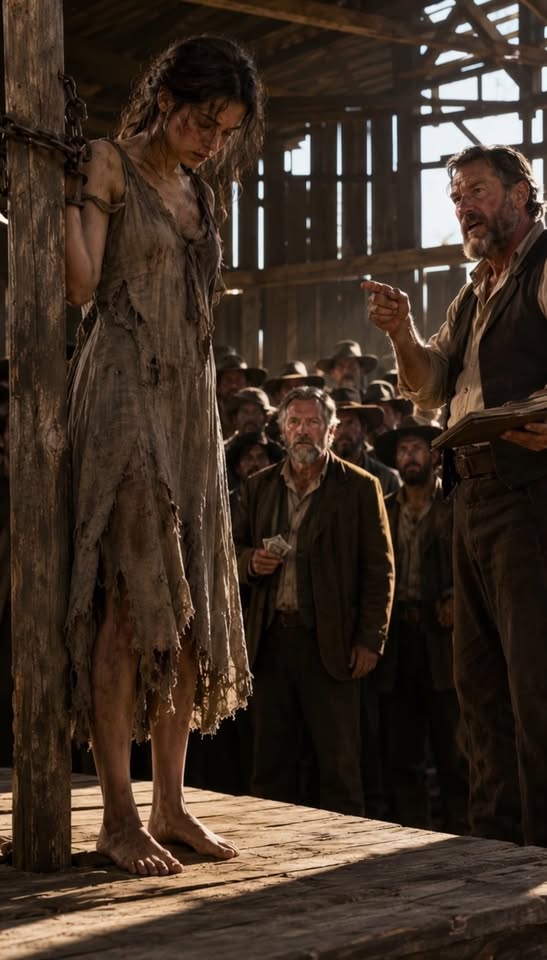
The first sound Lena heard after the gavel fell was not freedom.
It was laughter.
It rolled through the hot Texas auction barn like dust under a door, low and mean, following her as Grant McCade led her down from the platform with one hand steady beneath her elbow and the other closed around the end of her chain.
**Twenty dollars.**
That was what her life had been worth to the crowd.
Twenty dollars, a few gasps, and a gavel strike.
The auctioneer had already moved on, calling out another name, another debt, another body wrapped in legal language. Lena did not look back. She had learned that looking back only gave pain a second chance to find you.
Grant McCade walked beside her slowly, his hat held low in his hand. He was a hard-looking man, fifty-six years old, with gray stubble, sunken eyes, and shoulders that seemed built for carrying grief. The crowd parted for him, not out of respect, but curiosity.
“Fool,” someone muttered.
“Twenty dollars for that?” another said.
Grant did not answer.
Lena did.
At the barn threshold, where the sunlight struck her face like a blade, she stopped walking. Her knees nearly failed, but she forced herself upright. Then she lifted her chained wrists between them.
Her green eyes, fever-bright and hollow, locked on his.
“You paid for me,” she whispered. **“Now do it.”**
Grant stared at the iron cuffs.
Then at her face.
“What?”
Lena swallowed. Her lips were cracked. Dirt streaked her cheeks, and beneath the grime, a dark bruise bloomed over one cheekbone.
“Marry me,” she said.
The men behind them went silent.
Then the laughter started again, louder this time.
Grant’s hand tightened around his hat.
Lena did not blink. She had used the last of her strength to say those words, and she knew what they sounded like. Mad. Desperate. Shameless.
But shame was a luxury for people who had choices.
“The contract says whoever pays my debt gets my labor,” she said, voice barely holding. “Unless I belong to a household by marriage. Then the contract is void.”
Grant’s eyes narrowed.
“You know that?”
“I’ve heard men argue over it while deciding where to send me next.”
The auctioneer came striding toward them, ledger tucked under his arm, face red with irritation. “Now hold on. That’s not how this works.”
Lena flinched at his voice, but she did not lower her hands.
Grant turned slowly. “You sold her.”
“I sold her contract.”
“You said sold.”
The auctioneer smiled, all teeth and rot. “Careful, McCade. You bought debt. You didn’t buy trouble.”
Grant looked back at Lena.
For a moment, she saw something in his eyes that unsettled her more than cruelty ever had.
Recognition.
Not the kind men gave pretty things.
The kind a person gave a ghost.
“Lena Cartwright,” he said softly.
Her breath caught.
No one had spoken that name in years.
Not like it belonged to her.
Not like she had once been a girl with a father and a porch and a blue ribbon tied around her braid.
Grant lowered his voice. “Your father was Robert Cartwright.”
The world tilted.
Lena’s fingers curled around the chain until rust bit into her skin.
“My father died,” she said.
Grant’s face changed.
Something old broke inside it.
“No,” he whispered. “He didn’t.”
The auctioneer stepped forward. “Enough.”
Grant raised one hand without looking at him. “Get me a preacher.”
The barn stilled.
Lena stared.
The auctioneer barked a laugh. “You can’t be serious.”
Grant looked at Lena’s chained wrists again, then at the crescent scar near her hand. **The little scar he had once promised a frightened child would not remain.**
“I’ve been too late once,” he said. “I won’t be again.”
By the time the preacher arrived, half the town had followed them outside.
Reverend Amos Bell was old, thin, and angry in the way righteous men got when wickedness made the mistake of standing in daylight. He listened to Grant in silence, then looked at Lena’s chains and turned pale.
“Do you consent?” he asked her.
The question almost undid her.
No one had asked Lena what she wanted in four years.
Her throat tightened.
“I do,” she said.
Grant’s voice came rough. “I do.”
There was no bouquet. No music. No white dress. Only dust, rust, sunlight, and a crowd waiting for the joke to turn ugly.
When Reverend Bell declared them married, the auctioneer spat into the dirt.
“This won’t hold.”
Grant took Lena’s wrists gently and lifted the chain. “Key.”
The auctioneer did not move.
Grant stepped closer. He did not raise his voice. He did not need to.
“Key.”
Something in his tone made the man reach into his pocket.
When the cuffs fell from Lena’s wrists, she almost collapsed.
Grant caught her again.
This time, the town did not laugh.
He took her home in silence.
McCade Ranch lay six miles west, past dry creek beds and mesquite trees bent by wind. It was not grand, but it was solid: a low house, a barn, two corrals, and a porch with three empty chairs facing the sunset.
Lena noticed the chairs.
One for Grant.
One for someone gone.
One for a child who had never returned.
Inside, the house smelled of wood smoke, coffee, leather, and loneliness. Grant set a blanket around her shoulders and placed a cup of water in her hands.
She drank too fast and choked.
“Slow,” he said.
She recoiled before she could stop herself.
Grant stepped back immediately.
“I won’t touch you unless you ask,” he said.
Lena hated that kindness frightened her more than anger.
For three days, fever dragged her under and pulled her back. She woke to cool cloths on her forehead, broth beside the bed, and Grant sleeping upright in a chair across the room, far enough away to make a promise without speaking it.
On the fourth morning, she woke clear-headed.
Grant was at the table, mending a strap.
“Why did you know my name?” she asked.
His hands stopped.
Outside, wind pushed dust against the windows.
Grant set the strap down. “Eight years ago, your father helped me after a cattle accident. Took me into his house. Fed me. Let me heal in his barn.”
Lena’s chest tightened around a memory: her father laughing on the porch, Grant’s younger face beneath a bandage, a needle flashing as he stitched her wrist after she cut it on a broken jar.
“You said my father didn’t die.”
Grant looked at the floor.
“I saw him two months ago.”
The room became very still.
Lena gripped the blanket.
“No.”
“He was alive.”
“No.”
“He was in a prison camp outside Fort Mercy.”
Her breath left in a broken sound.
Grant leaned forward. “Lena, he’s been looking for you.”
Her eyes burned. “My aunt told me he died during the fever.”
“Your aunt lied.”
Lena stood so quickly the chair scraped back. “Why?”
Grant’s face hardened.
“Because someone wanted your father’s land.”
She stared at him.
Her father’s land had been small, but good. Cotton bottomland near the river. A farmhouse. Three acres of peach trees. After the war, men came with papers. Debts. Taxes. Fees no one had explained. Then her aunt signed something. Then Lena was sent away to “work until things settled.”
They never settled.
They swallowed her.
Grant reached into his coat and pulled out a folded paper, worn soft at the edges.
“Your father gave me this when I found him.”
Lena took it with trembling fingers.
It was a letter.
Her father’s handwriting leaned across the page, familiar as a voice from another life.
**My dearest Lena, if this reaches you, trust the man who brings it. Do not trust Harlan Pike. Do not trust the contracts. Your mother’s deed is hidden where the peaches cast no shadow at noon. You were never in debt. Neither was I.**
The paper blurred.
“Harlan Pike,” she whispered.
Grant nodded. “The auctioneer.”
Cold moved through her.
“That man sold me?”
“He helped create the debt records. Your aunt signed under threat. Pike took the land, then moved you from contract to contract so no one would know you were the Cartwright heir.”
Lena pressed a hand over her mouth.
All those years.
All those houses.
All those locked rooms.
Not because she owed anything.
Because she owned something.
Grant’s voice roughened. “I came back too late. Your house was empty. Your aunt was dead. Your father was gone. I searched when I could, but Pike had changed your name in the records.”
“Why keep my father alive?”
“Because he refused to say where the deed was.”
Lena stared at the letter.
**Where the peaches cast no shadow at noon.**
She knew exactly where.
At noon, the old well behind the peach trees was shaded by nothing.
The deed was in the well.
That night, Lena slept with the letter beneath her pillow and woke before dawn with one decision burning through her.
“I’m going back,” she told Grant.
He was already saddling the horses.
“I figured.”
They rode east under a pale sky, Grant beside her but never ahead, as if he understood she needed to arrive at her past on her own terms.
By noon, they reached what remained of Cartwright farm.
Lena nearly stopped breathing.
The house still stood, though sagging and gray. The porch leaned worse than memory. The peach trees were wild now, branches tangled, fruit rotting sweetly in the grass.
She walked to the well.
At noon, no shadow touched it.
Grant lowered the rope. The bucket scraped stone, then struck something with a dull wooden knock. When they pulled it up, inside was a sealed tin box.
Lena opened it with shaking hands.
The deed was there.
So was a second document.
Grant unfolded it.
His face drained.
“What?” Lena asked.
He did not answer.
She snatched the paper from him.
It was a birth record.
A child born twenty-two years ago.
A girl.
Mother: Elise Cartwright.
Father: not Robert Cartwright.
Lena frowned.
Then she read the name.
**Grant McCade.**
The world disappeared.
Wind moved through the peach leaves.
Lena looked at him slowly.
Grant’s face was ash.
“No,” he whispered. “I didn’t know.”
“You?” Her voice was not loud, but it cut deeper than shouting. “You were my mother’s—”
“I loved her before Robert,” he said, grief spilling out raw. “Before the war. Before everything broke. She married him after I left. I swear to God, Lena, I never knew.”
She looked back at the paper.
Her hands began to shake.
Grant McCade was not merely the man who bought her contract.
He was her father.
And yesterday, to save her, he had become her husband.
Lena stumbled back as if struck.
Grant reached for her, then stopped himself, horror twisting his face.
“The marriage,” he breathed. “Reverend Bell can annul it. It was never—Lena, I swear I didn’t know.”
But hoofbeats thundered before she could answer.
Six riders burst through the trees.
At their center rode Harlan Pike.
He smiled when he saw the tin box.
“Well,” he said. **“I wondered when the dead girl would find her grave.”**
Grant stepped in front of Lena.
Pike drew a pistol.
“You should’ve left her in chains, McCade.”
Lena’s fingers closed around the deed.
For the first time in years, she did not lower her eyes.
Pike aimed at Grant.
A gunshot cracked.
Grant staggered.
Lena screamed.
But Grant had not fired.
From behind the old peach trees, another man stepped out, thin as a skeleton, beard white, eyes blazing with a love that crossed years, lies, and suffering.
Robert Cartwright held a smoking rifle in both hands.
And Harlan Pike fell from his horse into the dust.
Lena could not move.
The man lowered the rifle.
His voice broke on her name.
“Lena.”
She stared at Robert. Then at Grant. Then at the birth record crushed in her fist.
Robert walked toward her slowly, tears cutting tracks through the dirt on his face.
“I raised you,” he said. “I loved you from the first breath. Blood or no blood, you were mine.”
Grant stood frozen, wounded only by splintered wood from the shot that had struck the post behind him.
Robert turned to him.
“And you,” he said quietly, “were the reason I kept fighting. Elise made me promise that if the truth ever came, I would not let it destroy her child.”
Lena’s knees gave way.
Both men reached for her.
This time, she did not pull away.
By sunset, Pike’s riders had fled, the deed was in Lena’s hands, and the lie that had ruled her life lay dead beneath the peach trees.
Reverend Bell annulled the marriage before a judge two days later.
The town whispered, of course.
Then the town learned the truth.
**Grant McCade had not bought a wife. He had unknowingly bought back his daughter.**
Robert Cartwright lived his last winter on the McCade porch, in one of the empty chairs, watching Lena walk freely across the yard each morning.
Grant never asked her to call him father.
He simply left the choice open, like a door.
One spring evening, Lena found him mending fence at dusk.
She stood beside him, quiet for a long time.
Then she said, “Pa.”
Grant’s hands stopped.
He did not look at her right away.
When he finally did, his eyes were wet.
Lena took the hammer from him.
“Don’t cry,” she said.
Grant laughed once, broken and soft.
“I’m not.”
“You’re lying.”
He nodded toward the western sky, glowing gold over the ranch.
“Maybe.”
Lena looked out at the land that was hers, the home that was becoming theirs, and the road that no longer led back to chains.
For the first time in years, the silence around her was not waiting to hurt her.
It was peace.
And on the porch behind them, Robert Cartwright smiled as if he had lived long enough to see justice learn her name.