# I Found a Dying Woman and Her Baby in the Prairie Grass. Then the Doctor Opened Her Locket and Whispered the Name Every Man in Town Feared.
The baby was screaming like the prairie itself had torn open.
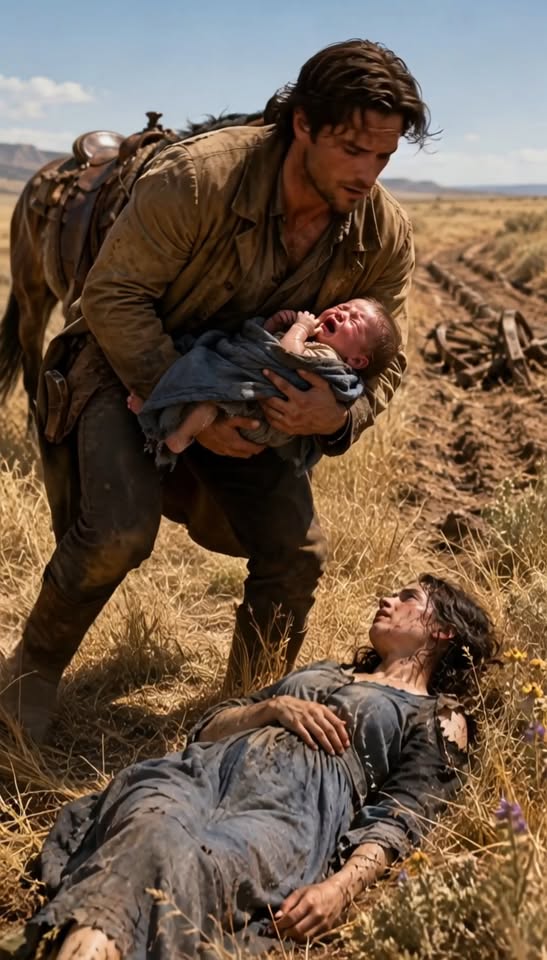
I heard her before I saw her—one thin, desperate cry cutting through the hot afternoon wind, sharper than a hawk’s call, cleaner than a rifle shot. My horse, Dakota, lifted his head and stopped before I even pulled the reins. For three days we had ridden through dust, sage, and sun-cracked silence, chasing the promise of **$312 in cattle wages** waiting in Elorn Ridge.
But money has a way of turning weightless when a child is crying for her life.
The grass was tall there, yellow and brittle, bending in long waves beneath the heat. At first I saw only a torn strip of blue cloth snagged on a wildflower stem. Then I saw the baby.
She lay half-wrapped in a faded shawl, her tiny face raw from screaming, her fist jammed into her mouth so hard the skin around her lips had reddened. Dirt streaked her cheeks. Dried milk crusted white near one corner of her mouth. Her eyes were open—bright, furious, and terrified.
Beside her lay her mother.
The woman was twisted in the grass with one cheek pressed into the dirt. Her dark hair stuck to her temples. Her dress was torn at the shoulder, her bare feet scratched and bleeding. A bruise, deep purple and ugly, spread along her jaw.
I dropped from Dakota and ran.
“Easy,” I said, though my own voice sounded strange. “Easy now.”
The baby screamed harder when I lifted her, then clutched my thumb with fingers so cold they startled me. She weighed almost nothing. Heat burned through the cloth wrapped around her, but her hands were icy.
The mother did not move.
I knelt beside her, pulled my canteen free, and dripped water between her split lips. For a breath, nothing happened. Then her throat worked. One eye opened just enough to show me a gray-blue flash of pain.
She did not look at me first.
She looked at the baby.
Then her gaze dragged toward the grass behind us, where **fresh wagon ruts** cut deep through the earth. One wheel had crushed a patch of yellow wildflowers flat.
Her hand clawed weakly at my sleeve.
“He pushed us out,” she rasped. “Not worth the water.”
Those six words changed the shape of the whole world.
I had seen cruelty before. I had watched men cheat at cards, beat horses, lie over graves, and smile while they did it. But leaving a woman and an infant to die in open prairie beneath a sun like that was not cruelty.
It was murder with patience.
“Who?” I asked.
Her lips moved, but no sound came. Her eye rolled back. Her body went limp again.
I tore off my coat and wrapped the baby in it. She rooted blindly against the rough cloth, searching for milk that was not there. “I know,” I whispered, holding her close. “I know, little one.”
May you like
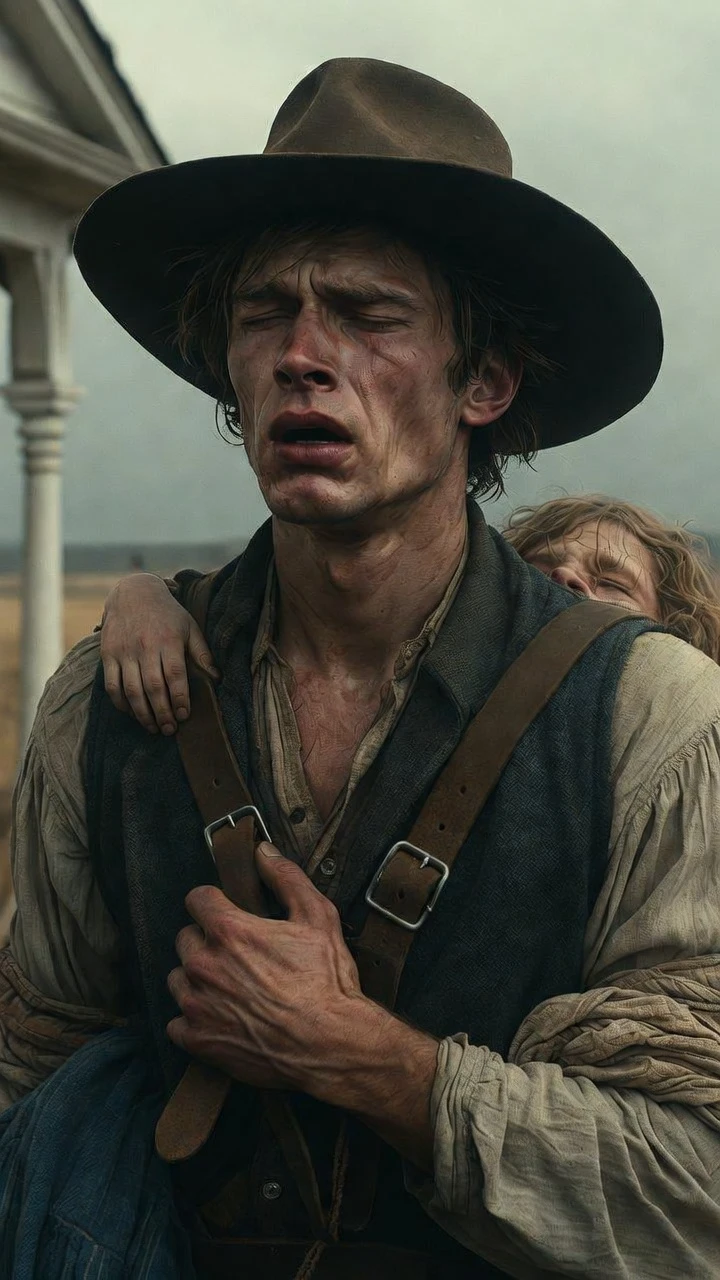
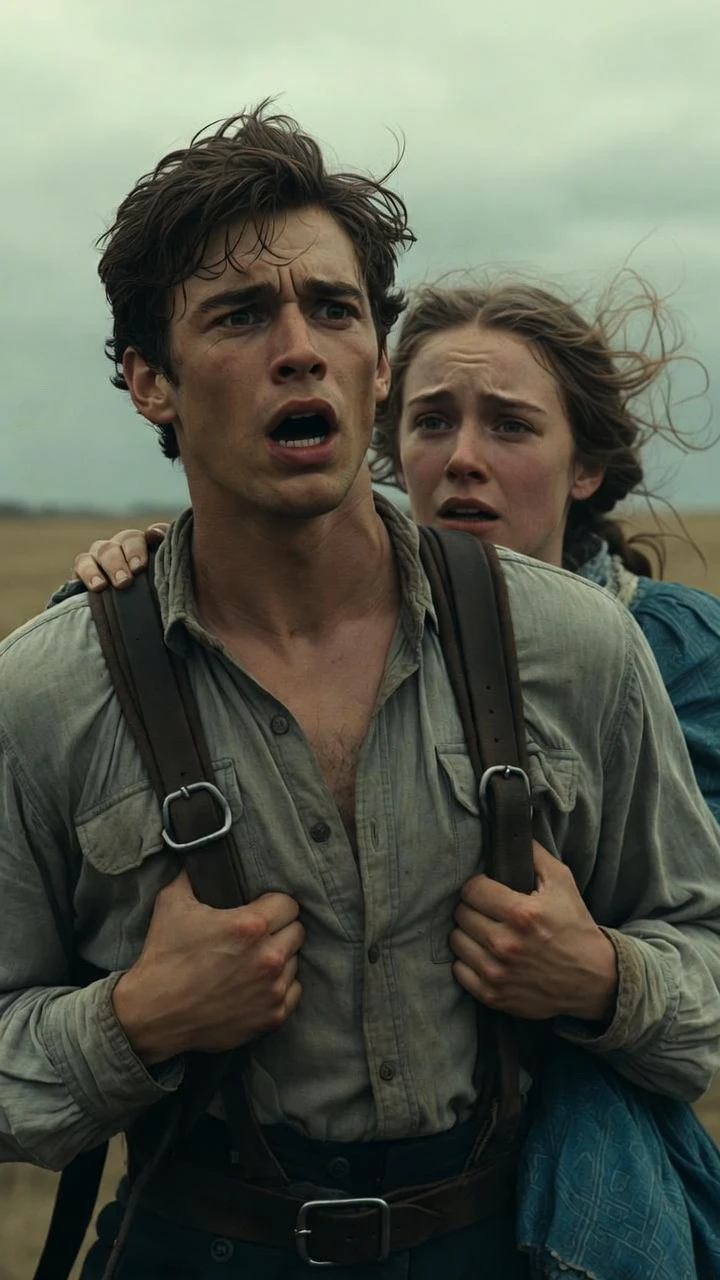
Dakota snorted behind me, stamping at the flies. Getting both of them onto him took more strength than skill. I set the baby against my chest, tied her in place with my scarf, then lifted the woman across the saddle. Her fever soaked through my shirt. Her bare heel dragged against Dakota’s flank, leaving a thin red smear.
As I tightened the saddle strap, something cold struck my wrist.
A silver locket slipped from inside the woman’s torn dress and swung on a broken chain.
Dust clung to the metal, but the engraving was still clear: **a crane inside a circle of stars**.
My hand froze.
I knew that mark.
Every man in Elorn Ridge knew it.
It was burned into shipping crates behind the bank. Stamped in blue wax on letters delivered under guard. Carved over the iron gate of the biggest ranch house in three counties.
**Beaumont.**
Elias Beaumont owned more land than some countries and more men than the sheriff cared to count. They said he could make a bank close by clearing his throat. They said judges lowered their eyes when he entered a room. They said the only thing Beaumont loved more than power was making sure no one forgot he had it.
And now a woman wearing his mark had been left in the grass with her baby.
I tucked the locket into my coat and swung into the saddle.
“You are not dying here,” I told her.
Dakota flew.
The prairie became a blur of grass, heat, and dust. The baby went quiet after the first mile, and that frightened me worse than her crying. Every few seconds I bent my head to feel her breath against my thumb. It came soft, faint, but still there.
The woman did not wake.
By the time the church steeple of Elorn Ridge rose against the horizon, my shirt was soaked with sweat and fever. Dakota’s breath came hard. Dust coated my teeth. The baby gave one thin, exhausted whimper as we hit the main road.
People turned.
A blacksmith stepped out of his shop, hammer hanging loose in one hand. Two women outside the mercantile froze with baskets on their arms. A boy dropped an apple into the dirt. Nobody spoke.
Nobody came forward.
That told me more than I wanted to know.
I stopped in front of Doc May’s porch so hard Dakota slid in the dust. “Doc!”
The door banged open before I had both boots down.
Doc May was a narrow old man with sleeves always rolled, beard always untrimmed, and eyes sharp enough to cut a lie in half. His hands smelled of carbolic, tobacco, and the kind of work that kept people alive.
“What happened?” he snapped.
“Found them five miles west. In the grass.”
He reached for the baby first. “Dear God.”
The locket slipped from my coat and struck the wooden step with a bright metallic clink.
Doc looked down.
For one second, I thought he might ignore it.
Then he bent, picked it up, and flipped it open.
The change in him was immediate. **The color drained from his face so completely he looked carved from ash.** His mouth opened, but no sound came.
“Doc?” I said.
He looked from the locket to the woman, then to the baby.
Then he looked at me.
“Cole,” he whispered, “where did you find the Beaumont girl?”
Behind us, a wagon stopped hard in the street.
The sound hit like a warning shot.
Wheels ground into dust. Horses snorted. Harness chains rattled. Slowly, I turned.
A polished black wagon stood twenty yards away, too fine for a town like Elorn Ridge and too clean for a road like that. On its door, painted in gold, was the crane inside the circle of stars.
Beaumont.
Two men jumped down first, both armed. Then a third man stepped out.
Tall. Silver-haired. Dressed in black despite the heat.
Elias Beaumont himself.
The street emptied without anyone moving. Men lowered their eyes. Women pulled children back into doorways. Even the wind seemed to hold its breath.
Beaumont looked at the woman slumped across Dakota’s saddle. Then he looked at the baby in Doc May’s arms.
His face did not change.
“Doctor,” he said calmly, “I believe you have something that belongs to my house.”
Doc May stiffened. “She needs treatment.”
“She needs discretion.”
I stepped between them before I thought better of it. “She needs water, medicine, and a bed.”
Beaumont’s pale eyes shifted to me. “And you are?”
“Cole Maddox.”
“A cattle hand.”
“Today, yes.”
His mouth curved slightly. “Then take your wages and walk away.”
The words were quiet, but every man in the street heard the threat beneath them.
I should have taken the money. I should have remembered I had no land, no family, no law behind me, and one tired horse beneath me. Men like Beaumont did not argue. They erased.
But the baby made a sound then, weak and broken, and reached one tiny hand toward her mother.
I stayed where I was.
“She said someone pushed her out of a wagon,” I said.
Beaumont looked at the woman again. “Fever makes people speak nonsense.”
“She said, ‘Not worth the water.’”
For the first time, something flickered across his face.
Not guilt.
Recognition.
Doc May saw it too.
“Elias,” Doc said slowly, “if this is Amelia—”
“Do not say that name in the street.”
There it was.
A crack.
The armed men shifted their hands toward their guns.
The woman stirred.
Her eyes opened just enough to see Beaumont standing beyond me. Her whole body went rigid with fear. She tried to speak, but only a dry whisper came out.
“No,” she breathed. “Please.”
Beaumont took one step forward. “Amelia, you have caused enough embarrassment.”
The baby cried again.
The woman’s gaze snapped to the child. Something changed in her then. Fear remained, but beneath it rose a force I recognized—the last strength of someone who had nothing left except the thing she loved.
“She is not yours,” Amelia whispered.
The street went still.
Beaumont’s expression hardened. “You are ill.”
“She is not yours,” she said again, louder this time.
Doc May looked down at the locket in his hand. His thumb brushed the inside. His eyes narrowed.
“What is it?” I asked.
He opened the locket wider.
Inside was not a portrait.
It was a folded scrap of paper, tucked behind the silver frame.
Doc May pulled it free with trembling fingers. The paper was stained with sweat and dust, but the ink remained dark.
Beaumont saw it and moved fast.
“Give me that.”
I stepped in front of Doc. One of Beaumont’s men drew his pistol halfway.
“Careful,” I said.
The man smiled. “You first.”
Then the baby stopped crying.
No one noticed at first except Amelia.
She lifted her head from the saddle, eyes wide, staring past Beaumont’s shoulder.
A second wagon had rolled silently into town.
It was plain, mud-splashed, and driven by a woman in a widow’s black bonnet. Beside her sat an old Lakota man with a rifle across his knees.
The widow climbed down.
Beaumont turned, and for the first time since he arrived, his confidence faltered.
“You,” he said.
The woman removed her bonnet.
Every person in the street gasped.
Doc May whispered, “Clara Beaumont.”
I looked from her to Elias. The resemblance was unmistakable, but wrong in the way a ghost is wrong. Same pale eyes. Same proud bones. Same silver streak at the temple.
Clara Beaumont was supposed to be dead.
I had heard the story in every saloon from Cheyenne to Deadwood. Elias Beaumont’s wife had died twelve years earlier in a winter carriage accident. No body recovered. Only wreckage, blood, and a black veil found frozen to the riverbank.
The woman in the street looked very much alive.
She walked toward Elias with calm steps.
“You buried an empty coffin,” she said.
Beaumont’s face turned gray. “You should have stayed gone.”
“I did,” Clara replied. “Until Amelia found me.”
Amelia began to sob.
Doc May unfolded the paper from the locket. His voice shook as he read aloud.
**“If I die, let it be known: Elias Beaumont murdered my father, stole my inheritance, imprisoned his wife Clara, and meant to sell my child to secure his bloodline. The baby is not his heir. She is Clara’s granddaughter. And the true heir to Beaumont land is the man carrying this letter.”**
My breath stopped.
Doc looked at me.
Everyone looked at me.
Beaumont laughed once, sharp and ugly. “Absurd.”
Clara reached into her coat and pulled out a second locket.
Same crane. Same circle of stars.
She opened it and held it up.
Inside was a child’s portrait—dark-haired, solemn-eyed.
Me.
The street tilted beneath my boots.
“No,” I said.
Clara’s eyes filled with tears. “Your mother hid you after Elias killed your father. We searched for years, Cole.”
Beaumont’s hand went for his gun.
He never cleared leather.
The old Lakota man on the wagon raised his rifle with the smooth certainty of thunder. “Do not,” he said.
Beaumont froze.
Clara stepped closer to me, her voice breaking. “You were not passing through that prairie by chance. Amelia sent word to me that Elias had discovered the baby’s bloodline. She was trying to reach you.”
I looked at the woman on Dakota. Amelia’s eyes met mine, exhausted but clear.
“She knew,” I whispered.
Amelia nodded faintly. “Had to find you.”
Beaumont’s calm finally shattered. “Lies! All of it!”
But the town had heard. The sheriff, who had hidden near the jail door since Beaumont arrived, slowly stepped into the street. Then the blacksmith. Then the mercantile owner. Then men who had lowered their eyes for years began lifting them.
Power is a strange thing. It feels eternal until the first person stops believing in it.
Beaumont looked around and saw not subjects, but witnesses.
His men backed away first.
By sunset, Elias Beaumont was locked in the same jail he had paid to build.
Amelia lived.
So did the baby.
Her name was Rose.
Three weeks later, the court opened ledgers Elias had kept hidden for decades. Names came out. Bribes. Stolen deeds. Disappearances. Graves without markers.
And mine.
Cole Maddox was not my name, not by birth.
I was **Cole Beaumont**, son of the man Elias had murdered, grandson of the woman he had failed to kill, and rightful heir to every acre he had stolen.
But that was not the twist that stayed with me.
The twist came one month later, when Amelia was strong enough to sit beneath the cottonwoods behind Doc May’s house. She handed me the silver locket and smiled sadly.
“I lied about one thing,” she said.
My chest tightened. “What?”
She looked toward Rose, sleeping in Clara’s arms.
“Elias did not push us out because we were not worth the water.”
She closed my fingers around the locket.
“He pushed us out because Rose laughed when she saw your face in that old portrait.”
A chill ran through me.
“She recognized you?” I asked.
Amelia’s smile trembled.
“No, Cole.”
Behind us, Rose opened her eyes.
They were not Amelia’s.
They were mine.
“She is your daughter.”
The world went silent.
Amelia looked away, tears shining on her cheeks. “Your mother hid you. Mine hid me. We met once, years ago, before either of us knew who we were. Before Beaumont found me. Before he locked me in that house and called my child his future.”
I looked at Rose, tiny and breathing, the baby I had lifted from death in the grass.
The prairie had not given me a stranger.
It had given me back my blood.
And for the first time in my life, the name Beaumont did not sound like a curse.
It sounded like a promise.