
My family begged me not to wear my Army uniform to my grandfather’s military tribute because they said I would embarrass them in front of senators
My family begged me not to wear my Army uniform to my grandfather’s military tribute because they said I would embarrass them in front of senators
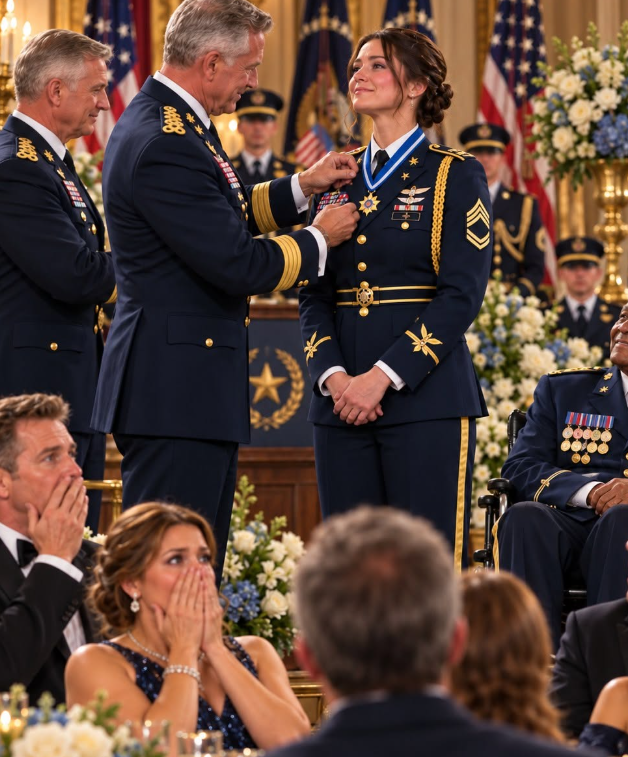
“Staff Sergeant Maya Parker.”
The general’s voice carried across the ballroom.
For a moment, nobody moved.
Then he looked directly at me.
“Staff Sergeant Parker, would you please join us onstage?”
I stood.
The room seemed to grow quieter as I stepped into the aisle. My shoes made a soft, measured sound against the polished floor.
At the front table, my father turned in his chair.
Daniel stared at me.
Ashley’s hand stopped halfway to her champagne glass.
And my grandfather, seated beside the podium in his dark suit, slowly began to smile.
He knew.
Of course he knew.
He was the only person in my family I had trusted with the news.
My grandfather’s name was Samuel Parker.
He had served in the Army during the Korean War and carried the experience with him for the rest of his life.
He rarely spoke about combat in detail.
When I was little, I used to ask whether he had been brave.
He would smile and say, “I was scared plenty of times, Maya. Courage is what you do while you’re scared.”
I remembered that answer during basic training.
I remembered it during difficult deployments.
And I remembered it on the day my unit responded to an emergency that changed several lives, including mine.
Grandpa had never treated military service as a competition for status.
He knew what the uniform meant.
He also knew that the people wearing it were still ordinary human beings, capable of mistakes, fear, loyalty, and extraordinary acts of care.
That was what he taught me.
Not to chase recognition.
To do the job in front of me.
The commendation being presented that afternoon concerned an overseas rescue operation.
Our unit had been supporting a multinational mission when severe weather damaged a remote facility and disrupted communications.
Several personnel and civilian workers were stranded.
Access routes were blocked.
Conditions were deteriorating.
My team was assigned to assist with the evacuation.
I was the senior enlisted leader on the ground for part of the response.
The mission was difficult, but it was not mine alone.
We had engineers, medics, vehicle crews, communications specialists, and partner personnel working together.
People made good decisions under pressure.
Others took risks to help strangers.
And by the time the operation ended, everyone we had been tasked to evacuate had reached safety.
I had been recommended for recognition because of my leadership during the response.
But whenever someone called me a hero, I thought about the people whose names would never appear in a ceremony program.
I thought about the medic who worked through exhaustion.
The driver who kept moving through dangerous conditions.
The young specialist who restored a critical communications link.
And the civilians who helped one another before we even arrived.
I had accepted the commendation on behalf of that effort.
I had not expected to receive it in front of my family.
The idea came from my grandfather.
Months earlier, I had called him after receiving official notification.
“Grandpa, I have news.”
“Good news or the kind that makes your grandmother’s picture fall off the mantel?”
I laughed.
“Good news.”
I told him about the award.
He was silent for several seconds.
Then he said, “Maya, I’m proud of you.”
My throat tightened.
“Thank you.”
He asked when the presentation would take place.
I explained that the arrangements were still being coordinated.
Then he mentioned his birthday tribute.
“Wouldn’t it be something,” he said, “if we could celebrate two generations together?”
I immediately refused.
“Grandpa, that’s your day.”
He chuckled.
“It’s my birthday. I get to decide what makes me happy.”
We discussed it with the appropriate officials.
The combined program was approved.
The details remained limited to those who needed to know.
My grandfather promised not to tell anyone.
And unlike most members of my family, he kept his word.
Now, as I approached the stage, I saw him reaching for the arms of his chair.
He wanted to stand.
I shook my head slightly.
He ignored me.
The general stepped aside as I reached the platform.
I stopped, came to attention, and saluted.
He returned the salute.
Then I turned toward my grandfather.
He stood as straight as his ninety-year-old body allowed.
His eyes were wet.
I leaned down and embraced him.
The ballroom began applauding.
Not the polite applause that follows a donor’s speech.
Something warmer.
Something that seemed to rise from the room before anyone thought about who was watching.
The general waited until we had taken our places.
Then he spoke about the operation.
He described the conditions.
The coordination.
The responsibility carried by the team.
And the leadership for which I was being recognized.
He did not invent a story in which I had single-handedly saved everyone.
He did not turn the mission into a performance.
He spoke about service.
About people who relied on one another.
About doing difficult work without knowing whether anyone would ever hear about it.
Then he read the approved citation.
I stood still.
I had practiced that.
What I had not practiced was looking out into the ballroom and seeing my father with tears in his eyes.
When the presentation was complete, the general shook my hand.
“Congratulations, Staff Sergeant.”
“Thank you, sir.”
He turned toward my grandfather.
“Mr. Parker, I understand your granddaughter credits you with inspiring her service.”
Grandpa smiled.
“She gives me too much credit.”
The general chuckled.
“Apparently modesty runs in the family.”
Then he invited my grandfather to stand beside me for a photograph.
We faced the audience.
Grandpa slipped his hand into mine.
I squeezed it.
And for a brief moment, I was seven years old again, walking beside him through a veterans’ memorial, listening as he explained why every name mattered.
The applause continued as we stepped down.
I returned to my seat near the back.
At least, I tried to.
My grandfather caught my sleeve.
“Where are you going?”
“Back to my table.”
He frowned.
“Nonsense.”
“Grandpa—”
“You’re sitting with me.”
I smiled.
“That’s your table.”
He leaned closer.
“And I’m inviting you.”
So I followed him.
My father stood as we approached.
For a moment, he looked uncertain.
Then he reached for me.
“Maya.”
I stopped.
He glanced at the commendation.
“I had no idea.”
“I know.”
He swallowed.
“Why didn’t you tell us?”
I looked at him.
“Because the arrangements were confidential until the ceremony.”
That was true.
It was not the whole truth.
He seemed to understand there was more.
But he said nothing.
Daniel stepped forward.
His expression had changed completely.
“Wow,” he said. “That was incredible.”
“Thank you.”
He looked at the general across the room.
“I didn’t realize you knew people at that level.”
I stared at him.
Even now, he was thinking about connections.
About access.
About who might be useful to know.
I glanced at my grandfather.
He gave me the smallest shake of his head.
Not now.
I understood.
I sat beside him.
And for the rest of the tribute, I allowed the afternoon to belong to him.
After the formal program, guests approached our table.
Some were veterans.
Others were active-duty personnel.
Several wanted to thank Grandpa for his service.
A few congratulated me.
I shook hands.
Answered questions.
And repeatedly explained that the rescue had been a team effort.
An older veteran told me he had served in Korea.
Grandpa immediately invited him to sit.
Within minutes, the two men were discussing weather, food, and the peculiar misery of trying to keep equipment functioning in freezing conditions.
I watched them laugh.
That was the part of the afternoon I treasured most.
Not the chandeliers.
Not the important guests.
Two old soldiers sharing memories.
My mother approached while Grandpa was speaking with another veteran.
She touched my arm.
“Maya, can we talk?”
I followed her toward a quiet hallway.
She looked at my uniform.
Then at my face.
“I owe you an apology.”
I waited.
“Your father shouldn’t have said what he said.”
“No.”
“And I should have spoken up.”
I looked down.
“Yes.”
Her eyes filled.
“I was worried about making a scene.”
I almost laughed.
“That seems to be everyone’s favorite concern.”
She flinched.
I regretted the sharpness, but not the truth.
She took a breath.
“I know.”
For several seconds, we stood quietly.
Then she said, “I am proud of you.”
I looked at her.
“I wanted you to be proud before the general said my name.”
She began crying.
“I know.”
That sentence had lived inside me for years.
I had wanted my parents to ask about my work.
To remember when I was promoted.
To understand that my career was not a temporary detour before I found something more respectable.
Instead, my father spoke about Daniel’s executive position.
My mother praised my sister’s wealthy in-laws.
And when someone asked what I did, my father usually said, “Maya’s still in the Army.”
Still.
As though I had failed to move on.
I returned to the ballroom.
Daniel was waiting near the doorway.
“Hey,” he said.
“Hey.”
He rubbed the back of his neck.
“Look, about earlier—”
I waited.
“I was joking.”
I looked at him.
“You asked whether I actually wore my uniform to a military tribute.”
He grimaced.
“Yeah.”
“Then you said I was trying to make it about myself.”
He looked down.
“I know.”
I continued.
“You didn’t know about the award. But you knew Grandpa was being honored for military service. Why was my uniform embarrassing before the ceremony and impressive afterward?”
He had no answer.
For once, he didn’t try to invent one.
Ashley approached.
She looked uncomfortable.
“Maya, I’m sorry too.”
I nodded.
She glanced at my ribbons.
“I didn’t understand what they represented.”
“You could have asked.”
Her cheeks reddened.
“Yes.”
I wasn’t interested in humiliating her.
I simply wanted her to understand that ignorance was not the same as permission to mock someone.
My father waited until the guests began leaving.
Then he asked me to join him in a smaller sitting room near the ballroom.
Grandpa came too.
He insisted.
My father looked at him.
“Dad, this is between Maya and me.”
Grandpa sat down.
“Then I’ll listen.”
I almost smiled.
My father remained standing.
He was sixty-eight, a retired corporate attorney who had spent much of his life measuring success through titles, income, and social standing.
He looked at my uniform.
Then he looked away.
“I embarrassed you today.”
“Yes.”
He nodded.
“I shouldn’t have compared you with Daniel.”
“No.”
“I didn’t understand the significance of what you do.”
I took a breath.
“Dad, you didn’t need to know about the commendation to respect my career.”
He closed his eyes.
Grandpa said nothing.
I continued.
“You knew I served. You knew I had deployed. You knew I was proud of my work. And you still told me I would embarrass you by wearing my uniform.”
My father sat down slowly.
“I thought you were trying to draw attention.”
“Why?”
He stared at his hands.
“I don’t know.”
Grandpa leaned forward.
“I do.”
We both looked at him.
My grandfather’s voice was quiet.
“You’ve spent your life worrying about how this family looks to other people.”
My father swallowed.
“Dad—”
“Let me finish.”
He folded his hands over his cane.
“Daniel has a good career. Your other daughter has a good life. Maya has a good career too. But because hers doesn’t come with the kind of title you understand, you’ve treated it as less.”
My father looked down.
Grandpa continued.
“I wore a uniform before I had money, a house, or anything worth putting in a newspaper. Nobody in this room would have called that embarrassing.”
He looked at me.
“And neither should you.”
My father began crying.
I had seen him cry only twice.
Once at my grandmother’s funeral.
Once when Grandpa had been hospitalized several years earlier.
Now he sat in front of me with his face in his hands.
“I failed you,” he whispered.
I felt my own eyes fill.
I wanted to comfort him.
I also wanted him to sit with what he had said.
So I waited.
After a while, he looked up.
“Can I ask you something?”
“Yes.”
“Why did you sit in the back?”
I thought about the moment I entered the ballroom.
The looks.
The comments.
The way my mother had remained silent.
“Because I didn’t want to spend Grandpa’s birthday arguing about whether I belonged.”
He nodded.
“And because I knew the ceremony would answer a question I was tired of answering myself.”
My father looked at me.
“What question?”
I held his gaze.
“Whether my service was worth respecting.”
He stood and approached me.
“I’m sorry, Maya.”
I looked at him.
This time, he didn’t mention the general.
The award.
The important guests.
He simply said, “I’m sorry I made you feel that you had to prove yourself to me.”
I began crying.
He opened his arms.
I stepped into them.
Grandpa looked away.
But not before I saw him wipe his eyes.
The following morning, I returned to my grandfather’s house.
He was sitting on the porch with coffee.
His birthday decorations were still hanging near the front door.
I sat beside him.
“Morning, Grandpa.”
“Morning, soldier.”
He smiled.
“Quite a day yesterday.”
I laughed.
“That’s one way to put it.”
He handed me a second cup.
For a while, we watched the neighborhood wake up.
Then he said, “You know, I was proud of you before yesterday.”
I looked at him.
“I know.”
“No,” he said. “I want you to hear it.”
I turned toward him.
He took my hand.
“I was proud when you enlisted. Proud when you finished training. Proud when you called me after your first difficult assignment and told me you were learning. Proud when you stayed in because you believed in the work.”
My throat tightened.
He continued.
“The award is an honor. But it isn’t the reason I’m proud.”
I leaned against his shoulder.
“Thank you, Grandpa.”
Over the next few weeks, the family changed in small ways.
My father called to ask about my work.
At first, his questions were awkward.
He didn’t understand military ranks or assignments.
He confused terms.
He occasionally asked something that made me laugh.
But he listened.
Daniel stopped introducing me as his sister who had “settled for the Army.”
Instead, he simply said, “This is Maya. She’s a staff sergeant.”
Sometimes he mentioned the commendation.
I asked him not to make it the first thing people learned about me.
He understood.
Mostly.
My mother began sending me articles about military families.
Some were relevant.
Some were not.
But she was trying.
She also apologized again for staying silent at the ballroom.
I told her I appreciated it.
I did not pretend that one afternoon had erased years of feeling overlooked.
But I allowed the relationship to improve.
A month later, my father invited me to dinner.
Just the two of us.
We went to a small restaurant near his house.
No senators.
No executives.
No generals.
He asked about my plans.
I told him I hoped to continue serving and eventually pursue additional leadership opportunities.
He listened.
Then he said, “I think I spent too much time comparing you children.”
I looked at him.
“Yes.”
He nodded.
“I thought I was motivating you.”
“It didn’t feel that way.”
“I understand that now.”
He reached across the table.
“I want to know who you are, Maya. Not how you compare with Daniel.”
I smiled.
“Then ask me.”
And he did.
My grandfather turned ninety-one the following year.
We held a much smaller celebration at his house.
There were no chandeliers.
No formal speeches.
No wealthy donors.
Just family, neighbors, a few veterans, and a cake that leaned slightly to one side because Emily, my niece, had insisted on decorating it herself.
Grandpa loved it.
He sat at the head of the table wearing his old veterans’ cap.
I wore jeans and a sweater.
Daniel grilled hamburgers.
My father carried plates from the kitchen.
My mother fussed over the candles.
For the first time in years, I felt comfortable simply being there.
After dinner, Grandpa asked me to walk with him into his study.
He opened a drawer and took out a small wooden box.
Inside was a photograph of him as a young soldier.
He handed it to me.
“I want you to have this.”
I stared at it.
“Grandpa, you should keep it.”
He shook his head.
“I’ve had it long enough.”
On the back, in faded handwriting, were his name and the year.
I traced the letters with my thumb.
“Thank you.”
He smiled.
“Put it somewhere you’ll remember where you came from.”
I hugged him.
“I will.”
That photograph now sits on my desk.
Beside it is a picture from his ninetieth birthday tribute.
Two generations in uniform.
His hand holding mine.
Both of us smiling.
When I look at it, I don’t think about my father’s embarrassment.
I don’t think about Daniel’s laughter.
I don’t even think first about the commendation.
I think about the man who taught me that courage was not the absence of fear.
It was doing what mattered while fear was still present.
The day of the tribute, my family thought my uniform would embarrass them.
They saw a daughter whose career didn’t fit their definition of success.
They worried about appearances.
They worried about important guests.
They worried about what people might think.
I quietly took a seat in the back because I refused to turn my grandfather’s celebration into an argument.
Then the general called my name.
And suddenly, the uniform they had wanted me to hide became something they were proud to stand beside.
But the most important lesson that day had nothing to do with the award.
I had earned my place long before anyone in that ballroom recognized it.
My family thought I needed a general to prove my service mattered.
My grandfather had known it all along—and by the end of that day, I finally stopped waiting for anyone else’s permission to be proud of it.