
At My Father’s Retirement, One Missing Name Changed the Entire Ceremony
At My Father’s Retirement, One Missing Name Changed the Entire Ceremony
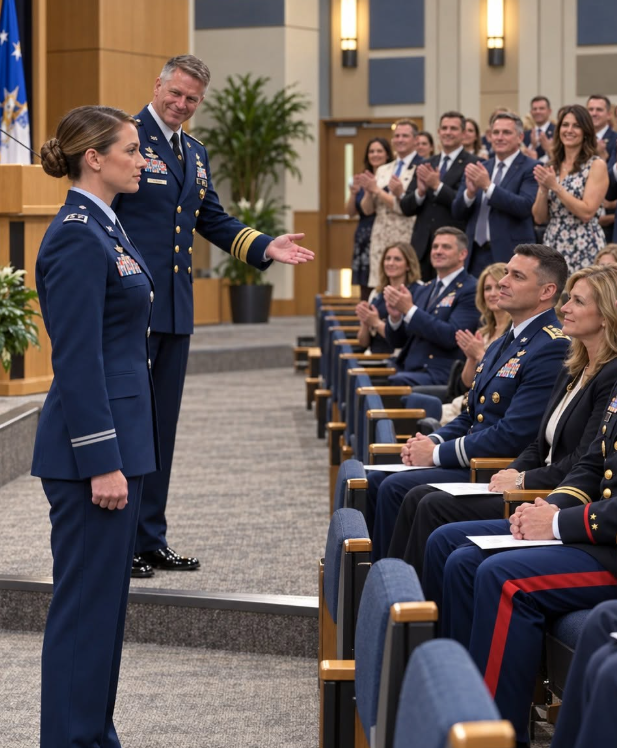
The commander’s voice carried across the auditorium as he announced, “Brigadier General Sable Rowan Vale.” Around my parents, people rose almost at once.
The applause hit in a solid wave.
My father didn’t move.
Neither did my mother. Penn had started to stand on instinct, then seemed to realize everyone around him was looking in my direction. Liora’s smile disappeared as she looked from my uniform to my father’s face.
I walked toward the stage.
For twenty years, I had learned how to cross rooms without attracting attention. That morning, every step sounded too loud.
The commander met me at the stairs and extended his hand. “General Vale, Fort Halder is honored to recognize your service today.”
A citation was read. Nothing classified. Nothing dramatic enough to explain the nights I had spent staring at moving dots on satellite feeds or the decisions that still woke me at three in the morning.
It mentioned two decades of intelligence leadership, overseas assignments, joint commands, and operational planning. It mentioned lives preserved through decisions made under pressure.
Then the commander handed me the installation’s highest command honor.
When I turned back toward the audience, I saw something I had never seen on my father’s face before.
Not anger.
Exposure.
He had spent years reducing my career to phrases like “government work” and “something in intelligence.” He had apparently done such a good job that even relatives in the room were staring at me as if I had arrived from another family.
I returned to my seat after the applause settled.
My father didn’t look at me again until the ceremony paused before his retirement remarks.
Then a staff officer appeared beside my chair.
“General Vale, Lieutenant General Vale would like a word with you backstage.”
Of course he would.
I followed the officer through a side door into a narrow corridor lined with framed photographs of previous commanders. My father was already waiting there with my mother and Penn.
The door had barely closed before he said, “You could have warned me.”
I stared at him.
“Warned you that I was attending the retirement ceremony I was invited to?”
His jaw tightened. “Don’t play games with me, Sable.”
“I’m not.”
Penn folded his arms. “Dad said you wanted to keep your attendance quiet because of your work.”
That made me turn toward him.
“He told you that?”
Penn’s certainty slipped slightly. “Yes.”
I looked back at my father. “My office confirmed my attendance three weeks ago.”
He said nothing.
“Publicly releasable information included my rank, current command, and the fact that I’m your daughter. I restricted operational details. I did not restrict my name.”
My mother’s fingers moved against her necklace.
My father finally said, “There are security considerations you don’t understand.”
I almost laughed.
“Dad, I am the security consideration.”
The corridor went silent.
Before he could answer, the commander came through the door carrying a folder.
“Harlan, there you are.”
My father’s posture changed instantly. His shoulders straightened and his voice became controlled. “Just clearing up a family misunderstanding.”
The commander glanced at me, then at him.
“About General Vale’s attendance?”
My father didn’t answer fast enough.
The commander opened the folder. “Because protocol sent your office the attendance confirmation on March eighteenth. Your aide acknowledged it the same morning.”
Penn slowly uncrossed his arms.
My father looked at the folder as though it had personally betrayed him.
The commander continued, not unkindly. “We also received a request from your retirement team not to include General Vale in the family acknowledgment section. I assumed that was her preference until her staff clarified otherwise.”
That was the moment the missing name at the gate stopped being personal pettiness and became something deliberate.
I looked at my father.
“You removed me twice.”
“Sable—”
“From the guest list and from the program.”
Penn turned toward him. “You told me she asked for that.”
My father ignored him.
Instead, he looked at the commander. “This is a private matter.”
The commander closed the folder. “Then I’ll leave you to it.”
He paused before going back through the door.
“But the recognition segment stays exactly as scheduled.”
My father’s face hardened.
That sentence told me there had been a third attempt I didn’t know about.
I waited until the door shut.
“You tried to cancel that too?”
He looked at me as if I had cornered him unfairly.
“This ceremony is about forty years of my service.”
“I know. I came here for that.”
“Then why did your command have to turn it into a spectacle?”
For years I had imagined what I might say if my father ever admitted that my accomplishments bothered him.
When the moment came, I didn’t feel triumphant.
I just felt tired.
“They didn’t make me a brigadier general this morning,” I said. “They just said it out loud.”
Penn looked down.
My mother whispered, “Sable, please. Not here.”
I turned toward her. “Where would you prefer? Christmas? I stopped getting invited.”
She flinched.
I regretted the sharpness immediately, but not the truth behind it.
My father stepped closer. “You made choices. You disappeared for years.”
“I deployed.”
“You missed family events.”
“Because I was working.”
“Penn managed to serve and still show up.”
There it was.
The comparison that had been running beneath everything for years.
Penn’s expression changed. “Dad.”
My father kept going. “Your brother understood that family matters.”
I looked at Penn. “Did you know he left me out of his official biography?”
Penn blinked. “What?”
“The retirement biography. One son carrying on the Vale military legacy.”
Penn looked genuinely confused.
That mattered.
Until then, part of me had assumed my brother had been enjoying the erasure from the beginning. His comment at the gate had been smug enough to support that theory.
But the look on his face wasn’t satisfaction.
It was recognition.
He had believed a story too.
“Dad told me you didn’t want your career associated with his because of classification,” Penn said.
“I never said that.”
Penn turned toward our father. “You said she wouldn’t even allow her assignments mentioned.”
“Her assignments can’t be mentioned.”
“That’s not the same thing.”
My father stared at him.
Penn had made one mistake that morning. He had seen me stopped at the gate and assumed I had created the problem myself.
Now he understood who had created it.
A staff member opened the corridor door and reminded my father that the reception line was forming.
He straightened his jacket.
Just like that, General Harlan Vale returned.
“We will discuss this after the ceremony,” he said.
I shook my head. “No. We discuss it when you stop giving orders and start answering questions.”
He walked away without responding.
The reception took place in a room beside the auditorium. Coffee, small sandwiches, framed photographs, polished silver trays—the kind of military hospitality my father had always loved because every object had an assigned place.
For twenty minutes, nothing exploded.
That almost made it worse.
Officers I had known years earlier came over to shake my hand. A retired colonel reminded me of a winter exercise when I had forced his team to reroute a convoy because I didn’t trust an intelligence report. He laughed and said, “You were right, by the way. I hated you for six months.”
I smiled. “Only six?”
People around us laughed.
Across the room, my father heard it.
Liora drifted toward the coffee urn, filled a cup, then left it untouched on a side table.
When she approached me, her voice was quiet.
“I owe you an apology.”
“For what?”
“I thought you didn’t come around because you looked down on everyone.”
That surprised me more than I wanted it to.
She glanced toward Penn. “That’s how your absence was always explained.”
“By my father?”
“Mostly.”
Before I could respond, my mother appeared beside us.
“Sable, can we speak privately?”
I followed her into an empty conference room.
She shut the door, then stood there with both hands wrapped around her purse.
For several seconds, she couldn’t meet my eyes.
“Your father didn’t start this because he hated you,” she said.
I felt my patience thin. “That isn’t comforting.”
“I’m not trying to comfort you.”
That made me listen.
She sat down.
“When Penn was younger, everything became a comparison. Your grades. Your academy record. Your first promotion. Your deployments. Harlan would talk about you at dinner, and Penn would shut down.”
“So you stopped talking about me?”
Her eyes filled, but she didn’t look away this time.
“At first, just a little.”
I said nothing.
“Then your father said Penn needed room to become his own man. He said your work was classified anyway, so there was no reason to explain where you were or what you were doing.”
“And after that?”
Her grip tightened on the purse.
“It became easier.”
Those three words hurt more than anything my father had said.
Not safer.
Not necessary.
Easier.
“The birthday slideshow?” I asked.
She nodded.
“The Christmas cards?”
Another nod.
“His biography?”
She swallowed. “I saw the draft.”
I leaned back against the conference table because my legs suddenly felt unreliable.
“You knew.”
“Yes.”
That was the collapse I hadn’t prepared for.
I had spent years treating my mother like collateral damage in my conflict with my father. Quiet. Passive. Uncomfortable but trapped.
She hadn’t been trapped.
She had participated because participation was easier than opposing him.
The door opened behind us.
Penn stood there.
From his expression, he had heard enough.
“You both did this?”
My mother stood quickly. “Penn—”
“No. You told me she didn’t want contact.”
“Sometimes she didn’t answer.”
I looked at him. “Because after enough calls where nobody asks anything about your life, you stop rushing to return them.”
His face tightened.
“At the gate,” he said quietly, “I thought you were doing your usual thing. Showing up without telling anyone and expecting everybody to adjust.”
“I know.”
“I was a jerk.”
“Yes.”
He almost smiled, but there was nothing funny enough to support it.
“I’m sorry.”
It was the first clean apology I had heard all day.
My mother tried to step closer to me.
I moved back.
“Not yet.”
She stopped.
I didn’t punish her. I didn’t forgive her either.
When we returned to the reception room, my father was surrounded by former commanders and old colleagues. He looked completely composed again.
For a moment, I thought that was how the day would end.
He would retire with a perfect speech. I would drive away with an award I hadn’t expected, and my family would promise to talk later until “later” turned into another ten years.
So I picked up my coat.
I had reached the lobby when the commander called my name.
“Sable.”
I turned.
He wasn’t smiling now.
“I thought you should know something before you leave.”
I waited.
“Your father saw the final ceremony schedule yesterday afternoon. He asked me personally to remove your recognition.”
I stared at him.
“What reason did he give?”
“He said it would distract from the purpose of the day.”
That was worse than the guest list.
The guest list could have been prepared weeks ago. The biography could have been part of an old pattern.
But yesterday, my father had known exactly who I was, exactly what the command intended to honor, and exactly how much of my life the recognition represented.
He had still tried to erase it.
“Why didn’t you?”
The commander looked back toward the auditorium.
“Because your service isn’t his to approve.”
I stood there holding my coat.
Then I took it off again.
Not because I wanted another confrontation.
Because I wanted to hear my father’s retirement speech knowing the truth.
When Harlan Vale returned to the stage, the room gave him the standing ovation his career deserved.
I stood too.
Whatever kind of father he had been to me, forty years of service were still forty years of service. I wasn’t going to rewrite his record just because he had tried to rewrite mine.
He stepped behind the podium and unfolded his prepared remarks.
For the first few minutes, he followed them perfectly.
He thanked commanders, troops, mentors, friends.
Then he reached the section about family.
I knew because his eyes moved toward my mother and Penn.
He stopped reading.
The silence stretched.
My father looked at the paper, then at me.
Finally, he set the prepared speech down.
“There is something I need to correct before I finish,” he said.
The room became completely still.
My mother covered her mouth.
Penn stared at the stage.
My father gripped both sides of the podium.
“For years, I told people I had one child carrying on the Vale tradition in uniform. That was false.”
No one moved.
“I have two children who served. One of them built a career I did not know how to speak about, partly because much of it was classified and partly because her success stopped fitting the story I had chosen to tell about my family.”
I felt every eye in the room shift toward me.
He continued.
“Yesterday, I asked for her recognition to be removed from today’s program. I told myself I was protecting the focus of this ceremony. The truth is that I wanted control over how my legacy was presented.”
That cost him something.
I could hear it in his voice.
Not his rank. Not his pension. Not his medals.
Something he valued almost as much: the image of absolute control.
“General Sable Rowan Vale is my daughter,” he said. “Her service belongs to her. Her achievements belong to her. And excluding her was my decision, not hers.”
He looked directly at me.
“Sable, I was wrong.”
The room stayed silent for another second.
Then the commander began clapping.
Others joined him, but this applause felt different from the first.
The first had been for my career.
This was not for me at all.
It was the sound of my father being forced to stand inside the truth he had finally spoken.
After the ceremony, people crowded around him again, but the conversations were quieter.
Penn found me near the auditorium doors.
“I don’t know how much of my relationship with him was built on being the easy son,” he said.
“Probably not all of it.”
“But some.”
“Probably.”
He nodded.
Then he said, “I should have asked questions.”
That mattered more to me than another apology.
My mother approached a few minutes later.
“Can we fix this?”
I looked at her.
“I don’t know.”
Her face crumpled slightly, but she accepted the answer.
“What do I do?”
“Stop telling people I disappeared.”
She nodded.
“Tell them I called. Tell them I came when I could. Tell them sometimes you chose not to include me.”
“I will.”
“And don’t turn today into the day everything became fine.”
“I won’t.”
My father was the last one to reach me.
By then, most of the auditorium had emptied.
He carried one of the folded ceremony programs in his hand.
Of course he did.
Clean paper. Sharp crease. Every name exactly where someone had decided it belonged.
“Public affairs is adding a correction to the archived copy,” he said. “Your name will be included in the official family record.”
I looked at the program.
That morning, being missing from it had felt like proof that I had been erased.
Now it looked smaller.
Still important, but smaller.
“Good,” I said.
He held the program toward me.
I didn’t take it.
“Keep it.”
His hand lowered.
“Sable, I don’t expect today to fix anything.”
“It doesn’t.”
He nodded once.
For the first time in my life, my father seemed unsure what order came next.
“I was proud of you,” he said. “I just—”
I stopped him.
“Don’t say you were proud if nobody could tell.”
He went quiet.
I buttoned my jacket and glanced through the glass doors toward the same pavement I had crossed that morning after discovering my name wasn’t on his list.
Then I looked back at him.
“If you want to change this, start somewhere simpler than a ceremony.”
He waited.
I pointed at the folded program still in his hand.
“The next time somebody asks how many children you have, say two.”