
My father dragged me into court over my grandfather’s $11 million inheritance. “Your Honor, she’s just a waitress,” he said. The judge gave a thin smile. “A waitress managing millions?” The courtroom chuckled. Then I stood up and said, “Actually, I am…” And suddenly, the judge stopped smiling.
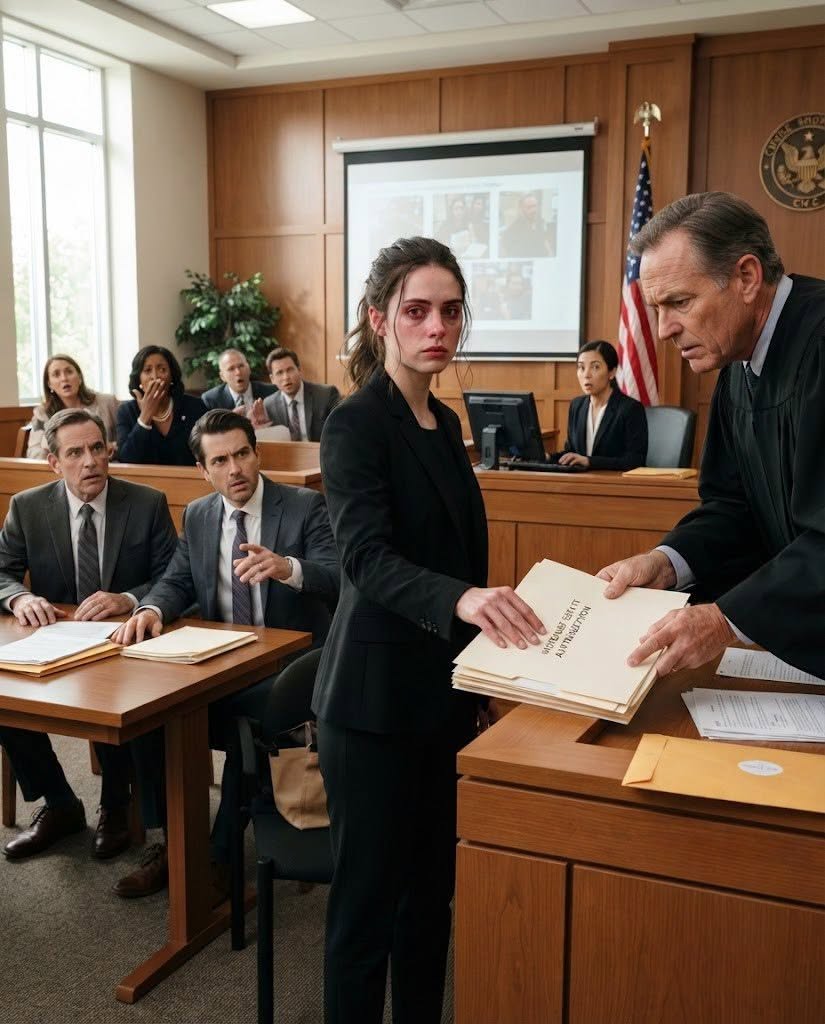
Sterling whispered, “That can’t be current.”
“It was updated,” I said.
Then I slid the sealed document forward.
That was the new part my father had not known existed.
The envelope had my grandfather’s handwriting across the front: To be opened only if Robert challenges Emily’s authority.
My father’s hand fell from his tie.
Sterling stopped breathing for a beat. The clerk looked up from her keyboard. Even Judge Harrison sat back like the bench had moved beneath him.
My father finally spoke, but his voice came out smaller than it had when he called me just a waitress.
“Emily,” he said, “what is in that envelope?”
I looked at him, then at the judge, and for the first time all morning, I let myself answer without shrinking.
“Your Honor,” I said, “before you open it, there is one thing my father forgot to mention about that freeze petition…”
“Your Honor,” I said, “before you open it, there is one thing my father forgot to mention about that freeze petition.”
Sterling recovered first.
He always did.
Men like him were trained to look calm while the floor disappeared beneath them.
“Objection,” he said quickly. “Ms. Whitaker is attempting to introduce irrelevant speculation.”
Judge Harrison did not even look at him.
“What did your father fail to mention?”
I turned toward my father.
Robert Whitaker sat perfectly still.
Too still.
For twenty minutes, he had been the confident son protecting his late father’s fortune from an inexperienced waitress.
Now he looked like a man trying to remember which lie had been written down.
“The petition claims my management puts the estate at risk,” I said. “But three days before my father filed it, he asked me to authorize a transfer of two million dollars from the estate’s reserve account.”
Sterling’s head snapped toward Robert.
The movement was small.
But I saw it.
So did the judge.
Robert finally spoke.
“That was a business proposal.”
“No,” I said. “It was a transfer request.”
“For an investment.”
“For your company.”
“My company is profitable.”
“Your company missed two debt payments last quarter.”
The courtroom changed.
Not dramatically.
Nobody gasped.
Nobody shouted.
But every person who had laughed at my apron suddenly seemed very interested in the table in front of me.
Robert leaned toward Sterling.
Sterling whispered something without moving his lips.
Judge Harrison raised one hand.
“No conferences yet.”
Sterling stopped.
The judge looked back at me.
“Do you have documentation?”
I opened my folder.
“Yes.”
I handed the clerk three pages.
She passed them to the bench.
The first was an email.
From Robert Whitaker.
Subject: Temporary Liquidity Allocation.
The second was a formal transfer request from Whitaker Development Holdings.
The third was my written rejection.
Judge Harrison read silently.
His eyes paused on one paragraph.
Then he read it aloud.
“‘The estate cannot extend liquidity to an entity carrying undisclosed debt exposure without independent valuation, board documentation, and conflict review.’”
He looked over the paper.
“You wrote this?”
“Yes, Your Honor.”
“When?”
“Monday at 10:14 a.m.”
“And the freeze petition was filed?”
“Thursday at 9:12 a.m.”
Robert exhaled through his nose.
“This is absurd. I was exploring an opportunity. She rejected it emotionally.”
I almost smiled.
Emotionally.
That word had followed me my entire life.
When I refused to lend him money at twenty-two, I was emotional.
When I stopped attending family dinners where he mocked my job, I was emotional.
When I told my grandfather not to concentrate forty percent of his portfolio in one industry, I was emotional.
Whenever a woman made a decision a man disliked, someone eventually called it emotional.
Judge Harrison looked at Robert.
“What was the purpose of the two-million-dollar transfer?”
Robert hesitated.
Sterling stood.
“Your Honor, my client should not be compelled to explain unrelated corporate financing in an inheritance proceeding.”
The judge’s expression hardened.
“Your client came into my courtroom asking me to freeze eleven million dollars because the estate manager allegedly lacked financial competence. If he attempted to access those same funds days earlier, I would say the reason is extremely relevant.”
Sterling slowly sat down.
Robert cleared his throat.
“Bridge financing.”
“For what?”
“A development.”
“Which development?”
“The Marston project.”
I pulled another document from the folder.
“The Marston project was canceled six weeks ago.”
This time the reaction was louder.
A whisper moved across the room.
Robert stared at me.
“You don’t know what you’re talking about.”
“I have the termination notice.”
His mouth opened.
Then closed.
Judge Harrison reached for it.
I gave it to the clerk.
The paper had been filed with the county planning office.
Marston River Redevelopment.
Permit withdrawn.
Primary investor exited.
Project inactive.
Judge Harrison read the date twice.
Then he looked at Robert.
“So you requested two million dollars from the estate for a project that had already been canceled?”
Robert’s face reddened.
“It was being restructured.”
“Then why does your request describe it as active?”
“It was a technical description.”
“A technical description.”
“Yes.”
The judge placed the paper down carefully.
I knew that movement.
My grandfather used to do the same thing when someone had lied to him.
The quieter he became, the worse the situation usually was.
Sterling rose again.
“Your Honor, none of this changes the central question. Even assuming Ms. Whitaker provided occasional analytical support, the estate is still valued at approximately eleven million dollars. My client’s concern regarding her qualifications remains legitimate.”
“Occasional?”
I looked at him.
Sterling held my gaze.
“Yes.”
I reached beneath the folder and removed a thinner binder.
Quarterly reports.
Sixteen of them.
Four years.
Every one signed by me.
Judge Harrison opened the first.
Then another.
Then another.
Asset allocation.
Bond ladders.
Tax-loss harvesting.
Risk concentration.
Liquidity ratios.
Dividend projections.
Estate distribution modeling.
There were handwritten notes in the margins.
Some mine.
Some my grandfather’s.
Judge Harrison turned one page toward the light.
“This notation says ‘Emily’s recommendation adopted.’”
“Yes.”
Another page.
“This one too.”
“Yes.”
He flipped deeper.
“And this?”
“Yes.”
Sterling interrupted.
“Preparing reports is not the same as managing an estate.”
“No,” I said. “It isn’t.”
He seized on the answer.
“Exactly.”
“So I brought the custodial records.”
The confidence disappeared from his face.
I placed a final packet on the desk.
Judge Harrison read the first page.
Then the next.
The documents were from the brokerage custodian.
Trade authorization limits.
Rebalancing authority.
Restricted withdrawal controls.
Emergency cash management.
My name appeared beside every operational permission my grandfather had granted.
Not ownership.
Not unrestricted access.
Authority.
Structured.
Documented.
Auditable.
Exactly the kind of authority nobody in that courtroom expected a waitress to have.
Judge Harrison looked up.
“Ms. Whitaker, how long have you had this authority?”
“Thirty-one months.”
“Were there any losses caused by your management?”
“No.”
“Any compliance violations?”
“No.”
“Any unauthorized transfers?”
“No.”
“Any complaints from the decedent?”
“No.”
Robert suddenly laughed.
It sounded forced.
“There were no complaints because Dad was deteriorating. Everyone knows that.”
The words landed harder than he intended.
Judge Harrison’s eyes narrowed.
I did not move.
Sterling closed his eyes for half a second.
Robert realized too late what he had said.
The judge leaned forward.
“Are you alleging your father lacked capacity?”
Robert hesitated.
“If necessary.”
“If necessary?”
“He was eighty-one.”
“That is an age, Mr. Whitaker. Not a diagnosis.”
“My father became dependent on Emily.”
There it was.
The next attack.
Not incompetence.
Manipulation.
Robert turned toward the gallery, as if he needed them to see the version of me he had built.
“She served him coffee. She spent hours around him. She isolated him. Then suddenly she has financial authority and eleven million dollars?”
“I did not inherit eleven million dollars personally,” I said.
Robert looked at me.
The judge did too.
I continued.
“The estate is eleven million. The will contains multiple beneficiaries, trusts, charitable distributions, and property instructions.”
Sterling frowned.
He knew that.
Robert apparently did not.
Or had pretended not to.
“My father’s petition repeatedly describes the full eleven million as if I received it directly,” I said. “I did not.”
Judge Harrison turned toward Sterling.
“Counsel?”
Sterling stood more slowly this time.
“The petition uses shorthand.”
“Eleven million dollars is considerable shorthand.”
Nobody laughed.
Not anymore.
Judge Harrison looked at the sealed envelope.
“To be opened only if Robert challenges Emily’s authority.”
His fingers touched the edge.
My father finally lost control.
“Wait.”
The word cracked through the room.
Judge Harrison stopped.
Robert stood halfway from his chair.
Sterling immediately grabbed his sleeve.
“Sit down.”
Robert ignored him.
“Your Honor, that envelope should not be opened until authenticity is established.”
“It is part of the probate file?”
“Yes,” the clerk said.
Sterling turned.
“What?”
The clerk checked her screen.
“It was deposited with the supplemental estate instructions six months before Mr. Whitaker’s death. The seal was logged and witnessed.”
Robert looked at Sterling.
Sterling looked back.
Neither of them had known.
That was the first moment I understood something important.
My father had not merely underestimated me.
He had underestimated my grandfather.
Judge Harrison picked up a letter opener.
The blade slid beneath the flap.
Paper tore softly.
No one moved.
He removed three sheets.
The first was handwritten.
The second appeared to be a bank record.
The third was a notarized statement.
Judge Harrison began reading silently.
Twenty seconds passed.
Then thirty.
His expression changed.
Not surprise this time.
Anger.
He looked directly at Robert.
“Mr. Whitaker.”
Robert swallowed.
“Yes?”
“Did you ever present your father with documents transferring voting control of Whitaker Family Properties?”
Robert’s face went blank.
Sterling stood immediately.
“My client will not answer until I’ve reviewed—”
“I asked whether such documents existed.”
Sterling turned toward Robert.
That was answer enough.
Judge Harrison held up the second page.
“This letter states that approximately fourteen months before his death, the decedent was presented with what he believed was a routine tax authorization.”
My father looked at me.
I had never seen that expression on him before.
Fear.
Real fear.
The judge continued.
“According to this statement, he later discovered that the packet included a voting proxy granting Robert Whitaker authority over family property interests.”
Sterling stepped forward.
“Your Honor, we need context.”
“You will have it.”
The judge kept reading.
“The decedent revoked the proxy immediately.”
Robert interrupted.
“He signed it.”
Judge Harrison looked up.
“You are confirming the document existed?”
Silence.
Sterling closed his eyes again.
Robert slowly sat.
The judge looked at the third page.
“This notarized statement says Mr. Whitaker believed his son had deliberately concealed the proxy among unrelated documents.”
“That is not true,” Robert said.
His voice was no longer polished.
It was sharp now.
Personal.
“Dad became paranoid.”
I felt something inside me go cold.
My grandfather had expected that too.
Judge Harrison continued.
“The statement further explains why Emily Whitaker was given independent control over estate liquidity.”
Robert stared at the envelope.
Judge Harrison read aloud.
“‘I am not appointing Emily because she is my granddaughter. I am appointing her because she is the only member of my immediate family who has refused to ask me for money.’”
A sound came from the back of the courtroom.
Not laughter.
Something closer to a stunned breath.
My father looked away.
The judge continued.
“‘Robert believes income proves competence. Emily believes discipline does. Over the last four years, I tested both.’”
My chest tightened.
I had never heard those words.
Not exactly.
Judge Harrison kept reading.
“‘I offered Emily a salary from the family office. She refused unless her work was independently reviewed. I offered Robert access to an investment account. He used it as collateral within ninety days.’”
Robert jumped up.
“That was a loan structure!”
“Sit down,” Judge Harrison said.
The force in his voice froze the room.
Robert sat.
Judge Harrison read the next line.
“‘If Robert challenges Emily’s authority after my death, examine his request history before granting him access to estate liquidity.’”
Then the judge stopped.
He looked at me.
“Ms. Whitaker.”
“Yes?”
“Do you have that request history?”
I opened the last section of my folder.
“Yes, Your Honor.”
Robert whispered something.
I barely heard it.
“Of course you do.”
I handed over the records.
There were nine requests.
Not one.
Nine.
Some had been made while my grandfather was alive.
Some indirectly.
One through a holding company.
One through a proposed “family investment vehicle.”
One through an unsecured bridge loan.
One disguised as a property acquisition.
My grandfather had approved two small transactions years earlier.
Both had been repaid late.
The later requests had been denied.
The largest was four million dollars.
Judge Harrison read through them.
Then he stopped at the final page.
“What is Red Harbor Holdings?”
Sterling’s posture changed.
Barely.
But enough.
I looked at him.
Then my father.
“That,” I said, “is what I believe the freeze petition was really about.”
The courtroom became motionless.
Robert shook his head.
“No.”
Judge Harrison looked at me.
“Explain.”
“Red Harbor Holdings is an LLC formed eleven days before my grandfather died.”
Sterling stood.
“Objection. Counsel has not had the opportunity to verify any allegation regarding—”
“It is not an allegation,” I said. “It is a state filing.”
Judge Harrison motioned for me to continue.
“The registered manager is not my father.”
Robert’s shoulders lowered slightly.
A strange kind of relief.
Too early.
“The manager is Daniel Pierce.”
My father’s relief vanished.
Sterling looked toward him.
Judge Harrison asked, “Who is Daniel Pierce?”
“My father’s chief financial officer.”
The judge turned to Robert.
Robert stared straight ahead.
I continued.
“Red Harbor opened a commercial account four days after formation.”
Sterling said, “And how would you know that?”
“Because they attempted to designate that account as the receiving account for the two-million-dollar estate transfer.”
The room erupted.
Not loudly.
But all at once.
Whispers.
Movement.
The clerk looked at the judge.
The judge looked at Sterling.
Sterling looked at Robert.
Robert did not look at anyone.
Judge Harrison struck the bench once.
“Quiet.”
The room settled.
He turned toward me.
“You have documentation connecting the requested estate transfer to Red Harbor Holdings?”
“Yes.”
I produced it.
The routing instructions.
The corporate account name.
The transfer memo.
Temporary capital placement.
Judge Harrison studied it.
“What ownership interest does Mr. Whitaker have in Red Harbor?”
“None listed publicly.”
Robert finally found his voice.
“Because I don’t own it.”
I nodded.
“That’s true.”
He turned toward me quickly.
For one second he thought I had saved him.
I had not.
“But Daniel Pierce signed a private side agreement giving my father an eighty-percent beneficial interest.”
Sterling went pale.
My father stood again.
“That document is confidential.”
The sentence escaped before he could stop it.
Nobody moved.
Judge Harrison slowly looked at him.
“Confidential?”
Robert realized what he had done.
Sterling did too.
He whispered, “Do not say another word.”
Judge Harrison leaned forward.
“Mr. Whitaker, your attorney is giving you excellent advice.”
My father sat.
His face had changed completely.
The boardroom confidence was gone.
The superior smile was gone.
Even the anger was beginning to disappear.
What remained was calculation under pressure.
The kind my grandfather had warned me about.
Judge Harrison turned toward me.
“How did you obtain the side agreement?”
“It was attached accidentally to the funding request packet sent to the estate account.”
Sterling looked genuinely shocked.
Robert closed his eyes.
I remembered the morning I found it.
6:41 a.m.
Coffee shop opening shift.
Rain tapping the front windows.
I had been sitting at a corner table before customers arrived, reviewing the transfer request on my laptop.
Thirty-two pages.
Most people would have read five.
My grandfather taught me to read every page.
Page twenty-seven was the mistake.
A PDF embedded behind a duplicate insurance certificate.
Red Harbor Holdings.
Beneficial participation agreement.
Robert Whitaker: eighty percent.
Daniel Pierce: twenty percent.
I had stared at it for almost a minute before understanding why my father needed estate money so quickly.
It was not investment capital.
It was rescue money.
His company had obligations he had hidden.
Red Harbor would receive estate funds.
Red Harbor would loan them to Whitaker Development.
The estate would carry the risk.
My father would keep control.
If the company recovered, he won.
If it failed, my grandfather’s estate absorbed the damage.
Judge Harrison looked at Robert.
“Did you disclose your beneficial interest in Red Harbor when requesting the transfer?”
Sterling spoke before Robert could.
“My client will invoke his right not to answer questions that may expose him to separate liability.”
There it was.
The entire courtroom heard it.
No joke.
No clever phrasing.
No waitress.
Separate liability.
Judge Harrison sat back.
“I think we have moved well beyond a simple petition regarding financial competence.”
Sterling nodded tightly.
“We would request a recess.”
“You may have one in a moment.”
Then the judge looked at me.
“One question first. Why did you not include all of this in an opposition filing?”
I looked down at my hands.
They were steady.
The same hands that had carried coffee that morning.
“I expected my father to challenge me eventually. My grandfather expected it too. But I did not know which argument he would use.”
I glanced at the photographs still frozen on the courtroom screen.
Me in the apron.
Me cleaning tables.
Me working the register.
“So I waited to see what he claimed.”
Judge Harrison followed my gaze toward the screen.
Something uncomfortable passed across his face.
He knew.
He remembered laughing.
Not loudly.
But enough.
I continued.
“If he had challenged the will, I had the capacity records. If he challenged my authority, I had the management records. If he claimed I was exploiting my grandfather, I had independent correspondence and review reports.”
“And when he claimed you were financially unqualified?”
“I had four years of performance records.”
Judge Harrison nodded.
“And the transfer request?”
“That told me why he was really here.”
My father pushed back from the table.
“You think you understand everything because Dad let you read spreadsheets?”
I looked at him.
There was the father I remembered.
Not the polished executive.
The man from our kitchen.
The man who once told me I was embarrassing the family because I kept working at the coffee shop after college.
“You serve cappuccinos, Emily.”
I said nothing.
He kept going.
“You lived in a one-bedroom apartment while your grandfather had properties in three states. You wore secondhand suits. You drove that ridiculous ten-year-old Honda.”
Sterling whispered, “Robert.”
He ignored him.
“And now you stand there pretending you’re some financial genius?”
“No.”
My voice was quiet.
“I never said I was.”
He laughed bitterly.
“That’s what this whole performance is.”
“No. This is accounting.”
That silenced him.
I walked back to the defense table.
“My grandfather taught me something you never learned.”
Robert’s jaw tightened.
“What?”
“That money does not become safer just because the person touching it wears an expensive suit.”
The courtroom was completely silent.
I picked up the first photograph Sterling had entered.
Me behind the counter.
Monday.
7:18 a.m.
“I work at the coffee shop because I like it.”
My father stared.
“I kept my shifts after Granddad offered me a full-time role because I did not want my entire life funded by family money.”
I placed the photograph down.
“The coffee shop gives me a paycheck that is mine.”
Another photograph.
Wednesday.
2:44 p.m.
“It gives me coworkers who do not care about my last name.”
Another.
Friday.
6:02 p.m.
“And it reminds me that people who clean tables are not stupid.”
Nobody smiled.
Not even slightly.
Judge Harrison looked toward Sterling.
“Counsel, I am denying the emergency freeze request.”
My father’s face hardened.
Sterling immediately stood.
“We ask the court to preserve the status quo pending—”
“I am not finished.”
Sterling sat.
“The estate accounts will remain under the existing management structure.”
I felt my chest loosen.
Barely.
Then the judge continued.
“However, given the evidence presented regarding attempted conflicted transactions, I am ordering a forensic review of all requests made against estate-controlled entities during the final twenty-four months of the decedent’s life.”
Robert turned toward Sterling.
“And I am directing the clerk to preserve the Red Harbor documents for referral.”
Sterling stood.
“Referral to whom?”
Judge Harrison looked at him.
“The appropriate authorities.”
For the first time that morning, my father looked old.
Not weak.
Not harmless.
Just old.
As if the effort required to maintain his version of reality had finally become too heavy.
Judge Harrison looked back at the sealed letter.
“There is another page.”
I had forgotten.
The third sheet.
The judge unfolded it.
My grandfather’s handwriting again.
But this page was shorter.
Only a few paragraphs.
Judge Harrison read silently.
Then his expression softened.
He looked at me.
“Ms. Whitaker, I believe this portion is intended for you.”
My throat tightened.
“Would you like it read aloud?”
I hesitated.
Then nodded.
“Yes.”
He began.
“‘Emily, if this letter is being opened, then Robert has done exactly what I feared and exactly what I hoped he would eventually stop doing.’”
My father stared at the floor.
“‘You may be angry. Do not let anger manage the estate. Numbers do not care who embarrassed you.’”
A small ache formed behind my ribs.
That sounded exactly like him.
“‘Protect the assets. Pay the obligations. Honor the charitable commitments. Give Robert only what the will gives him, neither less nor more.’”
My eyes burned.
I blinked once.
The judge continued.
“‘And keep the coffee shop job if it still makes you happy. Your father has always confused status with value.’”
Someone in the gallery breathed out.
I almost laughed.
Almost.
Then came the final line.
Judge Harrison paused before reading it.
“‘One last thing. If Robert tries to remove you by calling you a waitress, ask him whether he remembers who found the forty-three million dollar error.’”
My father’s head snapped up.
Sterling looked at him.
Judge Harrison lowered the page.
“What forty-three-million-dollar error?”
I did not answer immediately.
Because that was the secret I had promised my grandfather I would never use unless necessary.
Not the estate.
Not Red Harbor.
Something older.
Something that explained why my grandfather had begun testing me in the first place.
Robert whispered, “Emily.”
His voice had changed.
It was almost pleading.
I looked at him.
“What error?” Judge Harrison asked again.
I reached for the oldest document in my folder.
A folded spreadsheet.
Four years earlier, my grandfather had given me a stack of annual reports and asked one simple question.
Anything look strange?
I had spent three nights reading them after work.
On the fourth night, I found it.
A valuation model inside Whitaker Development’s acquisition division had counted projected revenue from the same properties twice.
Once through the holding entity.
Once through the subsidiaries.
The error inflated future asset projections by forty-three million dollars.
It had been used in lender presentations.
Investor materials.
Board forecasts.
Not intentionally at first.
But once my father discovered it, he had not corrected it immediately.
He had called it immaterial.
My grandfather disagreed.
Vehemently.
The numbers were restated before any transaction closed.
No investor lost money.
No crime had occurred.
But my grandfather never forgot who noticed it.
The waitress.
And who tried to minimize it.
His son.
I handed the old report to Judge Harrison.
“My grandfather asked me to review this before he gave me any authority.”
Judge Harrison scanned the marked figures.
“You found this?”
“Yes.”
Robert spoke through clenched teeth.
“She found a formula error.”
“A forty-three-million-dollar formula error,” the judge said.
“It never became a real loss.”
“Because it was found.”
My father said nothing.
Judge Harrison looked at the photographs on the screen one last time.
Then at Sterling.
“Counsel, remove those images from display.”
Sterling did not move.
The judge’s voice sharpened.
“Now.”
The projector went dark.
The wall became blank.
The courtroom suddenly looked different without my apron ten feet tall above everyone’s heads.
Judge Harrison gathered the documents.
“This matter is concluded for today.”
The gavel came down.
People stood.
Chairs scraped.
Whispers started immediately.
But I remained where I was.
My legs felt strange.
Not weak.
Just heavy.
Sterling gathered his papers without looking at me.
My father did not move.
The courtroom emptied around us.
Finally he said, “You could have told me.”
I stared at him.
“Told you what?”
“That Dad trusted you like this.”
“You never asked.”
“I’m your father.”
“Yes.”
That word hurt more than I expected.
He looked toward the door where the judge had disappeared.
“You embarrassed me.”
I almost could not believe it.
After everything.
The petition.
The photographs.
The laughter.
Red Harbor.
The hidden agreement.
His first grievance was embarrassment.
“You brought photographs of me working into a courtroom.”
“I was protecting the estate.”
“No. You were trying to prove I looked poor.”
His face tightened.
“That’s not fair.”
I nodded slowly.
“You’re right.”
He looked surprised.
“Fair would have been telling the judge about Red Harbor before filing the petition.”
His jaw clenched.
“You don’t understand the pressure I was under.”
“Then explain it.”
He looked away.
For the first time, I think he realized I meant it.
Not as a daughter.
As the estate manager.
He sat down.
Sterling was at the door now.
“Robert, don’t.”
My father ignored him.
“The lenders accelerated a covenant.”
Sterling closed his eyes.
“Robert.”
“The Marston cancellation triggered it. We needed liquidity for maybe sixty days.”
“And you were going to put estate money into Red Harbor.”
“It would have been repaid.”
“Maybe.”
“It would have.”
“You do not know that.”
He hit the table with his palm.
“I built that company!”
The clerk looked over.
Sterling walked back.
“Enough.”
Robert lowered his voice.
“You think Granddad was perfect? He squeezed every mistake until people could not breathe. He made me prove myself every day of my life.”
I looked at him.
“And what did you think he did with me?”
“You were his favorite.”
I laughed once.
Not because it was funny.
Because it was absurd.
“I served him coffee for two years before he told me he owned the building.”
Robert stared.
“He tested every assumption I made. He sent back reports because one footnote was vague. He made me explain bond duration on napkins. He once made me redo an entire liquidity model because I used an optimistic rent renewal rate.”
My father’s expression shifted.
“He never did that with me.”
“Yes, he did.”
“No.”
“He tested you differently.”
“How?”
I glanced at the Red Harbor documents.
“With access.”
That landed.
Hard.
My grandfather had given Robert money and watched what he did.
He gave me work and watched what I did.
Neither test was easy.
Only one of us understood it was a test.
Sterling picked up his briefcase.
“This conversation needs to stop.”
My father remained seated.
“What happens now?”
I answered carefully.
“The forensic review happens.”
“To the company?”
“To any transaction connected to the estate.”
“And Red Harbor?”
“That is no longer my decision.”
He nodded faintly.
Then he asked the question I had not expected.
“Do I still inherit anything?”
I looked at him for a long moment.
“Yes.”
He looked up.
I could see the surprise.
“The will gives you what it gives you.”
“You’re not going to block it?”
“No.”
“After today?”
“My grandfather’s letter was clear.”
Neither less nor more.
My father stared at the empty courtroom screen.
Then he gave a quiet, broken laugh.
“He knew.”
“Yes.”
“He knew I would challenge you.”
“I think he hoped you wouldn’t.”
That hurt him.
I could tell.
More than accusation would have.
He stood.
For a moment, I thought he might apologize.
Instead he buttoned his jacket.
Not yet.
Maybe never.
Sterling led him toward the door.
My father stopped beside me.
“Emily.”
I looked at him.
His eyes dropped toward my hands.
The same hands Sterling had enlarged on the courtroom screen holding two paper coffee cups.
“What are you going to do tomorrow?”
It was such a strange question.
I almost smiled.
“Open at six.”
He frowned.
“The coffee shop?”
“Yes.”
“After all this?”
“Especially after all this.”
He looked at me as if he still could not understand.
Then he left.
The next morning, I arrived at 5:42.
The city was still gray.
Delivery trucks hissed along the curb.
The bakery next door smelled like butter and warm bread.
I tied on my faded blue apron.
Turned on the espresso machine.
Counted the register.
At 6:03, the first customer walked in.
Then another.
By 7:15, the line reached the door.
Nobody in that room knew what had happened in court.
Nobody cared.
A construction worker ordered black coffee.
A woman in running clothes asked for oat milk.
A tired nurse bought two muffins and apologized because she only had a twenty-dollar bill.
Normal life.
Beautifully normal.
At 7:18, exactly the same time stamped on Sterling’s photograph, I carried two lattes across the room.
My phone vibrated in my pocket.
A message from the estate custodian.
FORENSIC REVIEW INITIATED.
Then another.
RED HARBOR TRANSFER ATTEMPT FLAGGED FOR EXTERNAL INVESTIGATION.
I read both.
Locked the phone.
And kept walking.
At the corner table, an elderly man in a navy coat unfolded a newspaper.
For one impossible second, the angle of his shoulders reminded me of my grandfather.
Yellow legal pad.
Paper cup.
Pen tapping twice against the table.
My chest tightened.
Of course it was not him.
The man looked up.
“Excuse me, miss?”
“Yes?”
“I think you gave me too much change.”
He held out a five-dollar bill.
I checked the receipt.
He was right.
“Thank you.”
He smiled.
“Most people would’ve kept it.”
I took the bill and placed it back in the register.
“My grandfather used to say small numbers tell you what people will do with big ones.”
The man laughed.
“Smart grandfather.”
“Very.”
At 9:06, the door opened.
I looked up automatically.
My father stood outside.
No attorney.
No tailored overcoat.
No courtroom posture.
Just Robert.
For several seconds, he remained behind the glass.
Then he came inside.
The room smelled of cinnamon, coffee, and rain.
He approached the counter.
I waited.
He looked at the menu like he had never seen one before.
Finally he said, “Black coffee.”
“What size?”
He almost smiled.
“Whatever Dad used to get.”
“Medium.”
I poured it.
He reached for his wallet.
I rang it up.
“Three twenty-five.”
He looked at me.
“You’re charging me?”
“Yes.”
Something changed in his face.
Then, unexpectedly, he laughed.
A real one this time.
Small.
Tired.
He handed me five dollars.
I gave him the change.
Every cent.
He looked down at the coins in his palm.
Then at me.
“The review team called this morning.”
“I know.”
“They’re going to tear through everything.”
“Yes.”
“I may lose the company.”
“Maybe.”
He nodded.
I did not comfort him.
I did not punish him.
That was not my job.
He took the coffee.
Then he noticed the table in the corner.
My grandfather’s table.
Empty.
Robert stared at it for several seconds.
“Did he really come here twice a week?”
“For almost four years.”
“And talk to you about investments?”
“Yes.”
“He never told me.”
“He knew you wouldn’t understand why.”
Robert looked at my apron.
For the first time in my entire life, there was no contempt in his eyes.
Only recognition.
He lifted the cup slightly.
“To Dad.”
I looked at him.
Then at the old corner table.
“To Granddad.”
Robert turned to leave.
At the door, he stopped.
“Emily.”
“Yes?”
He glanced at the crowded shop.
“At court, when Harrison asked what you actually were…”
He paused.
“What were you going to say before you changed the wording?”
I remembered the moment.
Actually, I am—
The entire courtroom waiting.
My father smirking.
The judge amused.
Everyone certain the answer had to be some impressive title.
Portfolio manager.
Analyst.
Financial professional.
Something respectable enough to erase the apron.
I looked at my father.
“I was going to say, ‘Actually, I am a waitress.’”
He stared at me.
I continued.
“And an authorized portfolio manager.”
A customer raised her hand from the window table.
“Excuse me?”
I grabbed the coffee pot.
Robert stepped aside.
I walked past him.
Because that was the part nobody in court had understood.
I had never needed the second title to make the first one respectable.
The waitress was never the embarrassing part of the story.
The mistake was assuming she could not count.