
My mother-in-law had no idea I earn about $50,000 a month. One day she threw hot water at me, forced me out of the house, and sneered, “Useless beggar! Get out and never come back!” I walked away without arguing but the next morning she woke up to a shock waiting at her own front door.
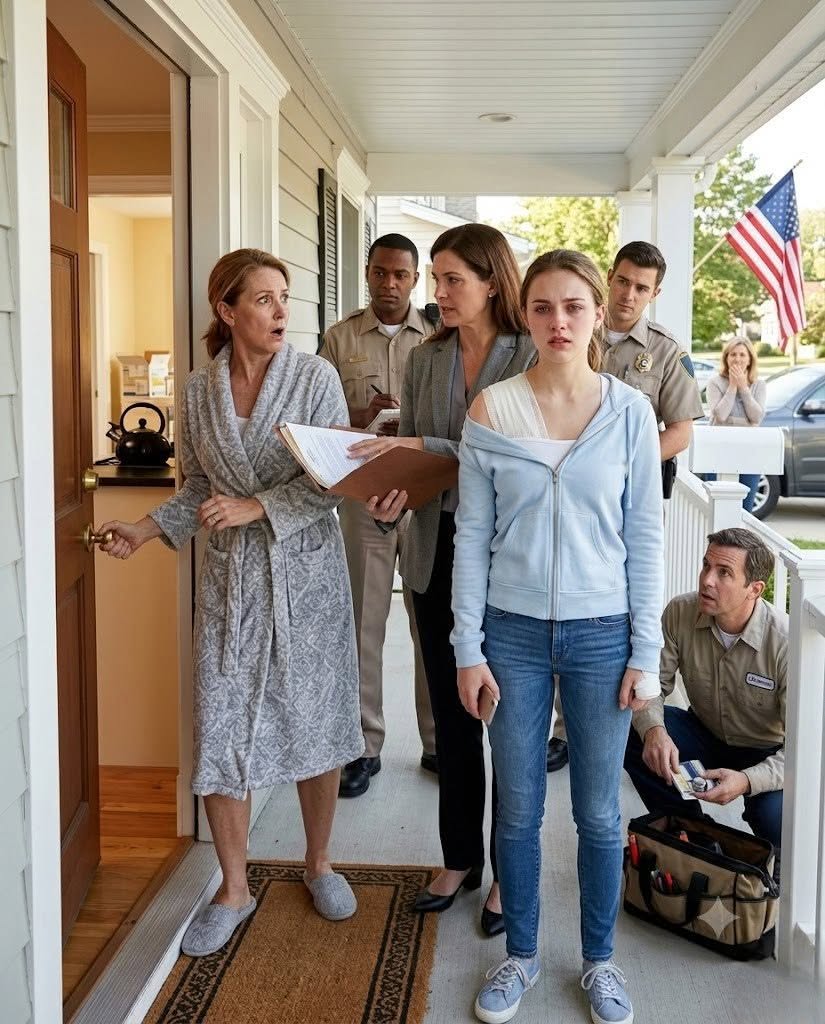
“Mrs. Hayes, I need you to step away from the doorway.”
Margaret blinked at the officer.
Once.
Twice.
Like she had heard the words but refused to believe they applied to her.
“What?”
The officer did not raise his voice.
He did not need to.
“Step away from the doorway, ma’am.”
For the first time since I had met her, Margaret obeyed without arguing.
She took one step back.
Then another.
Ethan remained frozen near the driveway, his lunch bag hanging uselessly from one hand.
My attorney, Rebecca Sloan, closed the folder but kept it tucked against her chest.
The locksmith waited quietly.
And I stood there with my burned arm wrapped under a loose cotton shirt, staring into the house I had purchased four years earlier.
My house.
My front door.
My hardwood floors.
My family photographs on the wall.
And somehow Margaret had spent the last twenty-four hours convincing herself I was the trespasser.
The officer turned toward me.
“Ms. Hayes, you confirmed this is your primary residence?”
“Yes.”
“And you were ordered to leave yesterday after the incident involving hot water?”
“Yes.”
Margaret made a sharp sound.
“Ordered to leave? I told her to get out because she was screaming at me.”
I almost laughed.
Not because anything was funny.
Because the lie arrived so quickly.
So naturally.
Like she had been preparing it overnight.
The second officer looked at me.
“Were you screaming?”
“No.”
Margaret crossed her arms.
“She’s manipulative. She always acts calm after provoking people.”
Rebecca glanced at me.
I could see the warning in her eyes.
Do not react.
So I did not.
Instead, I reached into my bag and handed the officer my phone.
“I saved the doorbell footage and the indoor security clip from the kitchen entrance.”
Margaret’s face emptied.
That was the first real crack.
Not the deed.
Not the police.
The camera.
She slowly turned her head toward the small black camera mounted above the hallway opening.
For eight months she had complained that Ethan and I had “too many gadgets.”
Apparently, she had forgotten one of them existed.
The officer took my phone.
The clip was only forty-seven seconds long.
Forty-seven seconds.
That was all it took.
Margaret’s voice came through clearly.
“This is Ethan’s house.”
Then mine.
“This is my home too.”
Then the scrape of the kettle.
My gasp.
And finally Margaret’s voice, loud and unmistakable.
“Get out of this house and never show your face here again. Useless beggar.”
No screaming from me.
No threat.
No provocation.
Just water.
Pain.
And Margaret ordering the actual owner out.
The officer stopped the video.
Nobody spoke.
Ethan lowered his eyes.
Margaret’s face had gone gray.
“I didn’t mean for it to hit her,” she said.
The officer looked at the bandage.
“You poured water in her direction?”
“I was angry.”
“That wasn’t the question.”
Margaret swallowed.
“It slipped.”
I looked at her.
Yesterday she had smirked.
Now the kettle had slipped.
The insult had become misunderstanding.
The violence had become clumsiness.
Consequences are interesting that way.
People suddenly become very uncertain about actions they were perfectly confident committing.
Rebecca stepped closer to me.
“Lauren, you don’t need to answer anything else right now.”
Margaret snapped toward her.
“This is a family matter.”
Rebecca’s expression did not change.
“No. Yesterday may have felt like a family matter to you. Today there is documented physical injury, recorded evidence, and a property dispute you created by removing the owner from her residence.”
“I did not remove her!”
“You told her to leave.”
“I was upset.”
“And she left because you had just burned her.”
Margaret’s lips tightened.
Then she saw Ethan again.
And something in her changed.
She moved toward him.
“Ethan, tell them. Tell them she’s doing this to punish me.”
He did not answer.
She grabbed his sleeve.
“Tell them.”
Ethan finally looked at his mother.
I had seen him angry before.
Frustrated.
Exhausted.
Disappointed.
But never like this.
There was no heat in his face.
That was what made it worse.
He looked emptied out.
“Did you throw boiling water at Lauren?”
Margaret shook her head immediately.
“It wasn’t boiling.”
My stomach turned.
Ethan stared at her.
She realized too late what she had just admitted.
“It was hot,” she corrected. “I mean—I had just made tea, but I didn’t throw it at her. I moved the kettle and some spilled.”
Ethan looked toward my shoulder.
Then back at her.
“And you told her to get out?”
Margaret’s eyes filled instantly.
A performance I had seen many times.
She could produce tears like other people produced receipts.
“She was disrespectful.”
Ethan closed his eyes.
Just for a second.
When he opened them again, he gently removed her hand from his sleeve.
That movement frightened her more than yelling would have.
“Mom.”
His voice cracked.
“This is Lauren’s house.”
Margaret stared at him.
He continued.
“She bought it before we got married.”
“You told me you paid the mortgage.”
“I said we paid the mortgage.”
“That means you.”
“No. It means us.”
His eyes flicked toward me.
Then down.
“Mostly her.”
Margaret took a small step backward.
“You’re lying.”
Ethan gave a bitter laugh.
“I wish I was.”
The quiet after that felt enormous.
Cars passed at the end of the street.
A lawn sprinkler clicked somewhere nearby.
A dog barked behind a fence.
Ordinary sounds.
Ordinary morning.
Except Margaret’s world had just cracked open.
She looked at me again.
Not with fear now.
Calculation.
I knew that look.
She was rebuilding the story.
Trying to find the version where she was still right.
“How much do you even make?” she asked.
Rebecca immediately said, “That is irrelevant.”
But I answered anyway.
Because for three years Margaret had built her contempt around one number she had invented.
I wanted her to hear the real one once.
“About fifty thousand a month.”
Nobody moved.
Margaret actually smiled.
A tiny, disbelieving smile.
Then she laughed.
“No.”
I said nothing.
She looked at Ethan.
He did not deny it.
Her laughter stopped.
“Fifty thousand?”
“Yes.”
“A year?”
“A month.”
Her mouth opened again.
Nothing.
I watched the arithmetic hit her.
The vacations she had assumed Ethan paid for.
The remodeled kitchen.
The guest wing.
The car she had called “too expensive for a young couple.”
The private health insurance upgrade she had benefited from while living with us.
The groceries.
The utilities.
The roof repair.
The property taxes.
The life she had enjoyed while calling me a beggar inside it.
Her eyes dropped to the entry table.
There was a white ceramic bowl there where she always tossed her keys.
Beside it sat the leather handbag I had bought her for Christmas.
She looked at the bag.
Then at me.
Something like shame flickered across her face.
It lasted less than a second.
Then pride killed it.
“Well,” she said stiffly, “if you earn so much, you certainly don’t need this house.”
Rebecca’s eyebrows lifted.
Even the officer looked at her.
Margaret heard herself too late.
Ethan whispered, “Mom, stop.”
But she was falling now.
And when some people fall, they do not reach for a hand.
They claw at everyone nearby.
“I raised my son,” she said. “I sacrificed everything for him. If his wife is earning that kind of money, then whatever is in this marriage belongs to both of them.”
Rebecca opened the folder again.
“That is exactly why the prenuptial agreement matters.”
Margaret turned toward her.
Rebecca pulled out a page.
“The property was acquired before marriage. It remains Lauren’s separate property. The refinance maintained that designation. Your son acknowledged that in writing.”
Margaret stared at Ethan.
“You signed something?”
“Yes.”
“Without telling me?”
Ethan’s face changed.
For the first time, anger appeared.
“Why would I tell you?”
That landed.
Hard.
Margaret recoiled.
Ethan stepped closer.
“Why would my wife’s deed, our prenup, our finances, or anything else in our marriage be your business?”
Margaret’s chin trembled.
“I’m your mother.”
“And Lauren is my wife.”
I looked at him.
There it was.
The sentence I had needed eight months earlier.
The sentence that would have mattered when Margaret rearranged my kitchen.
When she mocked my work.
When she corrected me in front of guests.
When she called me lazy.
When she told Ethan I was using him.
He finally said it.
And it was almost too late.
Margaret began crying for real then.
Not loudly.
Not dramatically.
Her shoulders folded.
For half a second, I saw the older woman beneath all the cruelty.
A widow who had sold her condo.
A mother terrified of becoming unnecessary.
A person whose son had built a life where she was no longer the center.
Understanding someone is not the same as excusing them.
I could see the wound.
I could also feel my own shoulder burning beneath the bandage.
The officer cleared his throat.
“Mrs. Hayes, I need to ask whether you have somewhere else to stay today.”
Margaret snapped her head up.
“What?”
Rebecca answered before the officer could.
“Lauren is revoking your permission to remain in the property.”
Margaret stared at me.
“You’re evicting me?”
I felt my pulse beating behind my eyes.
Eight months.
Eight months of small humiliations.
Eight months of swallowing comments to keep peace.
Eight months of Ethan saying, “She doesn’t mean it that way.”
Yesterday had ended that.
“I’m telling you that you cannot live here anymore.”
Margaret’s face hardened.
“You can’t put me on the street.”
“No one is putting you on the street.”
“Where am I supposed to go?”
“That is no longer my responsibility.”
She flinched.
Good.
Not because I enjoyed hurting her.
Because for once the truth reached the place excuses never had.
The officer explained that the immediate issue was safety and access, not some instant physical removal of belongings without process. Rebecca had already prepared the necessary notice based on Margaret’s occupancy status and local requirements.
Margaret barely listened.
She kept staring at me.
Then she said the sentence that changed everything again.
“You think this is over because you have money?”
My skin prickled.
Rebecca looked up.
“What does that mean?”
Margaret’s eyes shifted.
Tiny movement.
But I saw it.
So did Ethan.
“Mom?”
Margaret turned away.
“Nothing.”
Ethan took one step toward her.
“What did you mean?”
She began walking toward the stairs.
The officer stopped her.
“Ma’am, where are you going?”
“To get dressed.”
“That’s fine. We’ll stay here.”
She looked offended.
“You’re going to watch me change?”
“No, ma’am. We’re going to remain on the property while everyone stays separated.”
Margaret climbed the stairs.
Slowly.
Rebecca moved beside me.
“You heard that too.”
“Yes.”
Ethan rubbed both hands over his face.
“I don’t understand.”
I did not either.
Not yet.
Then my phone vibrated.
One email.
Subject line:
URGENT: Password Reset Request.
I opened it.
My company bank portal.
A password reset had been requested at 7:42 that morning.
I stared at the screen.
Another message arrived.
Security alert.
Attempted login.
Home IP address.
My home IP address.
My stomach dropped.
Rebecca saw my face.
“What?”
I showed her.
Ethan leaned closer.
“That’s our network.”
“Yes.”
The second officer immediately straightened.
“Is anyone else in the residence?”
“No,” Ethan said.
Then stopped.
His face changed.
“Mom has a laptop.”
I looked toward the stairs.
Rebecca’s voice became very quiet.
“Lauren, did Margaret ever have access to your financial information?”
“No.”
Then I remembered.
The refinance folder.
The scanned property documents.
The tax packets I once kept in the home office before moving almost everything into encrypted storage.
And Margaret.
Always cleaning.
Always reorganizing.
Always entering rooms she called “shared space.”
I turned toward Ethan.
“Has she ever used your laptop?”
His eyes widened.
“Mine?”
“Yes.”
“Sometimes.”
“Does your browser save passwords?”
He went pale.
I did not need the answer.
Rebecca closed the distance between us.
“Do not touch any device.”
The officer nodded.
“Agreed.”
Ethan whispered, “Mom wouldn’t.”
I looked at him.
He stopped talking.
Because twenty-four hours earlier he might have said she would never throw hot water at me either.
The officer called for guidance.
Then another unit.
Margaret came down fifteen minutes later wearing navy slacks, a cream blouse, and makeup.
Makeup.
At nine in the morning.
With police in the foyer.
That was Margaret.
If her life was collapsing, she still wanted good lighting.
She reached the bottom step and froze.
There were now three officers in the house.
One stood near the hall desk.
Another was speaking quietly into a radio.
Her eyes flicked toward her laptop bag near the sitting room.
Too fast.
Too obvious.
The nearest officer noticed.
“Mrs. Hayes, we need you to leave that bag where it is.”
Her face changed again.
“Why?”
I lifted my phone.
“Someone inside this house tried to access one of my financial accounts this morning.”
Margaret stared at me.
Then laughed.
It was the worst laugh I had ever heard.
Dry.
Forced.
Panicked.
“So now you’re accusing me of hacking?”
“I didn’t accuse anyone.”
“You just did.”
“No. I said someone inside the house.”
Margaret looked at Ethan.
“Say something.”
This time he stepped away from her.
That silence told her everything.
She pointed at me.
“This is exactly what she does. She sets traps.”
Rebecca said, “Margaret, stop speaking.”
“You don’t order me around.”
“I am advising you because every sentence you say is making your situation worse.”
Margaret folded her arms.
“There is no situation.”
Then her phone rang.
A loud old-fashioned ringtone.
Everyone looked at it.
Margaret snatched it from her purse.
She checked the screen.
And declined the call.
One second later, a voicemail notification appeared.
The officer nearest her said, “Ma’am, please don’t delete anything.”
“I wasn’t.”
Her hand tightened around the phone.
Then Ethan saw the caller name.
His face went blank.
“Who is Daniel Price?”
Margaret froze.
I knew the name.
Not well.
But enough.
Daniel Price was a financial advisor Margaret had mentioned twice during dinner months earlier.
A “friend from church.”
Someone who helped older clients move money.
Rebecca looked at me.
I whispered, “I’ve heard the name.”
Margaret suddenly shoved the phone into her purse.
The officer raised one hand.
“Leave the phone where it is.”
“This is harassment.”
“Ma’am.”
“I know my rights.”
“Then you know interfering with evidence can create additional problems.”
Margaret stopped moving.
Ethan stared at her purse.
“Why is Daniel calling you?”
“He’s a friend.”
“At nine in the morning?”
“He helps me with finances.”
“What finances?”
She did not answer.
That was answer enough.
The house felt colder.
Rebecca asked me quietly, “Do you have any shared accounts with Ethan?”
“One household account. Limited balance. Everything else is separate.”
Ethan looked sick.
“I gave Mom access to a credit card.”
My head turned.
“What?”
He rubbed his forehead.
“Not yours. Mine. For groceries and emergencies when she moved in.”
“How much was the limit?”
“Ten thousand.”
Margaret snapped, “I never abused it.”
Nobody had accused her yet.
Again.
The truth kept getting ahead of us.
Ethan pulled out his phone.
His banking app opened slowly.
Too slowly.
His thumb shook.
He stared at the screen.
Then sat down on the bottom stair.
“Oh my God.”
I moved toward him.
“What?”
He turned the phone around.
Over the last four months, the card had nearly nine thousand dollars in charges he did not recognize.
Cash-equivalent transactions.
Gift cards.
Money transfer services.
Small purchases spread across different dates.
Just enough to avoid immediate attention.
Margaret’s face turned white.
Ethan looked up.
“Mom.”
She said nothing.
“Mom, what is this?”
“I can explain.”
His voice rose.
For the first time.
“Then explain!”
The shout echoed through the foyer.
Margaret flinched.
I did too.
Ethan never shouted.
Not at work.
Not at me.
Not even during our worst arguments.
He stood.
“Did you use my card?”
“I was going to replace it.”
“How much?”
“I don’t know.”
“Nine thousand dollars!”
“It was temporary.”
“For what?”
Margaret looked toward the officers.
She realized she had trapped herself.
Anything she said mattered now.
So she pressed her lips together.
Rebecca whispered, “Lauren, this is beyond the housing issue.”
I knew.
The officer knew too.
He asked Ethan to preserve the account records.
Then he asked Margaret again whether she wanted to make any statement.
Margaret shook her head.
Finally.
Silence.
Smart.
Late.
But smart.
Within the hour, the scene stopped feeling like a family confrontation and started feeling like an investigation.
Photos were taken.
Statements documented.
The laptop bag remained untouched until the officers determined the next steps.
The locksmith changed the exterior cylinders on the doors I was legally entitled to secure, subject to Margaret’s remaining access rights during the formal move-out process.
Rebecca coordinated everything carefully.
Nothing dramatic.
Nothing reckless.
No tossing suitcases onto the lawn.
No movie-scene revenge.
Just paper.
Procedure.
Documentation.
The things arrogant people underestimate until documents become walls they cannot talk through.
At 11:16 a.m., Margaret left with Ethan.
Not because he chose her over me.
Because the officers asked that she stay elsewhere for the day while the incident was reviewed, and Ethan said he would take her to a hotel.
Before getting into his SUV, she turned toward me.
Her expression was pure hatred.
“I hope you’re happy.”
I looked at my bandaged arm.
Then back at her.
“I’m safe.”
That answer hurt her more.
She wanted me furious.
Vindictive.
Cruel.
She needed my reaction to prove we were the same.
I did not give it to her.
Ethan waited until Margaret was inside the SUV.
Then he walked back.
He stopped several feet away.
“Lauren.”
I looked at him.
He had aged ten years in one morning.
“I’m sorry.”
I said nothing.
His eyes filled.
“I should have stopped this months ago.”
“Yes.”
“I kept thinking if I didn’t pick sides, things would calm down.”
“You did pick a side.”
He swallowed.
“I know.”
“You picked the person who created the problem every time you asked the other person to tolerate it.”
His eyes closed.
The sentence landed.
Good.
He opened them again.
“Are we done?”
The question hung between us.
Not the house.
Not his mother.
Us.
I looked at the man I had married.
The patient engineer.
The mediator.
The son who had mistaken avoidance for kindness.
I loved him.
That was still true.
Love and safety are not the same thing.
Love and trust are not the same thing.
Love and staying are not the same thing.
“I don’t know.”
He nodded.
Once.
As if he deserved nothing more.
Then he walked back to the SUV.
For three days, I barely slept.
The burn hurt most at night.
Rebecca handled the legal paperwork.
I handled work.
Because campaigns do not stop because your family explodes.
At 8:30 Monday morning, I presented a national launch strategy to twelve executives while wearing a soft blouse that did not touch my shoulder.
Nobody on the call knew that police reports were sitting beside my keyboard.
Nobody knew my mother-in-law had called me a beggar in a house purchased with the income funding the presentation on their screens.
There was something clarifying about that.
My value had never depended on Margaret knowing it.
Money was not what made her wrong.
Even if I had made five hundred dollars a month, she would have been wrong.
Even if the house had belonged to Ethan, she would have been wrong.
Even if I had been unemployed, indebted, struggling, or dependent, she still would not have had the right to burn me and humiliate me.
For years, I thought revealing my income would be the satisfying part.
It wasn’t.
The satisfying part was realizing I never needed it to justify my dignity.
On Tuesday, the investigation deepened.
Daniel Price was not just a financial advisor.
He had been helping Margaret move money through several informal investment accounts.
Ethan’s credit card charges appeared connected to those transfers.
But that was not the worst part.
The attempted login to my account had come from Margaret’s laptop.
Browser data later showed she had accessed a file from Ethan’s cloud drive containing household documents.
My documents.
Not because Ethan knowingly shared them.
Because years earlier, while refinancing, I had emailed him a PDF packet.
He had saved it.
Margaret found it.
Inside were account references, partial financial details, property information, and enough personal data to make trouble.
She had apparently spent months building a picture of our finances while pretending I had none.
That irony would have been funny if it were not so ugly.
Then Rebecca called me Wednesday afternoon.
“There’s something else.”
I closed my office door.
“What?”
“Daniel Price’s name appears on a proposed private loan agreement.”
My stomach tightened.
“Using whose assets?”
There was a pause.
“Your property.”
I stood up.
“What?”
“He drafted paperwork listing the house as supporting collateral for a loan.”
“That’s impossible.”
“It was never validly executed.”
“But why would it exist?”
“We’re trying to determine that.”
I already knew.
Margaret had not simply underestimated me.
At some point, she had discovered enough to know the house was valuable.
Maybe not that it was mine.
Maybe she convinced herself Ethan could control it.
Maybe Daniel convinced her they could extract money somehow.
Maybe she planned to pressure Ethan into signing something.
Whatever the plan was, it had not finished.
The hot water incident had not created Margaret’s desperation.
It exposed it.
By Friday, Ethan asked to meet.
Neutral place.
Coffee shop.
Daytime.
I agreed.
He arrived early.
No mother.
No excuses.
He placed a thick envelope on the table.
“I moved out.”
I stared at him.
“From the hotel?”
“From the house.”
“You didn’t have to.”
“Yes, I did.”
I said nothing.
He looked exhausted.
“I’m staying near work. Mom is with my aunt.”
I wrapped both hands around my coffee.
“What’s in the envelope?”
“Everything I found.”
Inside were printed statements.
Screenshots.
Emails.
Messages from Margaret.
Some went back almost a year.
At first they were ordinary.
Complaints about me.
Questions about money.
Comments about how “secretive” I was.
Then they changed.
She began asking Ethan where we kept important papers.
He usually ignored her.
Sometimes answered without thinking.
One message made my throat close.
MARGARET:
If something happened between you and Lauren, could she force you out of the house?
ETHAN:
Why are you asking weird questions?
MARGARET:
Just protecting my son.
Another.
MARGARET:
A wife who hides money is already planning to leave.
ETHAN:
Lauren doesn’t hide money from me.
MARGARET:
Then prove it.
He had not responded.
The last message was from the night before she burned me.
MARGARET:
You’ll understand soon. I’m doing this because you won’t protect yourself.
I looked up.
Ethan’s eyes were wet.
“She thought you were planning to divorce me.”
“I wasn’t.”
“I know.”
“Did you?”
“No.”
He shook his head.
“But I let her keep talking.”
I pushed the papers back.
“Why?”
His answer came slowly.
“Because a part of me liked being defended.”
That was the first completely honest thing he had said about the situation.
He looked ashamed.
“She made me feel like I was the responsible one. The provider. The one carrying everything. Even though I knew that wasn’t true.”
There it was.
Not ignorance.
Ego.
Small.
Human.
Dangerous.
Margaret’s fantasy had made Ethan feel bigger.
So he did not challenge it hard enough.
He had not lied outright.
He had simply allowed a lie that benefited him.
I leaned back.
“Do you understand why that matters?”
“Yes.”
“Do you understand why this isn’t just about your mother?”
“Yes.”
His voice broke.
“I failed you.”
I did not rescue him from the sentence.
He needed to sit inside it.
For once, silence belonged to him.
Two weeks later, Margaret was formally charged in connection with the assault.
The financial investigation continued separately.
Some allegations against Daniel expanded.
Some did not.
I learned quickly that real investigations are slower than television.
Messier.
Less satisfying.
Evidence does not always arrive in order.
Intent takes time to prove.
People deny obvious things.
Lawyers argue over words.
But one thing was clear.
Margaret would never live in my house again.
She collected her belongings under supervision.
I was not there.
I did not want a final confrontation.
I had already had the only one that mattered.
Months passed.
My shoulder healed.
The scar was smaller than I expected.
A pale irregular shape near the top of my arm.
Ethan and I entered counseling separately before we ever considered attending together.
He did not move back.
That was my condition.
No pressure.
No grand apology.
No flowers on the porch.
No mother-blaming.
If our marriage survived, it would survive because he learned what accountability looked like when nobody rewarded him for it.
Margaret sent letters.
I returned the first unopened.
Rebecca kept the second.
The third came through her attorney.
It was not an apology.
Not really.
It said she had been “under extreme financial stress.”
That she “misunderstood Lauren’s role in the household.”
That she “reacted poorly during an emotional disagreement.”
Reacted poorly.
Interesting phrase.
Apparently throwing hot water becomes very polite once lawyers get involved.
I never answered.
Then, almost six months after the morning she found police at my door, Ethan called me.
Not about us.
About Margaret.
“She wants to speak with you.”
“No.”
“I told her you’d probably say that.”
“Then why are you calling?”
He was quiet.
“Because she finally admitted why.”
I sat down.
“Why what?”
“Why she was so obsessed with the house.”
I waited.
Ethan exhaled.
“Daniel told her about an investment opportunity. She lost most of the money from her condo.”
I closed my eyes.
There it was.
The missing piece.
“She sold her condo for what?”
“A little over four hundred thousand.”
“How much is left?”
“Almost nothing.”
I stared at the wall.
Ethan continued.
“She was trying to recover it before anyone found out. That’s why she used the card. That’s why she kept asking about the house.”
“And my accounts?”
“She thought if she could show Daniel enough assets, he could arrange financing.”
“She planned to use my property.”
“She says she thought it was partly mine.”
I almost laughed.
Of course she did.
Belief had always been Margaret’s favorite substitute for facts.
Ethan’s voice dropped.
“She said she hated you because every time she looked at you, she felt like you had everything under control while her own life was falling apart.”
I said nothing.
“She thought you were pretending to be small while secretly having more than anyone knew.”
“That part is true.”
“I know.”
“But it didn’t make me responsible for her choices.”
“No.”
He paused.
“She knows that now.”
Maybe she did.
Maybe consequences had simply taught her better vocabulary.
Either way, it was no longer my job to find out.
A year after the kettle incident, I stood in the same kitchen on a Thursday afternoon.
Same sunlight through the blinds.
Same tile.
Different life.
The guest wing had become a studio.
The old room where Margaret used to complain about my “boxes of nonsense” now held campaign boards, product photography equipment, and a long white table where my consulting team sometimes worked.
My income had increased.
Not dramatically.
Enough.
But money no longer felt like the twist in my story.
That belonged to something else.
At 3:47 p.m., almost exactly a year after the incident, the doorbell rang.
I checked the camera.
Ethan stood outside.
Not with luggage.
Not with flowers.
With two coffees.
We were still married.
Technically.
Carefully.
Slowly.
He had spent the year doing what I had asked.
Therapy.
Boundaries.
Financial transparency.
No contact pressure from Margaret.
No excuses.
No demand that I forgive anyone on his timeline.
I opened the door.
He looked at me.
“Am I early?”
“Two minutes.”
He smiled faintly.
“Engineer.”
“Obviously.”
I let him in.
That mattered.
I let him in.
Not because he owned the house.
Not because marriage entitled him to access.
Because I chose to.
There is a difference.
He set one coffee on the counter.
His eyes briefly moved toward the kettle.
We had never thrown it away.
For months I considered replacing it.
Then one day I realized I did not want Margaret to own an object in my kitchen through memory.
So it stayed.
Just a kettle.
Nothing more.
Ethan touched the counter.
“My mom accepted the plea agreement.”
I nodded.
Rebecca had already told me.
“She’s also selling some jewelry to pay restitution.”
I looked at him.
“How is she?”
He hesitated.
“Different.”
“That can mean anything.”
“I know.”
He looked at the floor.
“She works part-time now.”
That surprised me.
“Doing what?”
“Reception desk at a physical therapy clinic.”
I almost smiled.
Margaret, who used to mock anyone she thought had a lesser job.
Now answering phones.
Scheduling appointments.
Probably learning what work looks like when nobody is impressed by your title.
Ethan added, “She rents a small apartment.”
“Good.”
“She asked me to tell you something.”
I raised one eyebrow.
He immediately lifted his hands.
“You don’t have to hear it.”
I considered that.
Then nodded once.
“She said she spent so long trying to prove you were beneath her that she never noticed she was living on your generosity.”
The kitchen went quiet.
I looked toward the back door.
Same place the sample boxes had been stacked.
Same place she had called them nonsense.
There should have been satisfaction.
Maybe there was.
A little.
But mostly I felt tired.
Not wounded.
Not angry.
Finished.
I picked up my coffee.
“Anything else?”
Ethan looked directly at me.
“She said calling you a beggar was the most humiliating thing she ever said.”
I almost corrected him.
Throwing the water was worse.
But I understood what Margaret meant.
The insult had revealed her more completely than it had ever described me.
I took a sip.
Then asked Ethan, “Do you know what the strangest part is?”
“What?”
“If I had really been broke, she still would have been wrong.”
He nodded immediately.
“I know.”
“If I had owned nothing, earned nothing, and depended completely on you, she still would have had no right to treat me that way.”
“I know.”
“That’s the part she never understood.”
Ethan looked toward the kettle.
“Maybe now she does.”
“Maybe.”
He smiled sadly.
“You don’t care whether she does anymore.”
“No.”
And I meant it.
That was freedom.
Not the deed.
Not the monthly income.
Not the police at the door.
Not even the moment Margaret learned the house belonged to me.
Freedom was reaching the point where the person who misunderstood you no longer had the power to define you.
Ethan and I carried our coffees into the backyard.
The evening was warm.
A delivery truck rolled past the house.
For one second, the sound brought me back to that afternoon.
The hissing kettle.
The burning water.
Margaret pointing toward my own door.
Useless beggar.
Get out.
I touched the faint scar through my sleeve.
Then looked back at the house.
My house.
But even that thought felt different now.
Because a year earlier, I believed the shock waiting at Margaret’s front door would be the deed.
The police.
The locksmith.
The truth about my income.
I was wrong.
The real shock came later.
It came when she discovered that the woman she had treated as powerless had enough power to destroy her life—
and chose not to.
I did not take revenge.
I did not bankrupt her.
I did not humiliate her online.
I did not call every relative and turn the family into a courtroom.
I simply stopped protecting her from the consequences of her own choices.
That was enough.
Margaret lost the house she thought she controlled.
She lost access to Ethan’s finances.
She lost the comfort she had mistaken for entitlement.
She lost the version of her son who would stay silent just to keep her calm.
And almost everything that happened afterward came from one decision she made in less than five seconds.
Lift the kettle.
Tip the water.
Point to the door.
Sometimes a life does not collapse because of one enormous mistake.
Sometimes it collapses because one small act finally reveals every lie holding it up.
Ethan sat beside me on the patio steps.
For a while, neither of us spoke.
Then he said, “Do you think we’re going to make it?”
I looked at him.
A year ago, I would have wanted certainty.
Now I understood certainty is often another kind of fantasy.
“I think we’re finally being honest enough to find out.”
He nodded.
That was enough.
Behind us, the kitchen light clicked on automatically as the sun dropped lower.
Through the glass door, I could see the kettle sitting quietly on the counter.
Cold.
Harmless.
Ordinary.
Exactly as it should have been all along.