
During Boarding, A Flight Attendant Quietly Told Me To Leave The Plane. I Thought She Had Mistaken Me For Someone Else, Until She Came Back And Whispered, “Please, I’m Asking You.” Twenty Minutes Later, My Son’s Face Told Me Everything. 091
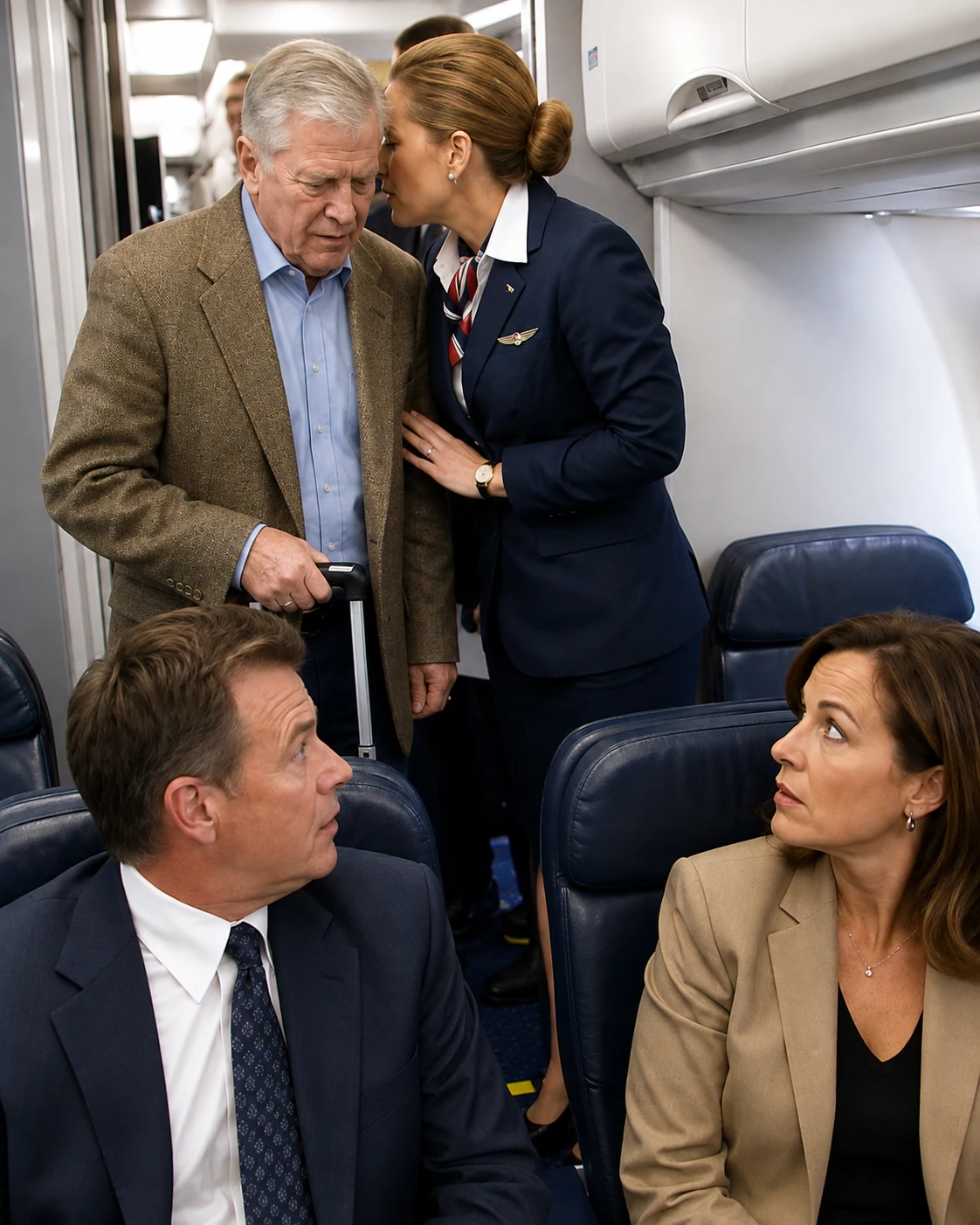
During Boarding, A Flight Attendant Quietly Told Me To Leave The Plane. I Thought She Had Mistaken Me For Someone Else, Until She Came Back And Whispered, “Please, I’m Asking You.” Twenty Minutes Later, My Son’s Face Told Me Everything.
“Pretend you’re feeling unwell and leave the plane,” the flight attendant whispered as I stepped into the cabin for what my son called a family trip to Miami. I almost laughed because it sounded impossible, the kind of thing you would expect from a late-night airport thriller, until she came back with worry in her eyes and said, “Please, I’m asking you.” Twenty minutes later, I was no longer on that plane, and my son’s face told me more than his words ever could.
My name is Francis Wilson, and for forty years I taught history to teenagers who thought the past was only a list of dates.
I used to tell them the same thing every September.
“People always leave evidence.”
They laughed because they thought I meant old letters, treaties, census records, dusty photographs in courthouse basements. They did not understand that evidence is often smaller than that. A pause held too long. A smile that arrives too quickly. A question placed where it does not belong.
That was how I first noticed something was wrong with Christopher and Edith.
They had lived in my house for eight months after Christopher lost his job. I never complained. He was my son. A father makes room. A father forgives awkward silences at the breakfast table, closed doors downstairs, and the way two grown adults can move through your home as if you are part of the furniture.
Then one afternoon, Edith appeared in my study with a sweetness I had never fully trusted.
“Francis, we need to talk.”
Christopher stood behind her, hands in his pockets, eyes everywhere but on me.
She said they wanted family time. He said Miami. A whole week. Their treat. Flights already arranged.
“Miami?” I asked. “You hated that trip when you were twelve.”
Christopher’s smile bent at the edge.
“I was a kid then, Dad. I see things differently now.”
That night, Edith cooked dinner.
She never cooked.
She moved through my kitchen with strange confidence, opening drawers, using my plates, watching me more than the food. Christopher poured wine and kept checking my face like he was waiting for a reaction.
Then Edith said it.
“Francis, your life insurance must be very organized, isn’t it? You’ve always been responsible with planning.”
My fork stopped halfway to my mouth.
“How do you know about that?”
“Oh,” she said, cutting her chicken into neat little squares. “Christopher mentioned it once.”
Across the table, my son stared down at his plate.
That was the first real marker.
Not proof.
Not yet.
Just a mark on the map.
The next week, they drove me to Orlando International Airport. Christopher claimed the trunk was too full, so I kept my carry-on on my lap, though I had seen the trunk open earlier and knew it was nearly empty. Edith sat in front, quiet and composed, checking the mirror too often.
At the gate, they boarded first.
I watched them disappear down the jet bridge without looking back.
When my group was finally called, I walked slowly, feeling each step more sharply than I should have. Airports are full of departures, but this one felt different. Too arranged. Too polished. Too final.
The cabin smelled of recycled air, coffee, and cleaning spray. Passengers were lifting bags into overhead bins. A child was asking for the window seat. Somewhere near the front, Christopher and Edith sat three rows ahead, their heads angled toward each other.
Then the flight attendant stepped close.
Her name tag said Mildred.
She took my boarding pass like she was checking my seat, leaned slightly toward me, and whispered, “Pretend you’re feeling unwell and leave this aircraft.”
I froze.
“Excuse me?”
She moved away before anyone could notice, smiling at another passenger as if she had only given a polite instruction.
I stood in the aisle, my hand tight on my carry-on handle.
Maybe I had misunderstood.
Maybe she had mistaken me for someone else.
Then she came back.
This time, the professional smile slipped just enough for me to see what was underneath.
Urgency.
“Sir,” she whispered, barely moving her lips, “I’m asking you. Please get off this plane now.”
That was when Christopher looked up.
“Dad?” he called. “Everything okay?”
His voice carried concern on the surface, but there was something sharper beneath it.
I made the decision in one breath.
My hand went to my chest.
“I don’t feel right,” I said.
The aisle seemed to tilt around me. I lowered myself carefully, making it look worse than it was, though the fear moving through me made the performance almost honest.
The crew gathered around.
“Sir, can you breathe normally?”
“Stay with us.”
“We need assistance at the front.”
Christopher stood too quickly.
Edith’s face changed for half a second before she remembered where she was.
Not worry.
Not concern.
Frustration.
Then the masks returned.
“Dad, should we come with you?” Christopher asked, loud enough for the nearby passengers to hear.
A crew member blocked the aisle.
“Please remain seated. We’ll take care of him.”
As they wheeled me backward toward the jet bridge, I passed close enough to hear Edith speak under her breath.
“This changes everything.”
Christopher answered quickly, almost without moving his mouth.
“Not here.”
The aircraft door stayed open behind us.
The terminal lights looked strangely bright after the cabin.
Twenty minutes later, I sat in a small airport medical room while Mildred closed the door and looked through the narrow window to make sure no one was listening.
Her hands were shaking.
“I need to show you something,” she said.
I straightened slowly.
“What did you hear?”
She swallowed.
“Enough to know you should not have stayed on that plane.”
Outside the room, through the glass, I could see the aircraft pulling away from the gate. My son and daughter-in-law were still on board, heading toward Miami without me, probably trying to understand how a quiet retired teacher had stepped out of the story they had written for him.
Mildred reached into her uniform pocket.
And when I saw what she had saved, I realized the flight was never the real destination.
It was only the first clue.
Her fingers trembled as she placed a folded cocktail napkin on the metal table between us.
For a second, I simply stared at it.
Blue airline logo.
A faint coffee ring near one corner.
Nothing dramatic.
Nothing that looked capable of destroying a family.
Then Mildred unfolded it.
Three lines had been written in black ink.
Room 417. After landing.
Call D. before hospital.
Do not let him sign anything sober.
My pulse slowed instead of quickening.
That is what fear sometimes does when it finally finds a shape.
“Where did you get this?”
Mildred sat across from me.
“From the floor beside your son’s seat.”
I looked up.
“I was helping a passenger with her bag before boarding finished. Your daughter-in-law dropped something from her purse. She didn’t notice. I bent down to pick it up.”
“And you read it.”
Her face flushed.
“I saw the word hospital first.”
She pushed the napkin toward me.
“Then I heard them.”
“What exactly?”
She hesitated.
“Your daughter-in-law asked whether you had brought your wallet.”
The room seemed colder.
“Christopher said yes.”
“He had my wallet?”
“I don’t know. He said, ‘It’s in the bag with his documents.’ Then she asked about a policy. He told her not to say the word out loud.”
I closed my eyes.
My carry-on.
The trunk had been almost empty, yet Christopher insisted I keep my bag with me.
Not generosity.
Control.
“What else?”
Mildred swallowed.
“She said if you refused to drink, they could still use the medication.”
My hand flattened on the table.
“What medication?”
“She didn’t say.”
“And then?”
“Your son said, ‘Once he’s admitted, we only need one signature.’”
The fluorescent lights hummed overhead.
I looked through the narrow window.
The aircraft was gone.
For one absurd moment, I pictured Christopher at eight years old asleep in the back seat after a school field trip, his cheek pressed against the glass.
Children do not grow into strangers all at once.
There are years between.
Years of excuses.
Years of interpreting selfishness as stress, entitlement as insecurity, cruelty as disappointment.
I looked back at Mildred.
“Did anyone else hear?”
“A passenger in 4C might have heard part of it.”
“Name?”
“I can get it.”
“No.”
She blinked.
“I don’t want you getting into trouble.”
Her chin lifted.
“Mr. Wilson, I watched your daughter-in-law ask whether you had taken your blood pressure medication this morning, and then your son told her it didn’t matter because ‘the doctor had already been arranged.’”
My stomach turned.
“Which doctor?”
“I don’t know.”
A knock came at the door.
Both of us froze.
An airport medical technician leaned in.
“Mr. Wilson? Airport police would like to speak with you.”
Mildred and I looked at each other.
“I didn’t call them,” she whispered.
Neither had I.
That frightened me more than if she had.
Two officers waited outside.
The older one introduced himself as Sergeant Luis Ramirez.
“Mr. Wilson, are you Francis Harold Wilson?”
“Yes.”
“Did you report luggage missing from Flight 482?”
“No.”
His expression changed.
“Your son did.”
I stared at him.
“What luggage?”
“A brown leather carry-on with your identification inside.”
Mildred inhaled sharply.
I had my carry-on.
It sat against the wall three feet away.
Ramirez looked at it.
“May I?”
I nodded.
He examined the tag.
FRANCIS H. WILSON.
Then he looked back at me.
“There’s another bag in your name on that aircraft.”
Every part of me went still.
“I don’t own another bag.”
That was the second clue.
And unlike the napkin, it was already moving thirty thousand feet above Florida.
Ramirez contacted the airline while I sat beside him.
The aircraft was in the air.
The crew could not safely conduct an extensive search without cause, but the captain was notified discreetly.
The additional bag had been checked at the gate.
By Christopher.
Using my boarding information.
“What was inside?” Ramirez asked.
“I have no idea.”
He studied my face.
“Any medications?”
“My prescriptions are in this bag.”
“Firearms?”
“No.”
“Cash?”
“No.”
“Legal documents?”
I stopped.
Ramirez noticed.
“What?”
“My son knows where I keep my estate binder.”
“What’s in it?”
“Will. Insurance information. Property records. Medical directives.”
Mildred whispered, “Oh God.”
I stood too quickly.
The room shifted.
Ramirez caught my elbow.
“Mr. Wilson.”
“I need my lawyer.”
“You have one?”
“Yes.”
“And I need someone to check my house.”
Christopher and Edith had lived there eight months.
They knew every room.
Every drawer.
Every lock.
I called my attorney, Jonathan Pierce.
He answered on the fourth ring.
“Francis?”
“Jonathan, I need you to listen carefully.”
By the time I finished, he had stopped interrupting.
“I’m going to your house.”
“No.”
“What?”
“Don’t go alone.”
Silence.
Then, “Understood.”
He contacted county law enforcement.
I called my neighbor, Ruth Bellamy, a retired principal who had lived across the street from me for twenty-two years.
“Ruth, are there cars at my house?”
She moved toward her window.
“One.”
“What kind?”
“White sedan. I don’t recognize it.”
My skin prickled.
“Anyone inside?”
“The curtains are closed.”
“They never are.”
Ruth’s voice changed.
“Francis?”
“Stay inside. Lock your door.”
“What happened?”
“I don’t know yet.”
That was the most truthful answer I had.
Forty minutes later, deputies entered my house with Jonathan present.
They found no intruder.
The white sedan belonged to a man named Dennis Vale.
He was upstairs in my study.
Not hiding.
Working.
He told police Christopher had hired him to “organize estate paperwork.”
Dennis was not an attorney.
He was a mobile notary.
On my desk sat copies of a revised power of attorney, a transfer-on-death deed, and medical guardianship documents.
None bore my signature.
Yet.
Jonathan called me from the hallway.
His voice was tight.
“Francis, you need to hear this from me.”
“I’m listening.”
“The deed transfers your house to Christopher upon execution.”
I gripped the phone.
“The house is already in my trust.”
“I know.”
“The trust goes to him eventually.”
“I know.”
“Then why would he need a deed?”
Jonathan was silent.
Because we both understood.
Eventually was not soon enough.
“What about the power of attorney?”
“Broad financial authority.”
“And the medical directive?”
Another pause.
“Names Christopher sole medical proxy.”
My throat dried.
“I named you secondary after Ruth.”
“Yes.”
“And Christopher was never on it.”
“No.”
I sat down.
Mildred watched me.
Ramirez stood near the door.
Jonathan continued.
“There’s another document.”
“What?”
“A letter drafted to your insurance company.”
My heartbeat became audible inside my head.
“Regarding what?”
“Changing beneficiary allocation.”
“To whom?”
“Christopher, one hundred percent.”
I closed my eyes.
My policy had three beneficiaries.
Christopher.
A scholarship fund named for my late wife, Helen.
And a small historical society where I had volunteered for years.
Christopher knew that.
He had complained about it once.
Only once.
I remembered the exact sentence.
Why leave money to strangers when you have family?
At the time, I called it grief talking.
Now the sentence felt excavated from a ruin.
“Jonathan.”
“Yes?”
“Take photographs of everything.”
“Already doing it.”
“Touch nothing unnecessarily.”
He was quiet for half a second.
Then he said, “Forty years teaching history and you still sound like you’re preserving a battlefield.”
“Evidence.”
“Yes.”
People always leave evidence.
The aircraft landed in Miami forty-eight minutes later.
Airport police were waiting.
Christopher called me before officers reached him.
I watched his name appear on my phone.
This time, I answered immediately.
“Dad.”
His breathing was fast.
“Where are you?”
“Orlando.”
“What?”
“I got off the plane.”
“I know that. Why didn’t you get back on?”
I looked at Ramirez.
“Medical advice.”
“Whose?”
“Mine.”
Silence.
Then Christopher softened his voice.
“Dad, you scared us.”
“No, I didn’t.”
Another pause.
“Excuse me?”
“You were annoyed.”
“What are you talking about?”
“Edith said it changed everything.”
The line went dead quiet.
Then Christopher said, “You misheard.”
“Did I?”
“Yes.”
“What was in the second bag?”
He stopped breathing.
There.
Not confusion.
Recognition.
“What second bag?”
“The one you checked under my name.”
“I don’t know what you’re talking about.”
“Christopher.”
His voice sharpened.
“You’re confused.”
That word.
Confused.
The oldest weapon used against an elderly person who still knows exactly what he saw.
“Am I?”
“Dad, you just had a medical episode.”
“I pretended.”
Silence.
I could almost see his face.
“What?”
“I wasn’t sick.”
His voice disappeared.
Then returned smaller.
“Why would you do that?”
“Because someone gave me a reason.”
He whispered something away from the phone.
Edith answered.
Not to me.
To him.
“What does he know?”
I smiled without humor.
“Enough.”
Christopher heard me.
“Dad, listen to me—”
“No.”
I had rarely said that word to him.
Not when he wanted a car at seventeen.
Not when he changed colleges twice.
Not when he needed money after the divorce from his first wife.
Not when he came home at forty-three and asked to live with me “for a month.”
Eight months later, I finally said it.
“No.”
He exhaled hard.
“Don’t do anything stupid.”
That was when Sergeant Ramirez held out his hand.
I gave him the phone.
“Mr. Wilson,” he said, “this is Sergeant Ramirez with airport law enforcement. You need to remain available to officers upon deplaning.”
Christopher hung up.
Twenty-seven minutes later, Miami police opened the second bag.
Inside were two bottles of liquor.
A pill organizer bearing my name.
A sealed envelope containing copies of the fraudulent estate documents.
A prepaid cell phone.
A hotel key packet.
And a prescription bottle labeled for me.
The drug inside was not mine.
The bottle contained a strong sedative.
The label had been forged.
I did not cry when Ramirez told me.
I took off my glasses.
Cleaned them.
Put them back on.
“What room?”
“417.”
The same room from the napkin.
The hotel reservation had been made in my name.
One night.
Not seven.
There was no family vacation.
There was only a staging point.
Investigators later reconstructed the plan from messages on the prepaid phone and Edith’s cloud backups.
Christopher and Edith intended to get me intoxicated in Miami.
If I resisted alcohol, the sedative was backup.
Dennis Vale, the notary, was scheduled to fly down that evening.
A man named Dr. Perry Kline had agreed to perform a private “capacity evaluation” at the hotel.
Kline had previously lost hospital privileges following complaints about questionable competency assessments in guardianship disputes.
The plan was crude and sophisticated at the same time.
Make me appear confused.
Obtain signatures.
Transfer control.
Then take me to a private hospital complaining of disorientation, medication misuse, and possible dementia.
Christopher would present himself as the devoted son forced to intervene.
Once he controlled my finances and medical decisions, he could move me into assisted living.
The house would be emptied.
The accounts consolidated.
The insurance revised.
And if my health declined after that?
Christopher would already hold every key.
The life insurance question at dinner had not been curiosity.
It had been inventory.
But the worst truth came two days later.
Jonathan found it.
He arrived at my house carrying a folder and looking ten years older than he had that morning at the airport.
“Sit down.”
I hated when people said that.
I sat.
He opened the folder.
“Christopher didn’t lose his job eight months ago.”
I stared.
“What?”
“He was fired.”
“For what?”
“Financial misconduct.”
My mouth dried.
“How much?”
“His employer claims approximately three hundred thousand dollars was diverted through vendor reimbursements.”
I closed my eyes.
“They didn’t prosecute?”
“Settlement and restitution. He signed a confidential agreement.”
“With what money?”
Jonathan looked at me.
That was the moment I knew.
“How much has he taken?”
“From you?”
“Yes.”
“We don’t know yet.”
Bank statements revealed the pattern.
Small transfers.
Then larger ones.
Christopher had online access to one household account because I trusted him to pay utilities during a surgery the year before.
He never surrendered access.
Over sixteen months, he moved nearly ninety thousand dollars through payment platforms.
Edith used my credit card for cash-equivalent purchases.
They opened a line of credit against one of my brokerage accounts using falsified electronic authorization.
And three weeks before the Miami trip, someone attempted to request an early payout option from my insurance policy.
Denied.
Because the signature did not match.
That denial had accelerated everything.
I sat at the dining table looking at numbers.
Not because the money mattered most.
Because each transfer corresponded to an ordinary day.
A Tuesday I had cooked Christopher breakfast.
A Friday Edith drove me to the dentist.
A Sunday we watched football.
Betrayal is hardest when it has timestamps.
Jonathan sat across from me.
“You need to decide how far you want to take this.”
I looked up.
“What do you mean?”
“Law enforcement already has enough for multiple investigations.”
“Then there is nothing to decide.”
He studied me.
“He is your son.”
“I know exactly who he is.”
My voice broke on the last word.
Jonathan looked down.
I pressed my palms against the table.
“I spent forty years teaching children that history becomes dangerous when people protect a preferred story from evidence.”
He waited.
“I cannot spend my final years doing exactly that because the evidence has my son’s name on it.”
Christopher called from custody.
I accepted.
The room smelled faintly of Helen’s old lavender polish because I had opened the cabinet where she kept it years ago and could not bring myself to close it.
“Dad.”
His voice sounded different.
No performance left.
“I need you to tell them this was a misunderstanding.”
“No.”
“You don’t understand what Edith did.”
I felt something cold move through me.
“What Edith did?”
“She planned most of it.”
“Christopher.”
“She pressured me.”
“Did Edith steal from my account?”
Silence.
“Did Edith forge the hotel reservation?”
“She handled—”
“Did Edith tell you to lie about losing your job?”
Nothing.
“Did Edith force you to check a bag under my name?”
“Dad.”
“Did Edith make you ask whether I had my wallet?”
He began crying.
I hated that I still recognized the sound from childhood.
“I was desperate.”
“Then you ask for help.”
“You would’ve said no.”
“You never gave me the chance.”
“I knew.”
“No.”
I stood.
“You assumed.”
His breathing shook.
“I didn’t want you dead.”
The room went completely still.
I had not asked.
That was evidence too.
“I didn’t say you did.”
Christopher inhaled sharply.
“I mean—”
“You just did.”
“No, Dad.”
“What exactly were you afraid would happen in Miami?”
He began speaking too fast.
“The medication wasn’t enough to hurt you. Kline said it would only make you drowsy. You were supposed to sign the documents, then we’d get you evaluated and—”
“And what?”
Silence.
“And what, Christopher?”
“You couldn’t keep living alone.”
I laughed once.
“I was living alone until you moved in.”
He started crying harder.
“I made a mistake.”
“No.”
I closed my eyes.
“You built a plan.”
That ended the call.
Edith talked first.
Faced with the messages, forged documents, notary arrangement, sedative, and financial records, she accepted a cooperation deal and blamed Christopher for initiating the scheme.
Christopher blamed Edith for escalating it.
Dennis blamed both.
Dr. Kline claimed he believed the assessment was legitimate until investigators produced texts discussing how much “confusion” was needed for a guardianship filing.
Every person in the plan attempted to become the least guilty person in the room.
None succeeded.
Christopher’s downfall did not come because I wanted revenge.
It came because he had documented his entitlement so thoroughly.
Messages about my house.
My accounts.
My policy.
My medical history.
One text to Edith stayed with me longest.
Old man thinks because he taught school he can read people.
Edith replied:
Then smile more.
I stared at that exchange for several minutes.
Then I laughed.
Not happily.
Just at the arrogance.
He thought history was what I taught.
He never understood it was how I survived.
At sentencing months later, Christopher looked older.
His shoulders had narrowed.
Edith sat separately.
Dennis had already pleaded.
Kline faced proceedings of his own.
The judge asked whether I wished to speak.
I stood.
My knees hurt.
I hated that detail.
There are moments in life when you want your body to rise with cinematic certainty.
Instead, at seventy-two, my left knee clicked.
I walked to the lectern anyway.
Christopher looked at me.
I had written four pages.
I used none of them.
“When my son was nine, he stole five dollars from my dresser.”
Christopher closed his eyes.
“I found him crying before I even knew the money was gone.”
The courtroom was silent.
“He gave it back.”
I looked at him.
“And I told him something I later repeated to thousands of students.”
His mouth trembled.
“People always leave evidence.”
I paused.
“I thought I was teaching him that wrongdoing is difficult to hide.”
My fingers tightened around the lectern.
“I wish I had also taught him that needing help is not wrongdoing.”
Christopher looked up.
“For years, I rescued him from consequences because I mistook relief for love.”
His face collapsed.
“But desperation does not excuse what he did.”
I breathed slowly.
“He did not simply steal money.”
I looked at the judge.
“He tried to steal authorship of my life.”
That sentence changed the air.
“My house. My medical decisions. My ability to speak for myself. My right to be believed.”
Christopher cried silently.
“I love my son.”
My voice broke.
“And I am asking this court not to confuse that love with permission.”
When I sat down, Mildred was behind me.
I had invited her.
She squeezed my shoulder.
Christopher received a prison sentence tied to fraud, attempted exploitation, identity-related offenses, conspiracy, and the financial crimes uncovered during the investigation.
Edith received less because of cooperation, but she still faced consequences.
Kline lost his license permanently.
Dennis lost his commission and was prosecuted for his role.
My money was partly recovered.
The rest was gone.
I sold nothing.
Changed no house.
Moved no room.
For the first time in eight months, my home became quiet again.
At first, the quiet hurt.
Christopher’s coffee cup remained in the cabinet.
Edith’s herb tea sat untouched.
A pair of his old running shoes stayed near the back door for three weeks because I could not decide whether throwing them away was anger or housekeeping.
Finally, Ruth came over.
She looked at the shoes.
Then at me.
“Francis.”
“What?”
“They’re shoes.”
“I know.”
“You’ve been staring at them like they’re evidence from Watergate.”
I laughed.
Then cried so suddenly I had to sit down.
Ruth sat beside me.
“I miss him.”
“I know.”
“I hate what he did.”
“I know.”
“Both feel wrong together.”
“They aren’t.”
I covered my face.
“He used to call me every Sunday when he was in college.”
Ruth rubbed my shoulder.
“That happened too.”
“He was not always this person.”
“No.”
“What happened?”
She waited.
Then said, “Maybe that’s the wrong question.”
I looked at her.
“What is the right one?”
“What happened doesn’t have to erase who he was. And who he was doesn’t erase what happened.”
Historian’s answer.
I smiled faintly.
“You’ve been listening.”
“For twenty-two years. Against my will.”
Mildred visited once too.
She refused the money I tried to give her.
“I didn’t save you for money.”
“I know.”
“Then stop insulting me.”
I laughed.
She smiled.
“What you can do is write the airline.”
“I did.”
“Good.”
“They’re recognizing you.”
Her eyes widened.
“What?”
I enjoyed that.
A month later, Mildred received a formal commendation for passenger safety intervention.
She called me furious.
“You did this.”
“I left evidence.”
“You’re impossible.”
“Occupational hazard.”
We became friends.
Not dramatic friends.
The better kind.
Christmas cards.
Occasional calls.
A photograph when her daughter graduated nursing school.
Two years passed.
Christopher wrote me every month from prison.
At first the letters were apologies shaped like arguments.
I didn’t know how desperate we were.
Edith convinced me.
I thought I was protecting you.
I stopped answering.
Six months later, the letters changed.
No excuses.
He began writing about the men he tutored for GED exams.
About reading.
About a history book I had given him when he was thirteen.
Then one letter arrived with a sentence I read five times.
Dad, I spent years thinking asking you for help made me weak, so instead I took from you and called it survival.
I answered that one.
Four words.
Now you’re telling the truth.
He wrote back.
I’m trying.
That became our relationship.
Trying.
Not healed.
Not restored.
Not erased.
Trying.
When Christopher was eventually released, I did not let him move back into my house.
He asked once.
I said no.
His face tightened.
Then he nodded.
“Okay.”
That mattered.
He rented a small apartment.
Found work managing inventory at a warehouse.
Paid restitution every month.
Slowly.
Painfully.
He came to dinner for the first time almost a year later.
He stood on my porch holding nothing.
No gift.
No flowers.
“Can I come in?”
I looked at him.
There was the son I remembered around his eyes.
And the man who had betrayed me everywhere else.
“Yes.”
He stepped inside.
He saw the dining table.
The chair where Edith had asked about my insurance.
His breathing changed.
“I can’t sit there.”
“Then don’t.”
We ate in the kitchen.
Sandwiches.
Not a reconciliation feast.
Just food.
Halfway through, Christopher put down his fork.
“I remember the night before Miami.”
“So do I.”
“I kept waiting for you to notice.”
My hands stopped.
“What?”
He stared at the table.
“I think part of me wanted you to.”
I said nothing.
“I left things wrong.”
“What things?”
“The trunk.”
My skin prickled.
“I made sure you saw it was empty.”
I stared.
“You told Edith about the policy at dinner.”
“Yes.”
“You looked at me when she asked.”
“Yes.”
“Why?”
His eyes filled.
“Because I was a coward.”
I waited.
“I couldn’t stop the plan.”
“Yes, you could.”
“I know.”
His face crumpled.
“I mean I felt like I couldn’t. And some part of me kept leaving doors open, hoping you’d walk through one.”
I thought of history.
Evidence.
A mark on a map.
A pause.
A wrong smile.
The empty trunk.
Not mistakes.
Not exactly.
A conscience leaking through.
That did not absolve him.
But it changed the shape of what I remembered.
“Christopher.”
He looked up.
“You still chose.”
“I know.”
“And Mildred saved me.”
“I know.”
“Not you.”
Tears slid down his face.
“I know.”
I leaned back.
“But maybe some part of you had not completely disappeared.”
He covered his eyes.
That was as much mercy as I could give.
It was enough.
The last surprise came on my seventy-fifth birthday.
Ruth organized a dinner at the old high school.
I expected fifteen people.
There were more than a hundred.
Former students.
Teachers.
Parents.
Mildred came from Atlanta.
Jonathan sat near the front.
Christopher stood at the back.
I almost left.
Not because of him.
Because I hated surprises.
Then one of my former students, now a history professor, stepped to the microphone.
“Mr. Wilson taught us that people always leave evidence.”
Laughter moved through the room.
“He probably doesn’t remember saying it four thousand times.”
“I do,” I called.
More laughter.
She smiled.
“So we brought some.”
A screen lit behind her.
Photographs.
Old yearbooks.
Letters.
College acceptance notes.
A firefighter who had written that my class made him the first person in his family to graduate high school.
A woman who became a lawyer because I once wrote in the margin of her essay:
You argue well. Learn the law.
Then came a photograph I had never seen.
Christopher at twelve years old, sitting in the back row of my classroom after school.
I stood at the blackboard.
On it, in chalk, were the words:
HISTORY IS WHAT WE DO WITH WHAT HAPPENED.
My throat closed.
The professor smiled.
“Your son sent us that.”
I turned.
Christopher stood near the doors.
He did not smile.
He simply looked at me.
That was the final piece.
For years, I told students evidence preserved the past.
But that photograph reminded me of something deeper.
Evidence does not only prove wrongdoing.
It proves love happened too.
It proves laughter happened.
Effort.
Failure.
Repair.
The terrible thing about betrayal is that it tries to rewrite everything before it.
Make every birthday false.
Every hug suspicious.
Every good memory naïve.
I had refused to let Christopher rewrite my future.
Now I realized I did not have to let his crime rewrite my past either.
At the end of the dinner, he approached.
“Happy birthday, Dad.”
“Thank you.”
“You liked the picture?”
“I hated my haircut.”
He laughed.
So did I.
Then silence.
“Christopher.”
“Yes?”
“I remember that day.”
His face softened.
“You were waiting for Mom.”
Helen.
His mother.
My wife.
She had been late picking him up.
“Yes.”
“You complained for an hour.”
“I was twelve.”
“You were unbearable.”
He smiled.
Then looked down.
“I miss her.”
“So do I.”
We stood there.
No grand embrace.
No declaration that everything was fixed.
Healing rarely behaves for audiences.
I touched his shoulder.
He covered my hand with his.
That was enough.
Later, I drove home alone.
The porch light glowed warm against the dark.
Inside, my house smelled faintly of books and cedar.
I went to the study.
On the desk sat the photograph from the birthday presentation.
Christopher had left me a copy.
I placed it beside Helen’s picture.
Then I noticed something written on the back.
His handwriting.
Dad,
You were right.
People leave evidence.
I’m trying to leave better evidence now.
C.
I sat down.
For a long time, I looked at those words.
Then I smiled.
Outside, wind moved softly through the trees.
No airport announcements.
No engines.
No whispered warning.
Just home.
I thought of Mildred leaning toward me in that aisle.
Please get off this plane now.
At the time, I believed she had saved me from a flight.
Later, I thought she had saved me from Christopher.
Eventually, I understood the truth.
She had saved me from surrendering my own authority before I knew it was under attack.
But the rest?
The calls.
The records.
The questions.
The decision not to protect my son from evidence simply because I loved him.
Those were mine.
So was the decision years later to let him become more than the worst thing he had done without pretending that thing had never happened.
History is not forgiveness.
It is not punishment either.
It is memory disciplined by truth.
I turned off the study lamp.
Before leaving the room, I looked once more at Christopher’s note.
Better evidence.
That was enough for me.
The next morning, my phone rang.
Mildred.
“Francis, are you awake?”
“I taught teenagers for forty years. Of course I’m awake.”
“You’re impossible.”
“So I’ve been told.”
She laughed.
Outside my window, sunlight touched the oak trees.
I carried my coffee onto the porch.
A car pulled up.
Christopher got out.
He stopped at the walkway.
He did not reach for the spare key I no longer kept outside.
He did not assume.
He waited.
Then he raised one hand.
I looked at him.
He called, “Can I come up?”
I smiled.
“Yes.”
He climbed the steps.
Two cups of coffee.
One quiet morning.
No hidden bag.
No false document.
No destination arranged without my consent.
And when he sat beside me, he did not ask what I owned, what I had insured, or what would one day be his.
He asked me something much simpler.
“Dad, tell me about Mom when you first met her.”
I looked toward the trees.
Then I began.
And this time, the story belonged to me.