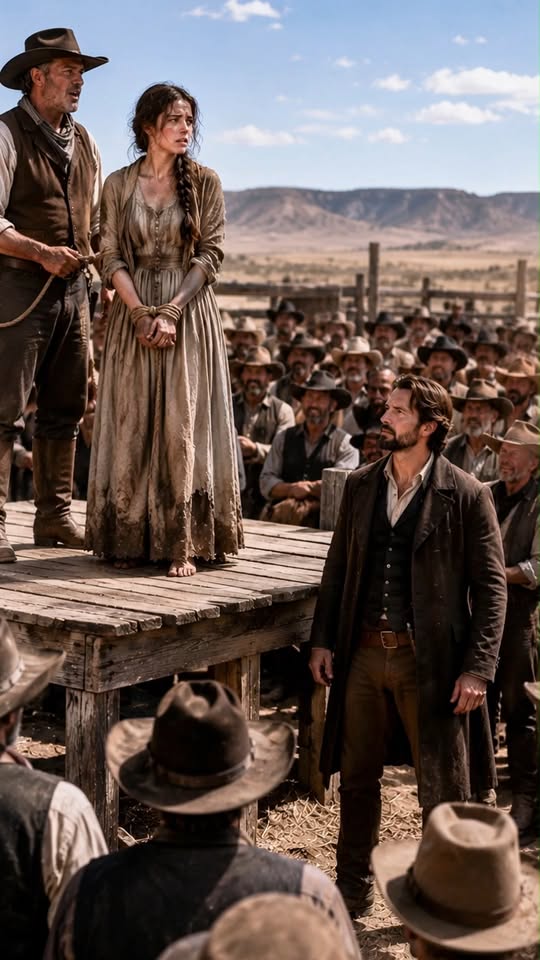
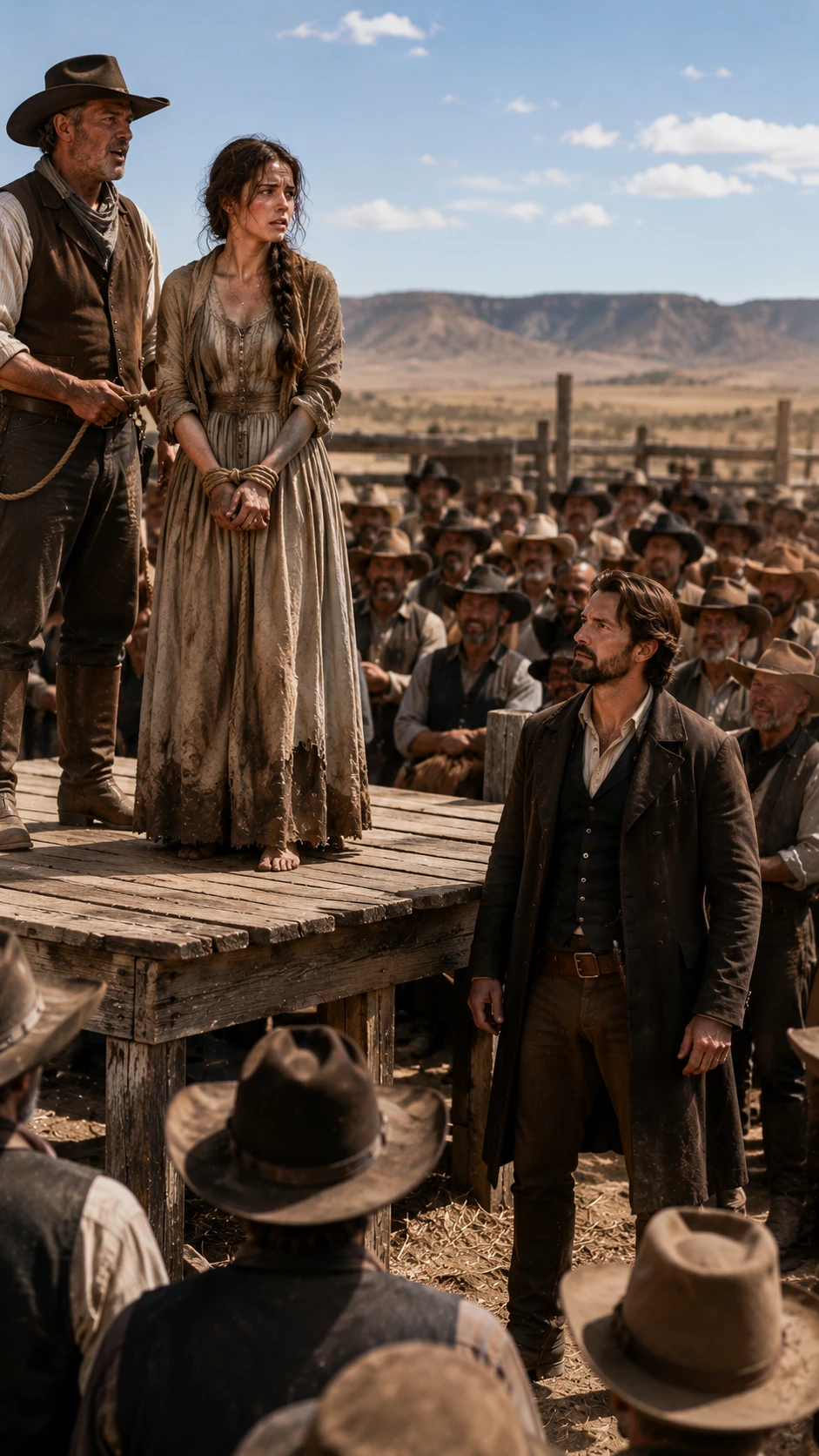
Nobody at the Dry Hollow auction intended to save Clara Vale.
The crowd had gathered beneath the punishing Texas sun for horses, cattle, tools, and cheap bargains. Dust hung over the yard like smoke. Men shouted prices from beneath sweat-darkened hats. Children climbed fences for a better view while traders laughed over animals with cracked hooves and tired eyes.
Then the wagon arrived.
A heavyset man in a brown vest climbed down first. He dragged a young woman after him by a rough rope looped around her wrists.
The laughter changed.
Not louder.
Crueler.
The living view of that terrible afternoon seemed to push through the restless crowd, tracking past boots, wagon wheels, and cattle pens until it found Clara standing barefoot on the raised platform. Her dress had once been pale gray, but dust and travel had turned it the color of old ash. Dark hair hung in a loose braid over one shoulder. A bruise shadowed her jaw.
She kept her eyes lowered.
The trader yanked the rope.
“Stand straight.”
Clara nearly fell.
A man near the front chuckled. “She looks half-dead already.”
“Same price as a mule!” the trader shouted. “Strong arms, healthy teeth, knows fieldwork, laundry, sewing, and cooking. Who’s bidding?”
More laughter.
Clara said nothing.
She had learned silence could sometimes reduce the length of a beating.
Not prevent it.
Only shorten it.
The trader grabbed her chin and forced her face toward the crowd.
That was when Mason Callaghan stopped walking.
He had come to buy two geldings for his ranch west of town. He was thirty-nine, broad-shouldered, dark-haired, and known for speaking only when words were necessary. His wife, Ruth, had died five years earlier from fever, leaving behind a house that sounded too large at night.
Since then, Mason had worked.
He repaired fences.
Raised cattle.
Built a second barn.
And avoided every woman whose family tried to arrange a meeting at church.
Now he stood among ranchers and drovers, unable to look away from the woman on the platform.
Clara finally lifted her head.
Her green-gray eyes found his.
Fear lived there.
But so did anger.
Not wild anger.
Not hopeless rage.
Something disciplined.
A flame hidden beneath wet wood.
Mason had seen that look once before—in his own mirror the morning after burying Ruth.
The trader pulled the rope again.
“Who’ll give me fifty dollars?”
Someone called, “Twenty!”
The crowd laughed.
“Thirty and a sack of feed!”
Clara’s face did not change, but her hands closed into fists beneath the rope.
Mason stepped forward.
“I’ll take her.”
The yard fell silent so quickly that the creak of the platform boards became audible.
The trader stared.
A few men turned toward Mason as though he had spoken in another language.
“You sure, Callaghan?” someone asked. “Didn’t know you were buying trouble.”
Mason removed a leather purse from his coat.
“I’m not buying anything.”
The trader narrowed his eyes.
“Then step aside.”
Mason counted out the money.
“You said fifty.”
The trader’s expression brightened.
Mason placed the coins in his palm.
The trader sliced the rope and shoved Clara forward.
She stumbled off the platform.
Mason caught her before she struck the dirt.
Clara flinched so hard that her elbow hit his chest. She raised one arm over her face and twisted away.
Mason released her immediately.
“I won’t hurt you.”
She stared at him.
He bent, picked up the cut rope, and dropped it into the dirt.
“You are not tied to me.”
The trader laughed behind them.
“She belongs to you now.”
Mason turned.
His voice remained low.
“No one belongs to me.”
Something in his expression ended the laughter.
He wrapped a blanket around Clara’s shoulders, gave her water, and helped her into his wagon without touching her again.
They traveled west beneath a sky burning gold and crimson.
For nearly two hours, Clara said nothing.
Mason did not press her.
The one continuous movement of the evening seemed to flow beside the wagon, circling the turning wheels, rising past the horses’ shoulders, then settling on Clara’s hands clenched around the blanket.
At last, she whispered, “Clara.”
Mason glanced toward her.
“That your name?”
She nodded.
“I’m Mason.”
“I heard.”
There was the faintest edge in her voice.
He almost smiled.
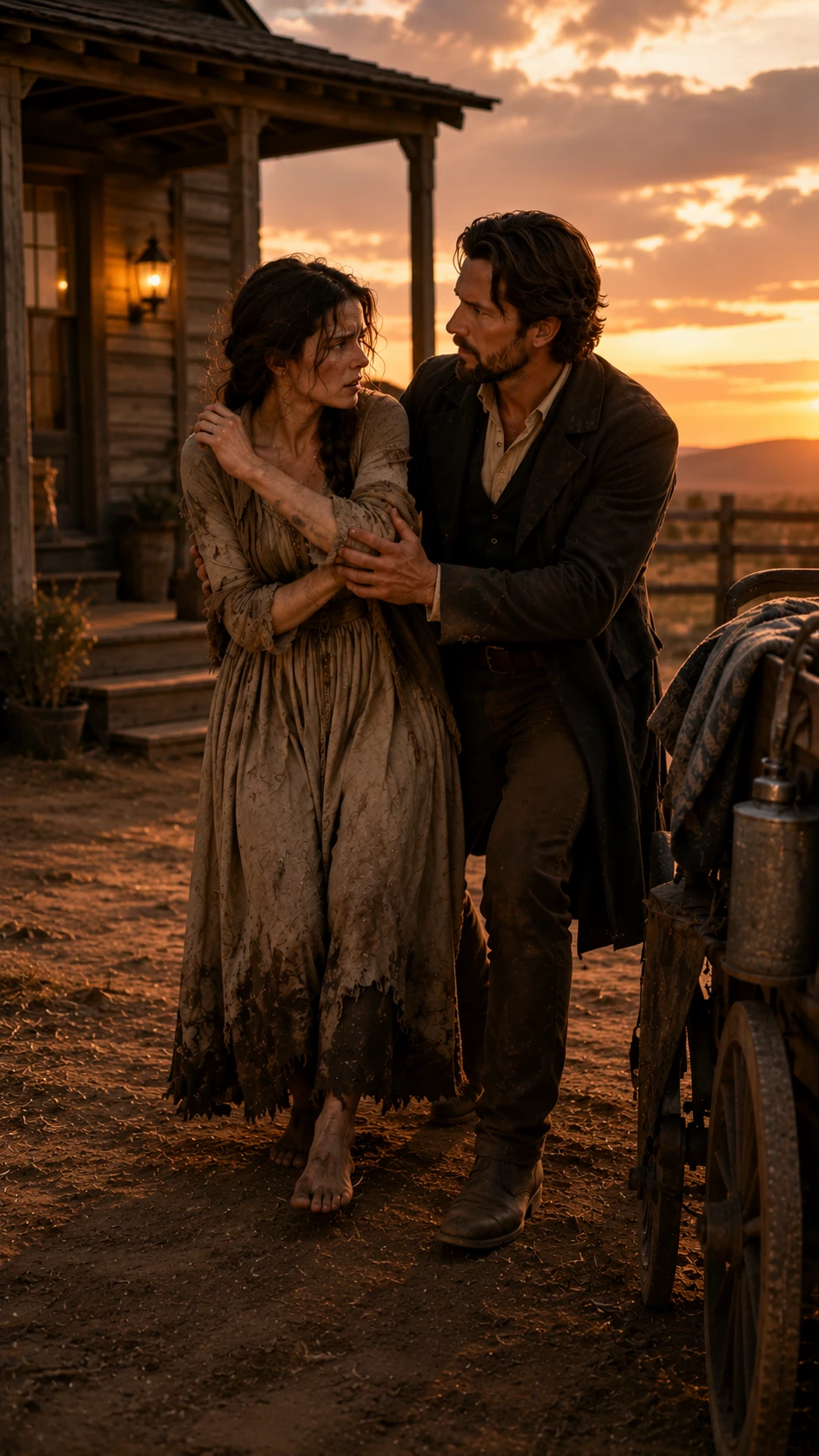
By the time they reached the Callaghan ranch, the sun had sunk behind the low hills. Mason guided the wagon toward a sturdy farmhouse beside a long barn and a windmill turning slowly against the red sky.
Clara looked at the house.
“Where do I sleep?”
“There’s a room upstairs.”
“And what do you expect?”
“Tonight?”
She nodded.
“Supper.”
She studied him carefully.
“After that?”
“Sleep.”
Suspicion tightened her face.
Mason climbed down.
“You can lock the door from inside.”
He carried her small bundle to the porch, then stopped several feet away while she descended.
Inside, he showed her the kitchen, the water pump, the pantry, and the narrow staircase.
“The blue room is yours.”
Clara looked toward the front door.
“What if I leave?”
“I won’t stop you.”
“Then why did you pay?”
“Because the trader wouldn’t untie you for free.”
“That makes no sense.”
“Most decent things don’t make financial sense.”
For the first time, her mouth almost curved.
Almost.
The following morning, Mason woke before dawn and found the kitchen swept, bread dough rising beside the stove, and Clara carrying a bucket toward the chicken yard.
“You don’t have to work,” he said.
She kept walking.
“Yes, I do.”
“No.”
She stopped.
“If I don’t earn my food, you’ll change your mind.”
“About what?”
“About being kind.”
The words struck him with quiet force.
Mason moved no closer.
“Kindness that requires payment is not kindness.”
Clara looked away.
Over the next weeks, she worked anyway.
She mended shirts with neat, tiny stitches. She cleaned windows that had remained cloudy since Ruth’s death. She reorganized the pantry and discovered mice had eaten through two flour sacks.
Mason never ordered her.
Clara never asked permission.
They moved around each other cautiously, like two wounded animals learning that the same shelter could hold both of them.
She began wearing boots Mason left outside her door. Then she accepted a new blue dress from Mrs. Alvarez, the neighboring widow, though she insisted on paying for it through sewing.
One evening, Mason returned from the north pasture and heard laughter coming from the kitchen.
He stopped at the threshold.
Clara stood with flour on her cheek while Mrs. Alvarez told a ridiculous story about a rooster chasing the town preacher through a funeral procession.
Clara laughed again.
The sound filled the house.
For one unbearable second, Mason remembered Ruth.
Then the memory loosened rather than sharpened.
Clara noticed him.
Her laughter faded.
Mason removed his hat.
“Don’t stop on my account.”
She wiped flour from her face.
“You’re late.”
“One cow decided fences were suggestions.”
“There’s stew.”
That was all.
But the word stew sounded dangerously close to home.
Soon, Mason began noticing other things.
Clara avoided coffee in the morning because the smell made her pale. She pushed meat around her plate. While hanging laundry, she sometimes stopped and pressed one hand against her stomach.
He asked whether she was ill.
She denied it.
Then she began waking before dawn to vomit behind the barn.
Mason heard her once from the porch.
He found her gripping the fence, breathing hard.
“I’m getting Dr. Bell.”
“No.”
“You’re sick.”
“I’m not sick.”
“You can barely stand.”
She turned toward him, fear flashing across her face.
“Do not bring a doctor here.”
Mason stopped.
“Why?”
Clara backed away.
“I said no.”
He let her go.
But the unease remained.
Three days later, she nearly collapsed in the barn.
A feed bucket struck the floor with a metallic crash. Horses shifted nervously in their stalls as Mason ran inside.
Clara clung to a post.
Her knees buckled.
He reached her just before she fell.
This time, she did not pull away.
Her face was white.
“Clara.”
“I’m fine.”
“That lie is getting worse.”
Tears filled her eyes.
She placed both hands over her stomach.
“I have to tell you something.”
Mason became very still.
Clara lowered her voice.
“I’m carrying a child.”
The barn seemed to contract around them.
Mason’s gaze moved to her hands.
“How far?”
“Nearly five months.”
Five months.
He calculated.
She had been pregnant at the auction.
Clara watched him brace for disgust.
Instead, he asked, “Does the child’s father know where you are?”
Her breath caught.
“Yes.”
“Will he come?”
“I don’t know.”
“Do you want him to?”
“No.”
The answer came too quickly to doubt.
Mason led her to a hay bale.
“Sit.”
She obeyed, trembling.
“Who is he?”
Clara closed her eyes.
“Silas Vale.”
Mason knew the name.
Everyone did.
Silas Vale owned half the warehouses along the Red River and controlled freight contracts across three counties. He donated to churches, financed political campaigns, and buried enemies beneath lawsuits rather than soil.
“He’s your husband?” Mason asked.
“No.”
Her shame was immediate.
Mason crouched several feet away.
“Then what happened?”
Clara’s fingers tightened over her dress.
“I worked in his house as a companion to his daughter, Amelia.”
Mason waited.
“One night he came into my room.”
Her voice nearly disappeared.
“He said no one would believe a servant over him.”
Mason’s jaw locked.
Clara continued before courage abandoned her.
“When I became pregnant, he sent me away. But his wife learned the truth.”
“Did she help you?”
Clara gave a broken laugh.
“She offered me money to disappear. I refused because I wanted him exposed.”
Mason’s eyes hardened.
“The auction.”
Clara nodded.
“Silas had me arrested for theft. The trader was supposed to take me south before the circuit judge arrived.”
“You were sold to prevent you from testifying.”
“Yes.”
“Why didn’t you tell me?”
“Because anyone who helps me becomes his enemy.”
Mason rose.
“He should have thought of that before making you mine.”
Clara flinched.
He caught the mistake instantly.
“No. Not mine.”
His voice softened.
“My responsibility.”
“That is still dangerous.”
“So is letting him continue.”
Clara stood.
“You don’t understand. Silas does not lose.”
A voice came from the barn entrance.
“That is true.”
Mason turned.
Silas Vale stood beneath the open doors with Sheriff Dodd beside him and four armed men behind them.
He wore a black coat, polished boots, and a silver watch chain across his vest. His hair was neatly combed despite the dust.
Clara went rigid.
Silas smiled at her.
“There you are.”
Mason moved between them.
“You are trespassing.”
Sheriff Dodd unfolded a paper.
“We have a warrant for the woman.”
“On what charge?”
“Theft of private documents.”
Clara whispered, “I took nothing.”
Silas’s smile widened.
“That is not entirely true.”
His gaze dropped toward her stomach.
“You took something.”
Mason stepped forward.
The hired men lifted their rifles.
Silas raised one hand, and they lowered them again.
“Callaghan, you’ve made an understandable mistake. Hand her over, and I will repay what you spent.”
Mason looked at Clara.
Her face had gone blank in the way of someone leaving her own body to survive.
He turned back to Silas.
“No.”
Sheriff Dodd cleared his throat.
“This is lawful business.”
Mason pointed toward the paper.
“Read the judge’s name.”
Dodd hesitated.
“Read it.”
The sheriff folded the warrant.
Silas’s patience thinned.
“I came here peacefully.”
“You came armed.”
“I came prepared.”
“So did I.”
Mason gave a sharp whistle.
From the loft above, two ranch hands rose with rifles. Mrs. Alvarez appeared behind the corral wall holding a shotgun, her gray hair pinned beneath a wide hat.
Silas looked around.
“You would risk your ranch for her?”
Mason’s answer was immediate.
“Yes.”
Clara stared at him.
Silas laughed.
“Do you even know what she carries?”
“A child.”
“My child.”
“No,” Clara said.
Everyone turned.
She stepped out from behind Mason.
Fear shook her body, but she remained standing.
Silas studied her.
Clara’s voice grew steadier.
“You have no claim to either of us.”
His expression chilled.
“I have blood.”
“You have evidence.”
Silence.
Mason looked at her.
Silas’s eyes narrowed.
“What evidence?”
Clara reached beneath the loose board beside the feed stall.
She pulled out a narrow leather book.
Silas went pale.
The ledger contained dates, payments, names, and coded entries documenting bribes, stolen freight, fraudulent land transfers—and payments made to Sheriff Dodd.
Dodd stared at it.
“You said she didn’t have the book.”
Silas turned toward him.
“Be quiet.”
The sheriff’s hand moved toward his pistol.
Silas drew first.
The gunshot exploded through the barn.
Dodd fell against the doorway, clutching his shoulder.
Horses screamed.
The hired men raised their rifles.
Mason grabbed Clara and pulled her behind the stone water trough as bullets tore through the stalls.
The camera of the moment seemed to plunge with them, sweeping low beneath flying splinters, rising as Mason returned fire, then circling the frantic movement without ever breaking.
Mrs. Alvarez fired from outside.
One gunman dropped his weapon and ran.
Mason’s ranch hands forced two others behind the hay wagon.
Silas crossed the barn toward Clara.
“Give me the ledger.”
She held it against her chest.
“You’ll have to kill me.”
“I should have done that months ago.”
He raised his pistol.
Mason tackled him.
They crashed into the stall gate.
The gun skidded across the floor.
Silas struck Mason with the silver handle of his riding crop. Mason staggered.
Silas drew a knife.
Clara saw it first.
“Mason!”
Silas drove forward.
Mason caught his wrist, but the blade hovered inches from his throat.
Clara picked up the fallen pistol.
Her hands shook.
Silas looked at her.
“You won’t do it.”
Clara aimed.
“No,” she said. “But I will make sure everyone sees who you are.”
She fired into the barn bell above the doors.
The bell rang violently.
Once.
Twice.
Again and again.
It was the emergency signal used throughout the valley.
Riders would hear it.
Neighbors would come.
Silas’s face twisted.
He shoved Mason away and lunged toward Clara.
Then another voice cut through the barn.
“Stop.”
A young woman stood at the entrance.
She wore a burgundy travel dress and held a small revolver in both hands.
Silas froze.
“Amelia.”
His daughter stepped inside.
Behind her stood Circuit Judge Harland and two territorial marshals.
Amelia’s eyes moved toward Clara’s stomach.
Then to her father.
“I found the letters you wrote to Sheriff Dodd.”
Silas lowered his knife.
“You don’t understand.”
“I understand everything.”
Clara stared at Amelia.
“You knew?”
“Not at first.”
Amelia’s voice broke.
“I thought you had stolen from us. Then I found my mother’s journal.”
Silas’s face changed.
For the first time, true fear appeared.
Amelia reached into her bag and removed a folded document.
“My mother knew about every girl.”
The barn went silent.
Every girl.
Clara’s knees weakened.
Mason moved beside her.
Amelia handed the document to Judge Harland.
It was a list of women who had worked in the Vale household over eighteen years.
Seven had disappeared.
Three had died under suspicious circumstances.
Two had been sent to institutions.
Clara had not been the first.
She had only been the first to escape with proof.
Silas looked toward the open field beyond the barn.
The marshals blocked his path.
Judge Harland took the ledger from Clara and opened it.
His expression darkened.
“Silas Vale, you are under arrest for conspiracy, fraud, kidnapping, assault, and murder.”
Silas looked at Clara with hatred.
“You think this ends with me?”
Clara held his gaze.
“No.”
She placed one hand over her stomach.
“It begins with me.”
Months later, the trial became the largest scandal Texas had seen in years.
Sheriff Dodd testified in exchange for leniency.
The trader who had placed Clara on the auction block was sentenced for kidnapping.
Several officials named in the ledger resigned before warrants reached them.
Silas Vale was convicted.
His wife’s journal revealed one final secret.
Amelia was not his biological daughter.
She had been born to one of the missing housemaids and secretly raised by Silas’s wife after the woman died.
Silas had spent years controlling Amelia with a blood claim that had never existed.
The man obsessed with ownership had no lawful claim to either young woman.
Clara gave birth during a thunderstorm in Mason’s farmhouse.
A daughter.
Mason waited outside the room for seven hours, pacing so constantly that Mrs. Alvarez threatened to nail his boots to the porch.
When Clara finally called him inside, she was pale and exhausted, holding a tiny child wrapped in white cloth.
Mason stopped at the bedside.
“She’s beautiful.”
Clara looked down at the baby.
“I named her Ruth.”
His breath caught.
“After your wife.”
Mason sat carefully.
“You didn’t have to.”
“She was loved here before me. I don’t want love to require erasing someone else.”
Tears filled his eyes.
Clara placed the baby in his arms.
Ruth opened one hand and closed it around his finger.
Mason’s face crumpled.
He had believed fatherhood had passed him by.
Now a child he had no blood claim to held him as though she had chosen him.
A year later, Mason asked Clara to marry him.
Not in the barn.
Not during a crisis.
Not because she needed protection.
He asked beneath the cottonwood tree at sunset after Ruth had fallen asleep inside.
Clara studied him.
“If I say no?”
“You keep the house, the room, and every choice you have now.”
“And if I say yes?”
“I spend the rest of my life proving I know the difference between loving someone and owning them.”
She smiled.
Then she said yes.
But the final surprise came eighteen years later.
After Silas died in prison, a sealed document was delivered to Ruth Callaghan.
It contained proof that Clara’s father had once been Silas Vale’s business partner.
The land, warehouses, and fortune Silas claimed as his own had originally belonged to Clara’s family. After her father’s suspicious death, Silas forged the transfer papers and reduced Clara’s widowed mother to poverty.
Clara had not been a servant by birth.
She had been the rightful heir to everything Silas built.
The young woman he placed on an auction block had legally owned the auction yard itself.
Clara stood beneath the weathered platform years later, holding the original deed.
Mason waited beside her.
“What will you do with it?” he asked.
She looked across the land where frightened people had once been treated as property.
“Destroy it.”
“The deed?”
“The yard.”
Within a year, the auction platform was gone.
In its place stood a school, a clinic, and a safe house for women with nowhere else to go.
Above the entrance, Clara placed a simple sign:
NO PERSON IS FOR SALE.
And every time someone asked how the place began, she told them the truth.
A crowd had looked at her and seen labor.
A trader had seen money.
Silas had seen something he could control.
But one lonely rancher had looked into her eyes and seen a human being.
That single act had not rescued her.
It had given her room to rescue herself.