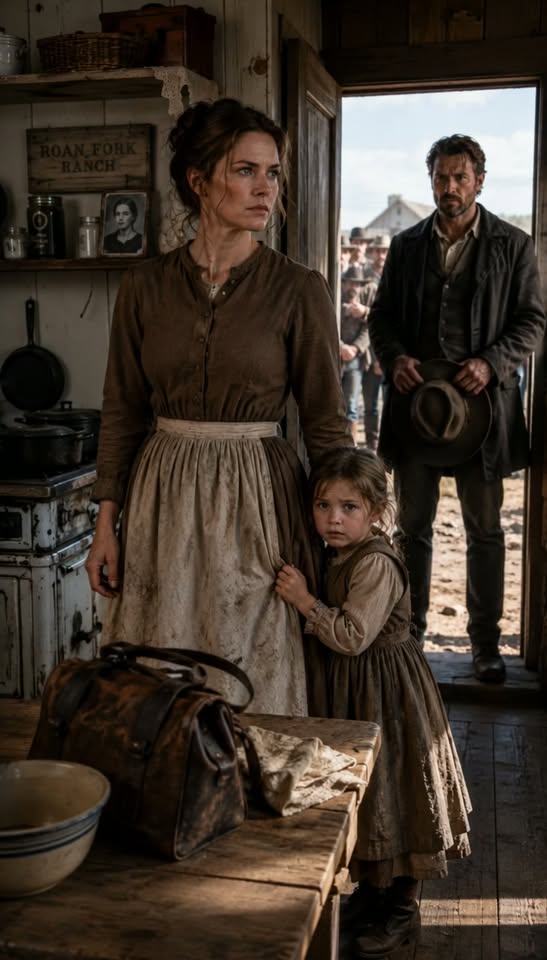
Pearl’s little hand had already twisted itself into my skirt before the wagon wheels stopped turning.
She was only five, thin as prairie grass after drought, but she had learned too early that **new doors did not always mean new mercy**. I climbed down first in my faded brown dress, gripping my carpetbag so tightly my darned gloves creaked around the handle.
Then I lifted my daughter from the wagon and set her small boots on the hard earth of Roan Fork Ranch.
The place stood before us like a judgment—gray boards, silent windows, and a Wyoming wind sharp enough to slice through wool. In the doorway, Wesley Tate held his hat in both hands and stared at me as if the storm had not arrived from the sky, but from the wagon.
He had sent away for a wife, but not for love.
I knew that before he spoke.
Behind him, the house smelled of dust, old grief, and work no one had touched since sorrow first entered it. His dead wife’s sewing basket still sat above the sink. A dirty pan waited beside a cold stove. Flour dust coated the shelves, and no bread had risen in that kitchen for longer than any man there cared to admit.
The hired hands gathered behind Wesley like crows on a fence.
They did not look at Pearl with pity.
They looked at me with the quiet hunger of men waiting for humiliation to begin.
The wagon boss gave it to them.
Silas Rudd was a heavy man with narrow eyes and a scar running from his left ear to his jaw. He let out a low laugh and said, loudly enough for everyone to hear, “Thought Wes ordered a cook, not somebody’s worn-out aunt.”
Several men chuckled.
Pearl’s fingers tightened in my skirt until I felt her nails through the cloth.
I did not look down. I did not flinch.
Cruel men always watched a woman’s face after wounding her, hoping to see the cut open.
**My silence was not courage. Not yet. It was survival, practiced in rooms where a woman had to keep her mouth steady while her heart bled.**
For one brief second, shame flickered across Wesley Tate’s face. Then he buried it beneath the hard voice men used when apology felt too much like weakness.
“The wagon heads back Monday noon,” he said. “You can think on whether you mean to be on it.”
I looked past him.
At the dead woman’s basket.
At the cold stove.
At the old flour-sack apron hanging from a nail beside the pantry.
May you like

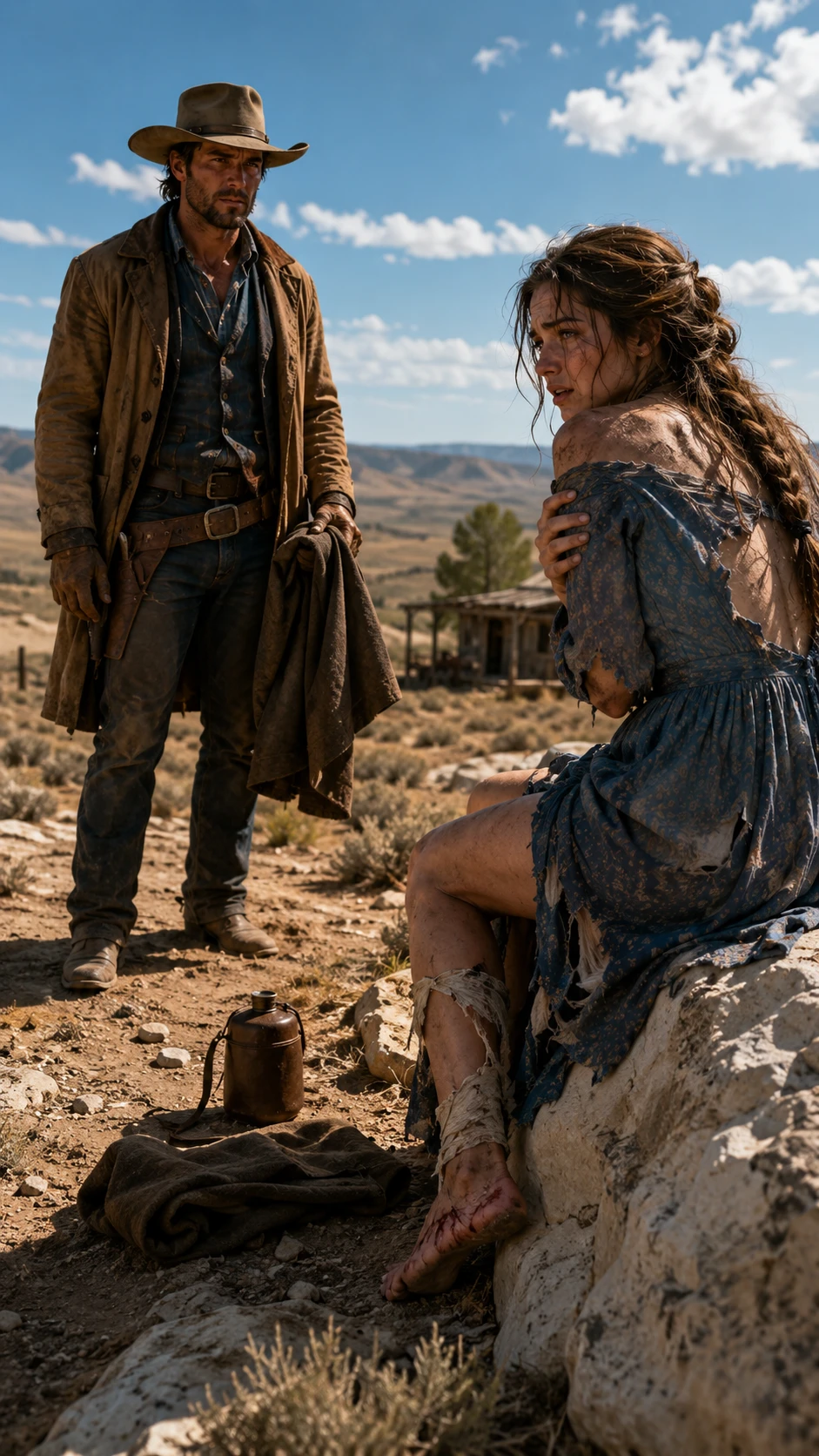
Then I looked at the man who had brought Pearl and me across two states without deciding whether he truly wanted us.
“I’ll cook supper tonight,” I said. “Then you can decide what you decide.”
No pleading.
No tears.
No promise that I would shrink myself small enough to fit his disappointment.
Pearl stayed beside me, silent as a shadow. The men smirked as if the ending had already been written and I was simply too tired to know it.
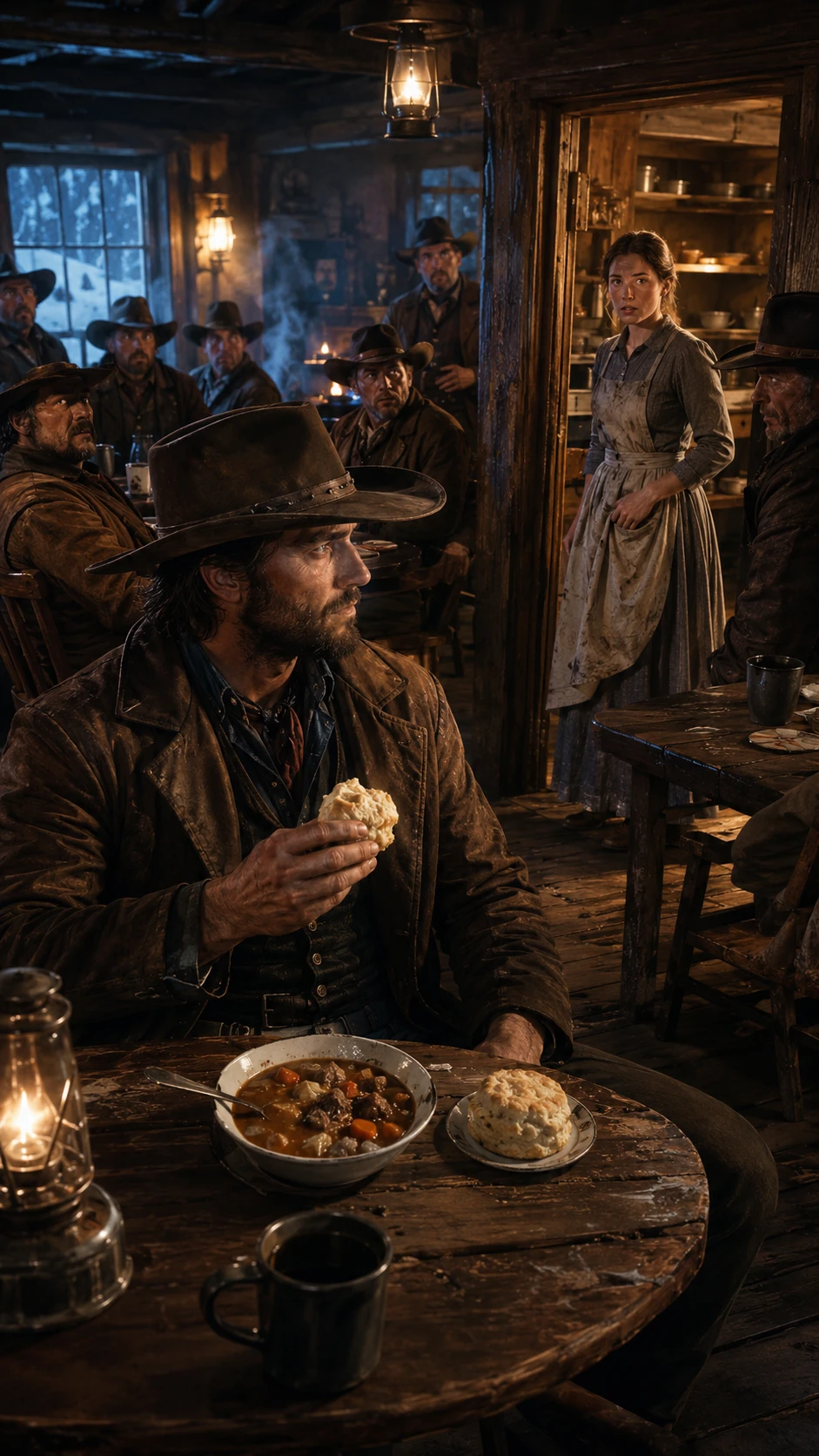
That evening, I made stew from salt pork, potatoes, and onions. I baked biscuits in a stove whose left hinge was broken and whose chimney smoked whenever the wind shifted east.
The men stopped laughing after the first bite.
Nobody praised me. Men like them considered silence a compliment.
But every bowl came back scraped clean.
Wesley ate alone at the far end of the table. Once, I caught him watching Pearl tear a biscuit in half and carefully save one piece inside her apron pocket.
“For later?” he asked her.
Pearl lowered her eyes.
“For Mama,” she whispered. “In case tomorrow is bad.”
Something changed in Wesley’s face.
It vanished before I could name it.
That night, Pearl and I slept in a narrow room beneath the stairs. I waited until her breathing softened before opening my carpetbag.
Beneath two dresses and a Bible lay a silver locket, a folded affidavit, and a birth ribbon faded nearly white.
On the ribbon, embroidered in blue thread, were the letters:
**P.E.T.**
Pearl Eliza Tate.
I closed my hand around it.
I had not come to Roan Fork because I needed a husband.
**I had come because five years earlier, someone on that ranch had stolen a newborn child and murdered the woman who tried to find her.**
Sunday morning passed under a sky the color of old iron.
By evening, word arrived that the cook Wesley had hired would not be coming. The man had quit before setting foot on the place, claiming someone had paid him twice his wages to head south.
Silas shrugged when Wesley demanded an explanation.
“Cowards change their minds,” he said.
Outside, the Wyoming wind rattled the house boards like bones in a warning.
Sixteen ranch hands were riding back through that weather—frozen, hungry, and half-beaten by the trail. They had spent nine days moving cattle along the northern ridge.
They would reach Roan Fork by noon.
And suddenly, every man who had laughed at me would soon need a plate in front of him.
Wesley appeared in the kitchen doorway shortly after dawn.
His hat was in his hands again, but this time it was not manners holding it there.
It was fear.
“Can you cook for a whole outfit?” he asked.
I set down my needle.
The room went still.
Pearl stopped swinging her legs beneath the table. Somewhere beyond the doorway, even Silas seemed to be listening.
I did not smile. I did not gloat.
“How many men, and what time?”
Wesley swallowed.
“Sixteen. By noon.”
The words settled into the kitchen like a challenge he had meant to place at my feet—only now it had turned and stood over him instead.
I looked at the flour-sack apron hanging from the wall.
Then I stood and reached for it.
The instant my fingers touched the stiff cloth, I felt something sewn into the hem.
A key.
Small. Brass. Blackened with age.
My breath caught.
My sister Eliza had hidden keys that way when we were children. She used to laugh and say, *Men search drawers. Women search seams.*
Wesley noticed my face.
“What is it?”
“Nothing yet,” I said.
I tied the apron around my waist.
Then I began giving orders.
I sent two boys to the smokehouse, one man to split wood, and another to bring every onion and potato from the cellar. I soaked beans in boiling water, cut salt pork, mixed biscuit dough, and put Pearl to work peeling apples with a blunt knife.
By eight o’clock, three fires were burning.
By nine, the kitchen windows had steamed white.
At half past ten, one of the boys returned from the smokehouse pale and empty-handed.
“The beef is gone,” he said. “Lock was broken.”
Silas leaned against the doorway.
“Guess the new cook’s miracle just died.”
I wiped flour from my hands.
“No,” I said. “It merely changed.”
I sent the men to slaughter two chickens, opened every jar of preserved vegetables, and turned the remaining salt pork into gravy. I stretched beans with cornmeal dumplings and baked six trays of biscuits.
Silas watched me with an expression colder than the storm.
At eleven fifteen, Pearl tugged my apron.
“Mama,” she whispered. “The key.”
I followed her gaze to the dead woman’s sewing basket.
There was a tiny brass lock beneath its handle.
My pulse thundered.
I climbed onto a chair, brought the basket down, and pushed the hidden key into the lock.
It turned.
Inside were spools of thread, yellowed patterns, and a photograph of a young woman standing beside Wesley Tate.
My sister.
Eliza.
Beneath the photograph lay a ledger, a sealed letter, and a certificate bearing the territorial stamp.
I opened the letter first.
*Wesley,* it began.
*If you find this, Silas knows I discovered what he did.*
My knees nearly failed.
Eliza wrote that the baby Wesley had been told was stillborn had survived. Silas had bribed the midwife to remove the child because Eliza’s father had left Roan Fork to **her first living heir**.
Silas had spent years stealing cattle, falsifying accounts, and lending Wesley money that already belonged to the ranch.
Eliza had discovered everything.
Before she could tell Wesley, her horse had thrown her near the western ravine.
Or so Silas had claimed.
At the bottom of the basket lay the original deed.
**Roan Fork did not belong to Wesley. It belonged to Eliza’s surviving child.**
A horn sounded outside.
The riders were coming.
I shoved the papers into my carpetbag just as sixteen exhausted men entered the yard. Their coats were crusted with snow, and two of them were supporting a third whose arm hung uselessly at his side.
“The north herd’s gone!” one shouted. “Fence was cut. Tracks lead toward Rudd’s Canyon.”
Every face turned toward Silas.
He moved fast.
His hand went beneath his coat and came out holding a revolver.
“You should’ve taken Monday’s wagon,” he said to me.
Pearl screamed.
Wesley stepped between us.
Silas fired.
The bullet struck the iron stove door with a deafening crack. Sparks burst across the kitchen. Wesley lunged, slamming Silas into the table, and the returning riders poured through the doorway.
They dragged Silas to the floor.
The ledger slipped from my carpetbag.
One of the men picked it up.
As they read the stolen cattle numbers, the forged debts, and the payments to the midwife and missing cook, Silas’s face emptied of all color.
Wesley stared at me.
“Who are you?”
I reached for Pearl.
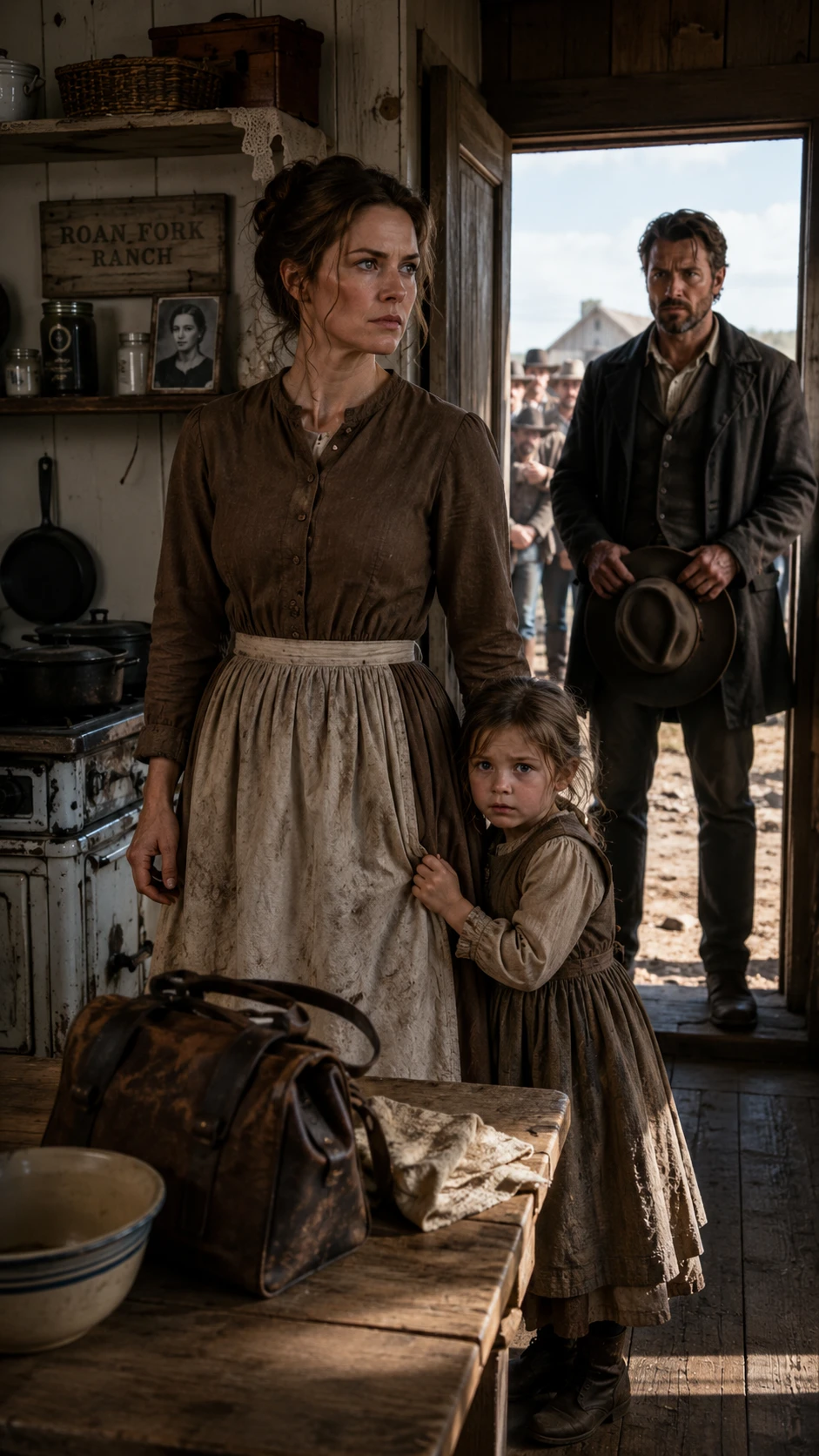
She trembled as I brought her forward, but she did not hide.
“My name is Clara Wynn,” I said. “Eliza was my sister.”
Wesley’s lips parted.
I removed the silver locket from my pocket and placed it in his hand. Inside was a miniature portrait of Eliza and a curl of infant hair.
“The midwife sent Pearl to me after Silas threatened to kill her. I raised her as my own. Before the woman died last month, she confessed everything.”
Wesley looked at Pearl.
His knees struck the floor.
“No,” he whispered.
Pearl stared at him, frightened and confused.
I showed him the faded ribbon.
**P.E.T.**
Pearl Eliza Tate.
Wesley made a sound that did not belong to a hardened rancher. It was the broken cry of a father grieving five lost years all at once.
“My daughter?”
Pearl looked at me.
I nodded through my tears.
Wesley did not reach for her. He seemed to understand that love could not be claimed simply because blood demanded it.
Instead, he held out one shaking hand.
Pearl studied him for a long moment.
Then she took the biscuit she had saved from the night before and placed it in his palm.
“For tomorrow,” she whispered.
Wesley bowed his head and wept.
The sixteen men ate before noon.
They ate beans, chicken gravy, biscuits, dumplings, preserved corn, and apple cobbler. Then they rode north, recovered the stolen herd, and delivered Silas Rudd to the territorial marshal.
That evening, Wesley placed the deed on the kitchen table.
“Roan Fork belongs to Pearl,” he said.
I shook my head. “She is five.”
“Then I’ll manage it for her until she is grown. Every account will be open. Every steer counted.”
He looked at me, shame and hope fighting in his eyes.
“I asked for a wife because I thought this house needed someone to cook and clean. I was a fool.”
“Yes,” I said.
To my surprise, he laughed.
Then his expression softened.
“I won’t ask you to marry me, Clara. Not because I don’t want to. Because you deserve to be asked after you know you’re free to refuse.”
He removed his hat.
“You can stay as Pearl’s mother. As Eliza’s sister. As the woman who saved this ranch. Or you can leave, and I’ll make sure neither of you ever struggles again.”
Before I could answer, Pearl climbed onto a chair and opened Eliza’s sewing basket.
“There’s another letter,” she said.
A narrow envelope was sewn beneath the lining.
It had my name on it.
**Clara.**
My hands shook as I opened it.
*Dear little sister,* Eliza had written. *I know the agency will eventually bring Wesley the woman I named in my papers. He will believe he chose her.*
I looked at Wesley.
He had gone pale.
Eliza had registered my name with the marriage bureau years before her death, arranging for my application to be matched with Wesley’s if he ever tried to seek a wife.
She had known Silas might kill her.
She had known Pearl might someday need both of us.
The final line blurred through my tears:
**Bring my daughter home. Then decide whether the two people I loved most can teach each other how to live again.**
Wesley had not chosen me.
I had not found Roan Fork by chance.
**A dead woman had reached across five years of silence and brought her sister, her husband, and her stolen child back to the same kitchen.**
I looked at the cold stove that was cold no longer.
At the flour on my hands.
At Pearl standing between us.
Then I took the old apron from around my waist and hung it beside Eliza’s sewing basket.
“I’ll stay until spring,” I said.
Wesley smiled carefully. “And after spring?”
Pearl slipped one hand into mine and the other into his.
I looked at the man who had once stood in that doorway ashamed of me, and who now stood before me willing to surrender everything.
“After spring,” I said, **“you may ask me properly.”**