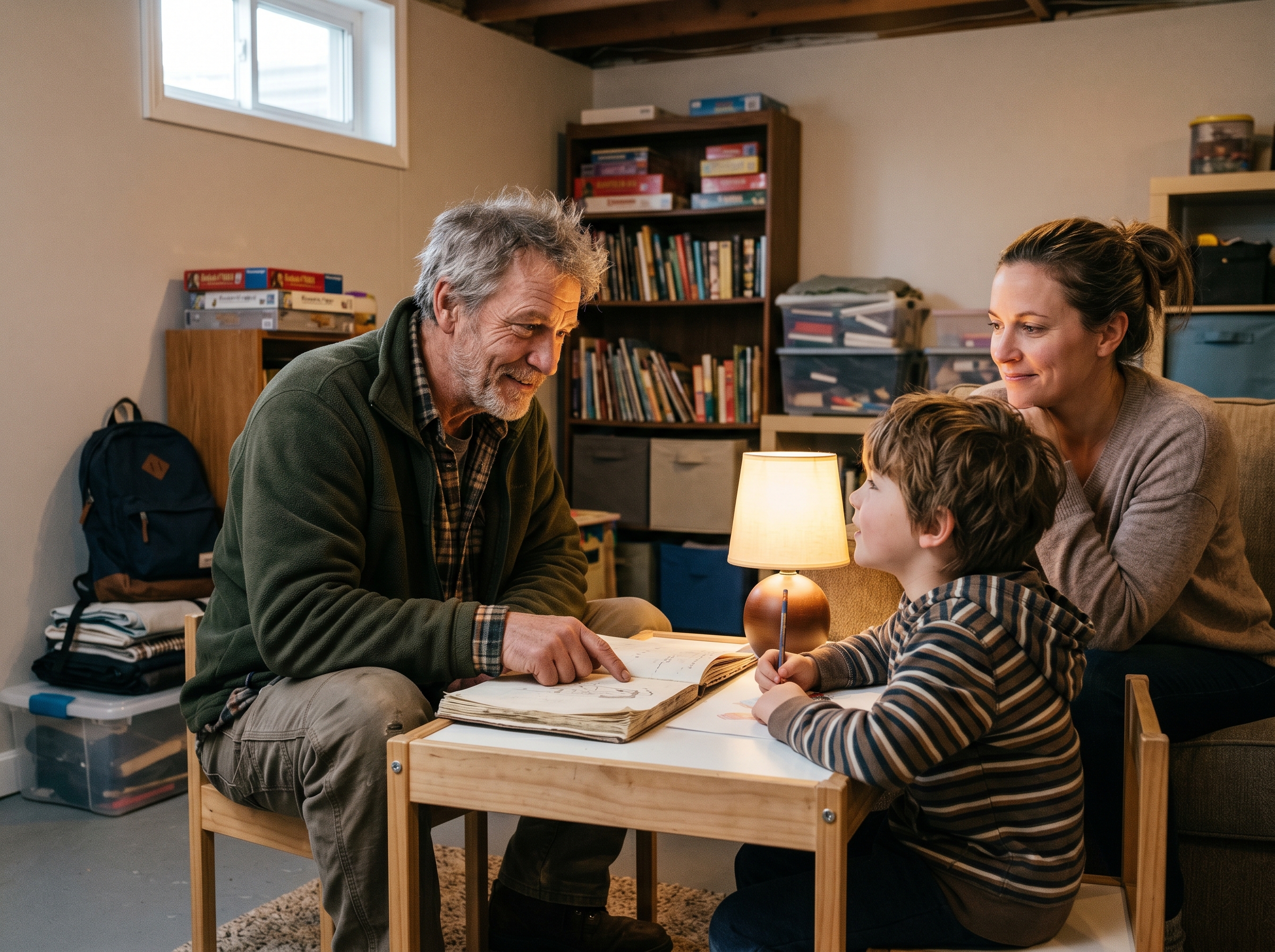
The Homeless Man I Let Stay in My Basement Changed My Family Forever
For months, I saw him standing outside my office building.
His name was Jeff.
At first glance, he looked like every other homeless man people passed without a second thought. His clothes were worn and slightly oversized, his jacket faded from years of use, and he always carried the same weathered backpack.
But there was something different about him.
He never begged.
Never held a sign.
Never approached anyone asking for money.
Instead, he sat quietly near the corner café with a small box of shoe repair tools and a handwritten sign that simply read:
“Shoe Repairs — Pay What You Can.”
People mostly ignored him.
But one rainy afternoon, after the sole of my work shoe nearly peeled off while crossing the street, I stopped.
“You think you can fix this?” I asked.
Jeff smiled politely.
“I can try,” he said. “Might not look brand new, but it’ll hold.”
Twenty minutes later, my shoe looked better than it had in years.
“How much?” I asked.
“Whatever feels fair,” he replied.
I handed him twenty dollars.
He tried to give half back.
“That’s too much.”
That surprised me.
Most people struggling to survive would have taken it without hesitation.
Over the next few months, I started noticing him more.
Every morning, same corner.
Same calm expression.
Same quiet dignity.
Sometimes I’d bring him coffee. Sometimes we’d chat for a few minutes before work. Slowly, I learned pieces of his story.
Jeff was educated.
Very educated.
He read books from the public library and somehow knew a little about everything—history, literature, economics, even classical music.
He never talked much about how he ended up homeless, only saying:
“Life unraveled faster than I expected.”
He mostly stayed in shelters when there was room.
When there wasn’t, he slept wherever he could.
Still, he never complained.
Never acted bitter.
If anything, he was kinder than most people I knew with stable homes and steady paychecks.
Then winter arrived.
And with it came the coldest night of the year.
I was leaving work late when I saw him sitting alone inside a nearly empty café that was about to close. Snow tapped against the windows. The staff looked impatient.
Jeff sat quietly holding a small wrapped package in his hands.
I walked over.
“Jeff,” I said, “you got a place to stay tonight?”
He gave me a tired smile.
“No luck with the shelter,” he admitted. “But I’ll manage.”
Something about the way he said it unsettled me.
Not dramatic.
Not desperate.
Just… accepting.
Like someone already used to disappointment.
I glanced outside at the freezing wind.
“You can’t stay out there tonight.”
He shrugged gently.
“Wouldn’t be my first winter.”
I hesitated.
Then heard myself say words I hadn’t planned.
“You could stay at our place.”
He looked stunned.
“What?”
“We have a basement,” I explained quickly. “It’s not fancy, but it’s warm. Just for the night.”
Jeff immediately shook his head.
“No, I couldn’t impose.”
“You’re not imposing.”
He looked uncomfortable.
“I don’t want your family feeling unsafe.”
I paused.
“I trust my instincts,” I said. “And my instincts say you’re a decent guy.”
For a moment, he said nothing.
Then quietly replied:
“Okay. Just for the night.”
At home, my wife looked surprised but supportive.
The kids—who were younger then—were curious more than anything.
Jeff thanked us at least ten times before heading downstairs.
I expected awkwardness the next morning.
Maybe tension.
Maybe discomfort.
Instead, I woke up to the smell of bacon.
And laughter.
Real laughter.
I walked into the kitchen and nearly froze.
Jeff stood at the stove cooking breakfast like he’d worked there his whole life.
My kids sat around the table laughing hysterically at one of his stories.
“What’s going on?” I asked.
Jeff turned, slightly embarrassed.
“Hope this is okay,” he said. “I found eggs in the fridge and figured I’d repay the kindness.”
My youngest interrupted.
“Dad! Jeff knows magic tricks!”
Another added:
“And he tells really funny stories!”
I stood there speechless.
Later that morning, I went downstairs to grab laundry and stopped in my tracks.
The broken shelf in the basement?
Fixed.
The loose cabinet door?
Fixed.
The leaking pipe I’d ignored for months?
Temporarily patched.
Even the clutter had somehow been organized.
And near the door sat every pair of shoes in the house.
Cleaned.
Polished.
Repaired.
Including a pair I’d meant to throw away.
I just stared.
The man we thought we were helping had spent the night helping us instead.
When I finally found Jeff packing his things, I felt oddly nervous asking what had been sitting in my mind all morning.
“Jeff,” I said carefully, “what exactly did you do before all this?”
He paused.
For the first time since I’d met him, he looked uncomfortable.
Then he sighed.
“Well…” he said quietly. “I used to own a business.”
I blinked.
“What kind of business?”
He hesitated.
“A construction company.”
“Used to?”
He nodded slowly.
“Before my wife passed away. Before the debt. Before losing everything.”
He looked down at his hands.
“Funny how quickly life can change.”
I didn’t know what to say.
Because standing there wasn’t a man who had failed.
It was a man who had survived.
And suddenly, inviting him in for one freezing night didn’t feel like charity anymore.
It felt like meeting someone the world had forgotten—but never should have.