
11-Year-Old Boy Helped a Nearly Blind Woman Cross the Street — Then Her Son Saw Him Being Punished at School
The crisp autumn morning air carried the damp scent of fallen leaves. A pale yellow sun struggled to pierce the thin cloud cover, casting weak light onto the muddy, puddled road. Along that road hurried Emory, a skinny 11-year-old boy. His old sneakers were worn and soaked. He hunched his shoulders, feeling the biting cold seep through his thin clothes.
His faded blue jacket, tattered and worn, was pulled tighter across his chest like a talisman. It was the jacket his mother had saved a month’s worth of night shift factory wages to buy for him. Now it was more than just a shield. It was a piece of her of the quiet sacrifices he always saw her bear. The jacket still carried the chill of the sudden morning rain, but also the lingering warmth of the small act he had just performed.
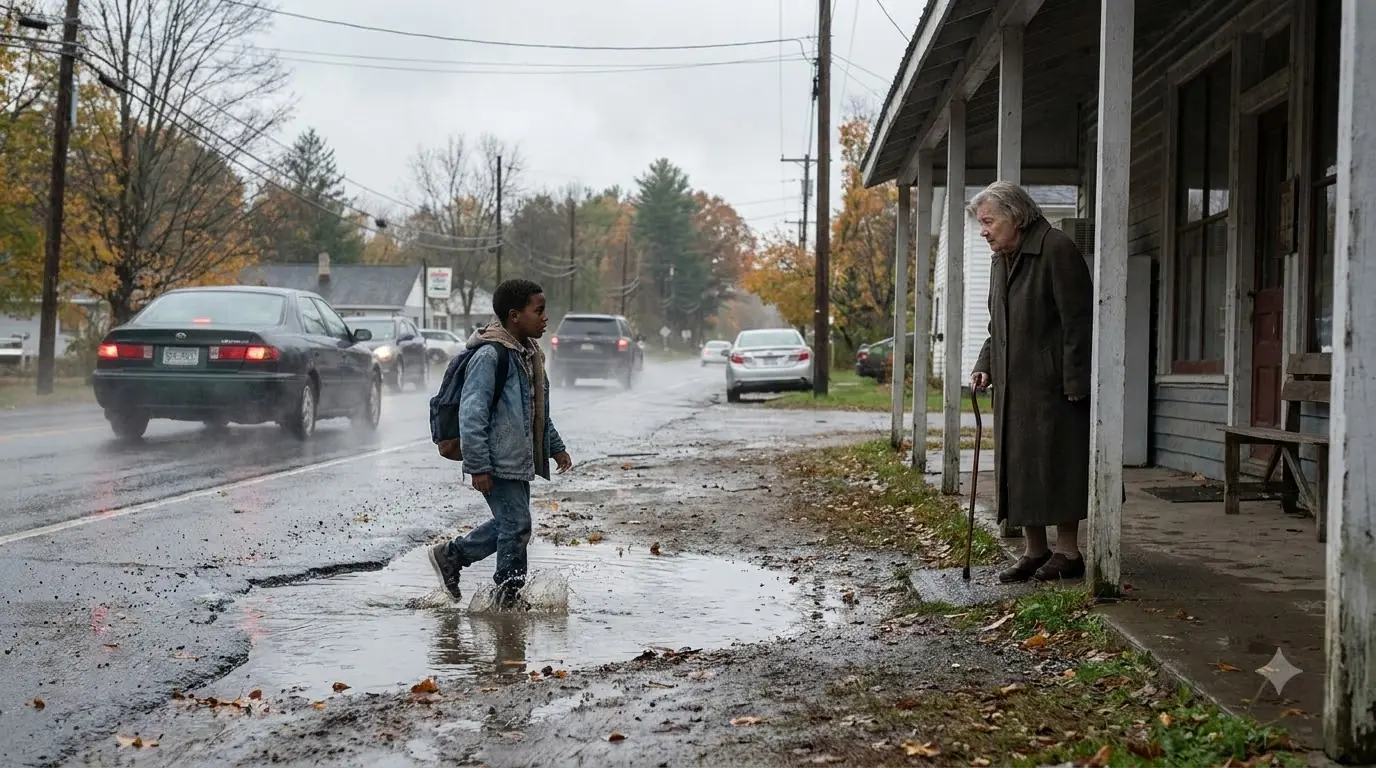 It was a tangible reminder of his mother’s unconditional love and the enduring lessons she had taught him. Emory, though he knew he was late for school, and every minute late meant punishment, found himself stopping. An elderly woman, Evelyn, was struggling under the rickety peeling awning of a dilapidated general store. She trembled, her hands fumbling in the air, trying to cross the waterlogged, muddy street. In Emory’s mind, he saw his own mother toiling daily, working hard to make ends meet.
He understood the helplessness of the elderly and the frail. A sudden, unexplainable urge, pushing past his fear of punishment, pulled him back. It was a quiet call from deep within his heart, the need to do the right thing, just as his mother always taught him. Without a moment’s hesitation, the boy stepped forward, taking her cold hand. He worried he might startle her, so his voice was gentle and sincere.
Grandma, do you need help? The road is really slippery. Just hold my hand tight. Evelyn flinched slightly, her frail shoulders shrinking from the cold, then her face relaxed, breaking into a gentle smile. She squinted her dim eyes, trying to make out the person in front of her. ”
Oh, little one, thank you. I can’t see the way. It’s so hard to walk this slope. ” Emory said no more. Only gently squeezing her hand.
He slowly led her down a slippery slope, shielding her from the pouring rain. His face was wet, tired, but his eyes held an unwavering determination, a quiet strength. He carefully supported the woman step by step, ensuring her safety over his own comfort. ” Are you feeling okay today, Grandma? ” He asked, his voice slightly breathless from the effort of keeping them both steady.
Evelyn took a deep, slightly shaky breath. Her voice was weak but warm. She felt the warmth from his small hand. I am well thanks to you. You are truly a kind boy.
What’s your name? Emory lightly shook his head. To him, his name was less important than the act itself. I’m Emory. You don’t need to know my name, Grandma.
I have to go quickly now. His action was not random. It stemmed from his mother’s profound lesson. A woman who had overcome countless hardships herself while always maintaining a smile and a good heart. My son, life is hard, but remember, just be kind.
That’s all. Just be kind and good things will come to you. Those words were a guiding principle for Emory’s every action ingrained in his mind as a self-evident truth. After safely taking Evelyn home, Emory raced to school late. He felt a gentle warmth spread through his chest.
A strange sense of peace, even though his legs were aching and his stomach growled with hunger. The grounds of Riverside Public School, a fairly large and old public school in the area, hummed with the familiar bustle of a morning. In class 5A, there were only soft rustles of textbooks and occasional whispered giggles from children near the window. Despite being a public school, there was an unspoken division. The crisp, clean uniforms, expensive backpacks, and confident demeanor of some students indicated they came from more privileged families.
Families whom Mrs. Susan always wanted her own children to emulate. Then Susan, the homeroom teacher, entered the classroom. Mrs. Susan was a dedicated educator, but she believed in strict discipline and perfection. To her, a good student had to be punctual, clean, and never cause trouble. Her gaze swept over each student, lingering imperceptibly in the back corner.
There, Emory stood beside his desk, thin and sharp-eyed. His faded blue jacket, still damp, sharply contrasted with the usual uniforms, looking out of place and somewhat disheveled in her eyes. He was late again. A familiar wave of frustration tightened Susan’s jaw, a tiny muscle twitching in her cheek. She saw tardiness not just as a lack of discipline, but as a personal affront, disrupting the order she always sought to maintain in her classroom.
Subconsciously, she linked tardiness with irresponsibility and lack of proper upbringing, things she believed were often found in students from less fortunate backgrounds, the different children she didn’t want in her class. Emory, you’re late for school again, Mrs. Susan’s voice was sharp, high-pitched, her eyes narrowed, staring at Emory as if to pierce him. Do you have a valid reason for this, or do you think my discipline isn’t worth following? Do you know how many times this has happened? Emory looked at his teacher, his mouth slightly open, intending to explain about Evelyn.
He felt a lump in his throat. A familiar fear of being misunderstood, of being judged solely by his appearance and circumstances, rose within him. But seeing Mrs. Susan’s stern face, her eyes devoid of any understanding. He knew she wouldn’t listen. She would only see him as a problem.
A poor child who didn’t meet her standards. He hung his head, accepting the punishment, a wave of humiliation washing over him. ” I helped someone, ” he whispered, but not loud enough for Susan to hear. He felt his face flush. ” I don’t need to hear useless excuses, Emory. ”
Susan cut him off, her expression unyielding. She crossed her arms, staring, ordering, “Your job is to be on time for school. Stand up. You will stand for the entire class. So next time you know how important punctuality is. ”
She coldly ordered him to stand for the entire class, allowing no word about the old blind woman he had just helped cross the dangerous street. Emory felt a knot of injustice flare in his chest. ” Why wouldn’t she listen? Wouldn’t she give him a chance? ” He swallowed hard.
Words caught in his throat. Silently struggling to keep his mother’s teaching paramount. My son, don’t let anyone make you lose your kindness. Always do the right thing. He stood tall, though his legs were already tiring, trying to appear strong.
Susan’s eyes showed clear annoyance, as if Emory’s presence clouded the ideal atmosphere of her classroom. In her eyes, success came from rule adherence and visible effort, not quiet, unseen actions. She frequently scrutinized his notebooks, grading them meticulously, almost aggressively, looking for proof of his inadequacy, as if to confirm her prejudices. On their way to school, some classmates, with their brand new shoes and overflowing backpacks, openly mocked his old muddy sneakers. ” Look at that kid shoes, dirty as mud.
He must have been rolling around somewhere. ” One whispered, giggling, pointing a finger, exchanging looks of contempt. Always messy. Who let him into this school? It’s really disgracing our school. ”
Laya curled her lip, looking him up and down, her tone full of disdain. Emory felt his cheeks burn, his hands clenched into fists, fingernails digging into his skin. He wanted to shout back, to defend himself, to say he wasn’t messy. He was just doing good. But his mother’s words echoed in his mind, reminding him to preserve his kindness.
He took a deep, slow breath, tasting the bitter tang of disappointment, trying to compose himself, he lowered his head, walking faster, feeling isolated amidst the judging eyes, a dull ache. Despite the punishment at school, the gnawing hunger, and the immense fatigue from helping his mother work late into the night, Emory persisted, quietly helping Evelyn every day. For him, it wasn’t just a simple act, but a silent promise to his mother, a way to uphold the values she had instilled in him. He recalled the evenings his mother taught him to sew. The way she smiled kindly despite her tired eyes, “My son, helping others is helping yourself. ”
Those words always resonated in his mind, giving him strength whenever he felt disheartened. Every afternoon after school, when most of his peers hurried home for games or homework, Emory’s steps turned toward the familiar road. He knew Evelyn was waiting. Alone in her small house, her sight stolen by a stroke. He didn’t just rush her across the street.
He took his time listening. He carefully carried her heavy bags, feeling the weight on his thin arms and gently guided her step by step, carefully avoiding every puddle, every crack on the slippery sidewalk. Emory felt the warmth of Evelyn’s hand in his a fragile vulnerability that needed protection, and it filled a small void in his young heart. This connection was a precious source of comfort. A simple but genuine joy. ”
Are you tired today, Emory? Your voice sounds a little sad. I feel you’re a bit more reserved than usual. Must have been punished at school again. ” ” Right, ” Evelyn asked, her voice weak.
Affectionate, she gently stroked the back of his hand, feeling the weariness in it. Emory gently shook his head though she couldn’t see. He let out a soft sigh, then recounted his troubles as if unburdening himself. Yes, Grandma Evelyn, Mrs. Susan punished me again, made me stand the whole class for being late. I wanted to explain that I was helping you, but she wouldn’t let me speak.
She just thinks I’m lazy. Evelyn squeezed his hand tighter, her fingers gently rubbing his as if transferring strength. In this life, not everyone understands the unspoken. My dear boy, people often judge by appearances, but you just keep doing the right thing. Your kindness, I know, will never be forgotten.
I believe in you, Grandma Evelyn, though blind, always told him little stories about her life, about the taste of a freshly baked cake, about the birds singing every morning. Emory listened attentively. He felt he was her friend, her eyes, and that gave him a profound sense of purpose that no academic achievement could match. He never asked for a penny, for his mother’s teaching that true kindness requires no reward was deeply ingrained. He also never breathed a word about his daily ritual to anyone.
It was his secret, a private grace, a quiet comfort amidst the prejudices he faced. Emory wasn’t a perfect student by public school standards. He often dozed off in class, his head drooping because the hum of his mother’s night shift sewing machine echoed in his ears, making it hard to concentrate. He stayed up late, helping his mother fold clothes to earn extra money, his eyelids heavy from lack of sleep. The two of them struggled for every penny.
Meals were often frugal, and Emory’s faded jacket was a testament to every sacrifice. He often secretly wished for a new pair of shoes, an expensive science book. But those dreams quickly gave way to the worry of tomorrow’s meal, and the exhaustion that always enveloped him. However, his innate compassion still shown through countless small unnoticed acts. He always greeted strangers on the bus with a smile, quietly picked up trash when no one was looking, and always offered his seat to the elderly.
Each gesture was an inseparable part of his nature, an invisible truth to Susan, who only saw what she wanted to see. During a parent teacher conference, Susan subtly hinted at Emory’s unsuitability. Her voice was polite, but carried a hint of judgment, accompanied by a scrutinizing look at Emory’s mother’s worn clothes. Madam, some students, as you see, require more effort and support to meet the school standards. Young Emory is frequently late, and his assignments sometimes fall short.
I’m afraid he lacks focus. Emory’s mother, a woman accustomed to judgment, her voice tired but firm, her eyes looking directly at Susan, not flinching. I understand Emory is a good child. He might be tired because he helps me work at night. It’s just the two of us, but I teach him to be kind.
Teacher, that’s the most important thing. I believe he won’t do anything wrong. Those words drifting through the slightly ajar classroom door fell like shards of ice on Emory’s young heart. He felt the sting of rejection, a familiar burning shame. He clutched the homemade box of cookies no one took.
Trying desperately to cling to his mother’s words, “Just be kind. ” It was a difficult choice for Emory to hold on to his mother’s hope and truth when all he felt was abandonment and judgment, to remain soft-hearted in a world that demanded toughness. He felt alone, but Evelyn’s trusting eyes and his mother’s words were the only anchors that kept him steady, helping him continue to choose kindness. It was a day of relentless rain. Richard, Evelyn’s son, a successful businessman who usually drove on major highways, happened to drive through Emory’s old neighborhood today to pick up his mother from a clinic.
Through the rain, he saw something that made him stop his car. Under the rickety awning of a general store, a thin boy, his faded blue jacket pulled tight, was sheltering an elderly woman and carefully leading her across the flooded street. This scene, simple yet powerful, made Richard instinctively pull out his phone and quickly snap a picture. A strange mix of emotions, both admiration and a touch of shame, welled up in him. He, with all his wealth, had never stopped to perform such a selfless act of kindness.
He didn’t think much of it, just a moment he wanted to capture, a rare, beautiful act, something that piqued his curiosity. When Richard brought his mother home, the scent of fresh tea filled the warm air. Evelyn, her hands slightly trembling, but her eyes shining with quiet joy, recounted her mourning. Her face was radiant, a smile never leaving her lips. ” Oh, Richard, today a kind boy helped me, ” she said, her voice soft, full of gratitude, her hand reaching towards her son as if to touch him. ”
Such a sweet, compassionate child. ” Richard sat down in the chair opposite his mother, listening intently, his face full of curiosity. He nodded. ” Really, mother? What was the boy like?
You seem very impressed. Evelyn sipped her tea, the warmth spreading through her body. She smiled, her eyes closed as if reliving the scene. He didn’t even ask my name. He just asked, “Are you feeling okay today, Grandma? ”
And he held my hand so tight, as if I were his own grandchild. He had an old blue jacket. It kept me so dry. My son, if you saw that boy again, would you recognize him? Richard gave a slight laugh, shaking his head.
Still not fully believing his mother’s words. Mother, that’s a strange question. Can you even see clearly anymore? Everyone looks the same to me on the street. Evelyn chuckled softly, her voice full of affection and certainty, confident.
Even though I’m blind, “My son, I would recognize the way he held my hand. I felt his kindness. ” And she said, her voice dropping to a confidential whisper. I would definitely recognize that faded blue jacket. Light doesn’t just come from the eyes, Richard.
It comes from the heart. Richard noted the detail of the blue jacket and the image of the boy sheltering his mother. He still didn’t know about the touching story behind this compassionate boy and his unexpected connection to Mrs. Susan, Emory’s teacher. The next day, Richard decided to visit Riverside Public School during break time. He wanted to see how Susan worked to check if she was being too strict with the students.
He entered the principal’s office, then looked out onto the schoolyard. As he looked into class 5A through the open door, he saw a boy standing alone in the corner, head bowed, and he immediately recognized that blue jacket. Richard was stunned. The kind boy who had helped his mother, who had touched his heart, was the very student Susan frequently complained about, and even punished by making him stand. A wave of complex emotions surged within him.
Awe at the boy’s selflessness and deep discomfort at Susan’s blindness, even callousness. He felt a crack in his own beliefs, a growing disappointment. Richard, now driven by a new conviction that this quiet boy deserved recognition, politely asked to speak with the principal. He requested a private meeting with Susan and invited Evelyn to participate. Susan was completely bewildered and caught off guard.
She felt a cold dread curling in her stomach, a creeping sense of guilt as she saw Richard and his mother. Her eyes darted towards Richard as if to ask what was happening. In the principal’s office, the air was suffocatingly tense. Susan froze when she saw her mother-in-law, Evelyn, enter with Richard. Evelyn, her hands slightly trembling, but her eyes holding a clear, unwavering brightness, slowly walked toward Susan.
She couldn’t see with her eyes, but she sensed Susan’s and Emory’s presence. Teacher Susan, the boy you punished the other day for being late. The boy in that corner. Young Emory, he is the one who saved me every day. Evelyn said, her voice soft, filled only with deep sadness, but firm.
She turned her face towards Susan. He helped me cross the street, carried my bags. He did all of that without being told, without asking for anything. Susan looked at Emory, then at Evelyn, her bewildered expression slowly turning to utter astonishment, then shame. She couldn’t believe her ears.
The image of the boy standing tired in class, flashed in her mind, and a sudden surge of remorse rose within her. His faded jacket, it’s warmer than any praise this school gives to anyone, ” Evelyn continued, her voice slightly trembling, but full of affection. She extended her hand towards Emory’s jacket, as if to touch it. If you truly look beyond what you think you see, you will find that this school is overlooking a person, not because of their grades or circumstances, but because of the pure selfless kindness in their heart. I was blind, but I saw that boy’s heart.
Richard stood beside his mother, his expression hardening as he looked at Susan. He said nothing, but his gaze spoke volumes. Deep disappointment, quiet anger, and a demand for an explanation. He waited, each passing second, heavy with meaning. An unbearable silence filled the room.
Susan bowed her head, her hands clenched. Her carefully constructed world of order and prejudice crumbled, exposing its emptiness. For the first time, she had no defense, no argument, no reason. She felt a flush of heat spread down her spine, not from anger, but from intense shame, a gnawing sensation in her gut. She recalled her own mother’s long-forgotten lessons of compassion.
The pure idealistic reasons she had chosen to be a teacher, to nurture, to inspire, not to judge, not to hurt. The injustice Emory suffered now weighed heavily on her. She wondered how many other Emmories she had overlooked in her teaching career, how many precious gems she had obscured with the dust of rigid rules. A few days later, the school auditorium was packed for an intimate, deeply meaningful gathering. Richard, driven by the conviction that Emory deserved public recognition, personally organized the event.
He wanted everyone to know about this boy to somehow rectify the errors of the prejudices that had existed. Richard did not announce an extravagant scholarship. Instead, he presented Emory with a special grant from his company’s charitable foundation named Evelyn’s Light. This fund, he explained in a clear, calm voice, was for students who always do the right thing when no one is watching. The quiet heroes who demonstrate true kindness.
A large framed photograph of Emory, his faded blue jacket sheltering Evelyn from the rain, taken by Richard, was unveiled and prominently placed on the school’s wall of fame alongside other academic and athletic achievements. That image, simple and powerful, spoke volumes. It made many students and teachers re-evaluate the true meaning of kindness and success. Emory’s mother stood quietly in a corner, her hands clasped. Tears streamed down her face, unchecked, but without a single sob.
She had never imagined that one day her son, her quiet, hardworking boy, would be publicly honored like this. She felt an overwhelming pride, a warm pride spreading through her tired body. Satisfaction and happiness crept into the mother’s heart. The students who once mocked Emory began to look at him differently. The contemptuous glances were replaced by hesitant curiosity, then quiet respect.
They no longer saw superficial poverty. They saw the faded selfless jacket sheltering an old, frail woman, a symbol of a deeper strength, of courage. Leela, the daughter of a well-off family at school, who once held clear contempt, now approached Emory. Her eyes, once full of disdain, now held awkwardness and genuine admiration. Emory, here these cookies.
I made them myself, Leela said, her voice timid, head bowed, her eyes avoiding Emory’s gaze, her hand gently offering the box of cookies to him. I’m sorry for what we used to say about you. I’m really sorry you you’re a good person. It was a small gesture, but it carried immense weight for Emory, a first step towards acceptance and inclusion. He smiled softly, his heart feeling a little lighter, a pleasant warmth.
Susan remained silent. She stood stiffly at the back, her gaze distant. A fierce internal battle raged between her pride, deep-seated prejudices, and the overwhelming shame that consumed her. For several nights after the meeting, she couldn’t sleep. The image of Evelyn’s unseeing eyes, and Richard’s disappointed gaze haunted her.
She was restless, reflecting on her own mother’s long-forgotten lessons of compassion. The pure idealistic reasons she had chosen to be a teacher, to nurture, to inspire, not to judge, not to hurt. She knew she had been wrong. She had missed the most important thing in a child. The next morning, Emory found a handwritten letter in his locker.
The elegant handwriting was unmistakably Susan’s. Her letter was written in a trembling voice, full of remorse, as if wanting to unburden her soul. Emory, I was wrong, terribly wrong. I judged you unfairly. Your kindness has opened my eyes.
You have taught me a lesson I may have forgotten long ago. I pray you never lose your kindness and sincerity because that is what all of us here need to learn from you more than anything else. I sincerely apologize. Evelyn and Emory continued their weekly Friday afternoon meetings, their bond growing deeper. Their weekly ritual was now openly accepted, sometimes with a chauffeured ride from Emory’s mother, or Richard himself would drive them, finding these simple moments a refreshing contrast to his complex business life.
Richard, while driving his mother and Emory, often listen to their stories, he began to reflect more deeply on the meaning of success and wealth. In those rides, he realized that financial reports or large contracts could not bring the same peace and joy as his mother’s and Emory’s simple stories of kindness. Not content with merely funding, he also took time to learn more about educational support programs for underprivileged children in the area. He realized that light wasn’t just about wealth or fame, but also the ability to understand and positively impact the lives of others. A kind of light that money couldn’t buy.
What’s new today, Emory? Tell me. I like hearing your stories more than anything else. Your voice brings me such peace, Evelyn asked, holding Emory’s hand tight. She smiled, her face content, her lips forming a warm, gentle smile.
Emory’s eyes lit up. He told his stories with an excited voice, forgetting all his fatigue. Today, I learned about the stars. Grandma Evelyn, it’s amazing. I want to be a scientist so one day I can help you see this world again.
I’ll invent a special medicine. I won’t give up. Evelyn smiled, her eyes filled with wisdom. She gently patted his head, a soft, affectionate touch. I don’t need to see Emory.
Because every time you hold my hand, I know the light is still there. It doesn’t come from my eyes, my son, but from your heart. From the enduring lessons of love and kindness you learned from your mother. That light shines brighter than any sun. You are my light.
Just keep that heart. Okay. Finally, a poignant image emerged. Emory stood before the end of year award ceremony. He wasn’t there to receive an award for himself.
Instead, he was there to share a short story as part of the school’s cultural program. A quiet testament to his journey, a voice for the unseen, the unacknowledged. He still wore his faded blue jacket, a familiar symbol of his humble beginnings, but his eyes now held a newfound confidence, a quiet dignity that shone brightly, no longer fearing judgment. He looked directly at the audience without a single tremble, he spoke, his voice clear and resonant, filled with genuine emotion, reaching every corner of the auditorium. He told stories of his mother, the woman who taught him the profound power of kindness and quiet resilience, instilling in him the courage to choose empathy no matter how hard life got.
He spoke of the struggling days, the times he just wanted to give up, but his mother’s words held him back. He spoke of Evelyn, the woman who, though physically blind, opened his eyes to a different kind of light, proving that true sight comes from the heart. He recounted his daily choices, his silent battles against prejudice, and the invaluable lessons that shaped him. He had been angry, he had been disappointed, but he had chosen to remain steadfast in his kindness, because it was the only way he knew how to live, to be himself. Then he took a deep breath, his young chest swelling with courage, and looked directly at the audience, not to preach, but to share a simple, profound truth drawn from his own experience.
A truth he now carried with unwavering certainty. Kindness isn’t just an action. It’s a choice. It’s choosing to hold a hand, to share a jacket, to listen even when it’s hard. It’s choosing to forgive those who don’t yet understand you.
And my mother taught me that choice. So if you see someone who needs help, don’t wait for permission. Don’t think about a reward, just choose kindness. Because as Grandma Evelyn said, true light isn’t just what we see with our eyes.
True light is what we give from our hearts. And that light will spread, igniting other sparks of light in the souls around us. The story concluded with a final symbolic image lingering in the viewer’s minds. Emory holding Evelyn’s hand, both walking into a vibrant sunset.
The road ahead stretched out. And though there might be shadows, the light of kindness passed on, continued to shine, illuminating their path. Emory’s mother stood slightly back, watching them. A faint contented smile on her face.
Her eyes filled with profound pride and triumph sparkled knowing that her son had not only understood her teachings but had become their living embodiment, a testament to her enduring legacy. The final scene showed two figures, small yet mighty, bathed in the warm golden light of the vast sky, leaving the audience with hope and the quiet, immense power of human connection, satisfaction, pride, and emotion spread deeply touching the heart. Join us to share meaningful stories by hitting the like and subscribe buttons. Don’t forget to turn on the notification bell to start your day with profound lessons and heartfelt empathy.