
The Lieutenant Laughed at My Mother Until the Rear Doors Opened
The Lieutenant Laughed at My Mother Until the Rear Doors Opened
The noise beyond the gym grew from a distant tapping into a measured thunder, and every face around me turned toward the rear entrance.
Mom did not.
She stood beside the tactical simulator with her hands relaxed, watching Lieutenant Hayes instead.
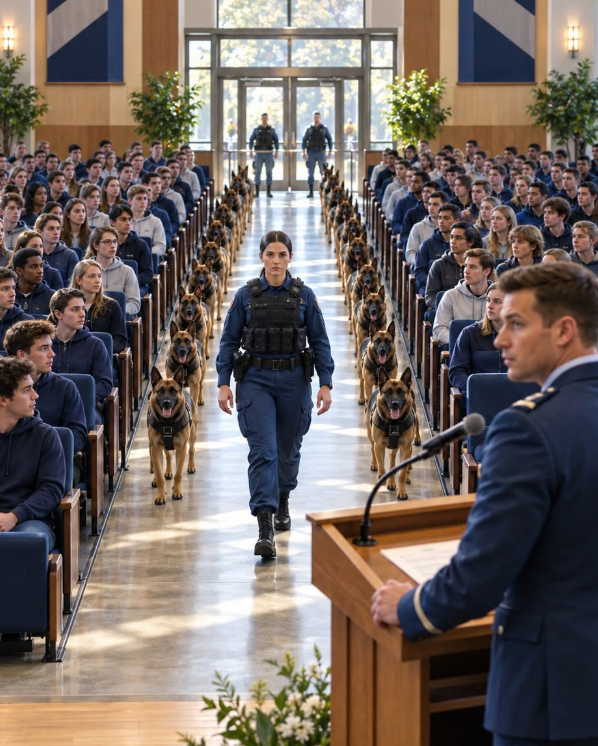
Then the double doors swung inward.
The first German Shepherd entered beside a uniformed handler. A Belgian Malinois followed. Then another Shepherd, then two more Malinois, each dog moving at heel with the kind of control that made two hundred teenagers suddenly remember how to be quiet.
They kept coming.
Handlers filed through both doors in organized columns until dogs lined the rear wall, the side aisle, and the open space behind the bleachers. Black coats, sable coats, tan coats. Some wore working harnesses. Others had simple collars and leads. None barked. None pulled.
Fifty military working dogs had just entered our high school gym, and the loudest sound in the room was claws touching varnished wood.
Kaiser remained beside me.
His ears lifted once, but he did not move toward them. He watched Mom.
Lieutenant Hayes lowered the microphone a few inches.
For the first time all morning, he looked uncertain.
A woman in a dark Navy uniform entered behind the final handlers. Silver stars caught the fluorescent light on her shoulder boards. Chief Delgado straightened so quickly that his heel struck the wall behind him.
Hayes saw that.
His face changed.
The woman stopped just inside the doors.
Chief Delgado came to attention.
‘Admiral.’
Every Navy representative near the recruiting table reacted at once.
Hayes reacted last.
The rear admiral returned Delgado’s greeting, then looked across the gym at Mom.
‘Cole.’
Mom gave her a small nod.
That was it.
No dramatic salute. No speech. Just recognition between two people who clearly did not need introductions.
Hayes looked from the admiral to my mother and back again.
The smile he had worn while humiliating me was gone.
Our principal, Mrs. Bennett, hurried toward the rear aisle. She looked alarmed by the number of animals entering the gym and raised one hand toward the handlers.
‘I’m sorry, but I wasn’t told fifty working dogs would be brought inside the building.’
The admiral calmly handed her a document from the folder under her arm.
Mrs. Bennett read the first page, glanced at the signature at the bottom, and immediately lowered her hand.
‘I see. My mistake.’
She stepped aside.
That was the only time anyone had to correct her all morning.
The admiral continued toward us.
Hayes cleared his throat and raised the microphone again.
‘Ma’am, we were just conducting a student demonstration.’
‘I heard some of it.’
His fingers tightened around the microphone.
The admiral stopped several feet from Mom.
Hayes tried another smile, but this one looked assembled rather than natural.
‘Then I’m sure you understand I was simply correcting misinformation. The young man made a claim that contradicts the public record.’
The admiral looked at me.
I expected her to say he was lying.
She didn’t.
Instead she said, ‘The lieutenant is correct about one thing. The public record available to him this morning did not identify a woman as having earned the qualification your mother holds.’
A murmur moved through the bleachers.
Hayes’s shoulders loosened.
For half a second, I saw his confidence returning.
Then the admiral continued.
‘Public record and complete record are not always the same thing.’
Hayes went still again.
The admiral opened her folder.
‘Raven Cole’s qualification record has been held under restricted classification connected to a compartmented assessment program. That restriction was scheduled to be lifted as part of today’s authorized announcement.’
She looked around the gym.
‘Which is why these teams are here.’
Nobody laughed.
I looked at Mom.
She had never told me anything about an announcement.
That did not surprise me. Mom could keep a secret from gravity if somebody ordered her to.
The admiral turned back to Hayes.
‘Your lack of access to a restricted record explains why you did not know. It does not explain why you chose to ridicule a student while wearing that uniform.’
Hayes’s face reddened.
‘I wasn’t ridiculing him, Admiral. I was educating him.’
The words sounded uglier the second time.
Mom finally spoke.
‘Then educate him now.’
Hayes looked at her.
Mom pointed toward the simulator.
‘You invited me to demonstrate.’
He hesitated.
The gym noticed.
So did she.
‘Is the invitation still open?’
Hayes could not withdraw it without admitting what everybody had already figured out: he had never expected her to accept.
He gestured stiffly toward the rig.
‘Of course.’
Mom rolled her shoulders once and stepped into position.
The simulator was not BUD/S. It was not combat, and Mom did not pretend otherwise. It was a recruiting demonstration designed to test reaction speed, target discrimination, movement, and decision-making under artificial pressure.
That almost made what happened worse for Hayes.
He gave her the training weapon and began explaining the sequence.
Mom listened.
She did not interrupt him to prove she knew more. She did not smirk. She did not look at the students.
When he finished, she asked one question about the safety setting.
Hayes answered.
Mom nodded.
‘Ready.’
The first screen flashed.
She moved.
Not fast in the wild, frantic way people move when they are trying to impress someone. Efficiently.
Her feet went exactly where they needed to go. Her shoulders stayed quiet. She identified the first threat, ignored a false target, shifted position, and completed the next sequence before half the students near me understood what had changed on the screen.
Hayes stared at the monitor.
The third scenario was deliberately harder. A threat appeared beside a nonthreat, vanished, then returned from another angle.
Mom stopped instead of firing.
Hayes frowned.
‘Why’d you stop?’
‘Sensor lag.’
He looked down.
A technician at the Navy table checked the system and raised his eyebrows.
‘She’s right. Left sensor dropped for six-tenths.’
That got a different sound from the students.
Not laughter.
Something closer to disbelief.
The technician reset the rig.
Mom finished the sequence.
When the final screen went dark, Hayes looked at the score and said nothing.
Mom removed the training equipment and placed it exactly where she had found it.
‘I could’ve gotten lucky,’ she said.
A few students laughed softly, but this time they were laughing with her.
Then Mom looked toward the admiral.
‘Paperwork is still easier.’
The admiral almost smiled.
She removed a sealed document sleeve from her folder and handed it to Hayes.
‘You’re cleared to read the verification page.’
Hayes stared at it before opening it.
I watched his eyes move across the sheet.
He read it once.
Then again.
His mouth tightened.
Chief Delgado finally stepped away from the wall.
Hayes looked at him.
‘You knew?’
Delgado’s expression did not change.
‘I recognized her.’
‘And you didn’t say anything?’
‘I wasn’t authorized to discuss her record.’
Hayes looked genuinely offended by that answer.
Mom noticed.
‘Secrecy isn’t an insult to you, Lieutenant.’
He looked down at the page again.
The admiral took it back.
Then she addressed the students.
She explained only what had been cleared for public release. Mom had completed a restricted qualification path administered under Naval Special Warfare authority. Her operational history would remain largely undisclosed. Her status, however, no longer would.
She did not give us missions, locations, enemies, or heroic stories.
She did not need to.
The only fact that mattered in that gym was the one Hayes had laughed at me for saying.
My mother had earned the Trident.
And now he knew it.
The strange thing was, watching him lose that argument did not feel as satisfying as I had imagined.
Maybe because Mom had never treated truth like a contest.
While Hayes stood near the simulator trying to decide what his face should do, Mom turned toward the working-dog teams.
One student near the front raised his hand timidly.
‘Are all those dogs attack dogs?’
Mom shook her head.
‘No. And don’t call them that around their handlers unless you enjoy being corrected fifty different ways.’
The room loosened.
She explained that military working dogs could serve different functions depending on training and assignment. Detection. Patrol work. Search. Specialized support. The dog mattered, but the partnership mattered more.
Handlers began introducing several of the teams while the rest remained settled along the walls.
For about ten minutes, Career Day became what it should have been from the beginning.
Students asked questions.
Nobody was being embarrassed.
Nobody needed to be smaller so somebody in uniform could look bigger.
One handler demonstrated how his Malinois ignored distractions while searching a row of training containers. Another showed a Shepherd responding to silent hand signals.
Mom stayed near the center of the floor answering questions.
I still held Kaiser’s lead.
He sat against my leg as if fifty working dogs were no more interesting than fifty folding chairs.
That calm stretch almost made me believe the confrontation was over.
Then Hayes reached for the microphone again.
Mrs. Bennett had begun directing students back toward their seats when he stepped forward.
‘Before we continue,’ he said, ‘I’d like to clarify something for everyone.’
Mom stopped.
So did the admiral.
Hayes looked toward the bleachers instead of at me.
‘Based on the publicly available information, my correction of Ethan’s statement was reasonable. Obviously, new information has now been presented, and I apologize for any misunderstanding.’
There it was.
A perfect military-shaped escape hatch.
He had been wrong, but only because information had been withheld.
He had humiliated me, but that was now an ‘understanding.’
His facts had changed. His behavior apparently had not.
For the first time that morning, Mom looked angry.
Not loud angry.
Worse.
She walked toward him.
Hayes lowered the microphone slightly.
Mom stopped an arm’s length away.
‘You still think this is about whether you guessed correctly.’
‘I relied on the record available to me.’
‘And if the record had supported you completely?’
He frowned.
Mom pointed toward where I had been sitting.
‘Would that make what you did to a sixteen-year-old acceptable?’
He did not answer.
The admiral did.
‘No.’
One word.
The room went silent again.
She stepped beside Mom.
‘An officer may correct inaccurate information. An officer may explain policy. An officer may say he does not have enough information. What he may not do is use rank, a microphone, and an audience to turn a student’s question into entertainment.’
Hayes swallowed.
‘I understand.’
The admiral looked at him for a long moment.
‘I don’t believe you do yet.’
Then she held out her hand.
‘Microphone.’
Hayes stared at her.
Not long.
Just long enough for everyone to notice.
Then he placed it in her hand.
She passed it to Mrs. Bennett.
‘Lieutenant Hayes, you are finished with recruiting duties at this event. Report to regional command at thirteen hundred. Your conduct here will be reviewed through your chain.’
Nobody cheered.
Mom would have hated that.
The absence of cheering somehow made it heavier.
Hayes had spent the morning acting as if authority meant never having to be questioned.
Now authority was the thing questioning him.
He nodded once.
‘Yes, Admiral.’
Then, finally, he looked at Mom.
‘Ma’am, I apologize.’
Mom’s expression did not soften.
‘Wrong person.’
Hayes blinked.
She looked at me.
Every head in the gym followed her eyes.
I wished they hadn’t.
Standing in front of two hundred students had felt bad enough when they were laughing. Having two hundred people watch a lieutenant decide how to apologize to me was somehow worse.
Hayes walked toward me.
Kaiser rose.
Not aggressively.
He simply stood.
Hayes noticed him and stopped a respectful distance away.
‘Ethan.’
I met his eyes.
He seemed to search for the polished version first.
Then he abandoned it.
‘I was wrong to mock you. I was wrong to use the microphone that way. I should have asked questions before deciding you were lying, and even if you had been mistaken, I should have corrected you without humiliating you.’
Nobody moved.
He took a breath.
‘I’m sorry.’
I believed that he was sorry about what had happened.
I wasn’t sure yet whether he understood why.
But Mom had taught me something else besides patience.
You do not demand perfection from somebody in the same second you demand accountability. You watch what they do after they are given the chance to change.
So I nodded.
‘Then tell them.’
Hayes looked confused.
I glanced toward the students.
‘Tell them what the lesson actually was.’
Mom’s eyes shifted to me.
That tiny movement was the closest thing I got to applause from her.
Hayes turned around.
Mrs. Bennett still held the microphone.
She offered it to him.
He accepted it with both hands this time.
He faced the bleachers.
‘I told Ethan that respecting reality meant accepting what an authority figure says when the evidence appears settled.’
He paused.
‘That was incomplete.’
Nobody laughed now.
‘Respecting reality also means recognizing the limits of what you know. It means correcting without humiliating. And rank does not excuse arrogance.’
He lowered the microphone.
The admiral took it back.
‘Better.’
Hayes stepped away from the gym floor.
That was his consequence.
Not some movie ending where fifty dogs chased him out of the building. Not handcuffs. Not a destroyed life because he had said something cruel and foolish.
He lost the privilege of representing the Navy at that event, and his command would decide what came next after reviewing his conduct.
Mom believed consequences were supposed to correct a problem, not satisfy an audience.
The admiral then did something I had not expected.
She called me forward.
I shook my head automatically.
Mom gave me the look.
There are entire paragraphs hidden inside a mother’s look.
I walked onto the floor with Kaiser beside me.
The admiral introduced Mom properly.
Raven Cole.
Qualification confirmed under a program whose public acknowledgment had been restricted until that day.
She did not list operations.
She did not turn Mom into a superhero.
Instead she talked about discipline, standards, adaptation, and the danger of confusing tradition with impossibility.
Then she explained why the dogs were there.
The military working-dog teams had been scheduled for a multi-service demonstration on the athletic field after Career Day. Mom had been asked to participate because part of her current work involved evaluating how specialized teams integrated canine support into training environments.
Fifty dogs had not come to prove Hayes wrong.
That part mattered to me.
They had been coming anyway.
The truth had simply arrived on schedule.
We moved outside after lunch.
The handlers formed stations across the field. Students watched detection runs, controlled searches, obedience exercises, medical-response drills, and demonstrations of how dogs worked through noise without losing focus.
Hayes was gone.
Chief Delgado stayed.
At one point he walked over to me and nodded toward Mom, who was speaking with two handlers near an obstacle lane.
‘She always that calm?’
‘No.’
He raised an eyebrow.
I waited a second.
‘Sometimes she’s asleep.’
Delgado laughed so hard he had to turn away.
That was the only joke I remember making that day.
Near the end of the demonstration, Mom came back for Kaiser.
I held out the lead.
She did not take it.
‘You keep him for the last run.’
I looked at her.
‘Why?’
‘Because he trusts you.’
Kaiser looked up at me as if the answer had been obvious all morning.
Mom stepped toward the field.
I followed with him at my side.
Hours earlier, I had stood in that gym holding myself still while two hundred students laughed because I knew defending Mom with louder words would not make the truth more true.
By afternoon, the same students were lining the fence to watch her work.
Some apologized to me quietly.
Most didn’t.
I didn’t need all of them to.
What stayed with me was not the simulator score, the admiral’s stars, or even the sight of fifty military dogs walking through those doors.
It was the moment Mom refused Hayes’s apology because he had aimed it at the person with power instead of the kid he had hurt.
That was the lesson I carried home.
Truth does not beg to be believed.
But when it finally has the room, it should do more than prove somebody wrong.
It should make them responsible for what they did while they thought they were right.
Mom walked ahead of me toward the training lane.
Kaiser matched my pace without pulling once.
I still had his lead in my hand.
Only now it did not feel like something Mom had passed me while she went forward to defend herself.
It felt like something she trusted me to carry beside her.