
During breakfast, my husband threw boiling coffee in my face because I refused to hand my credit card to his sister 666
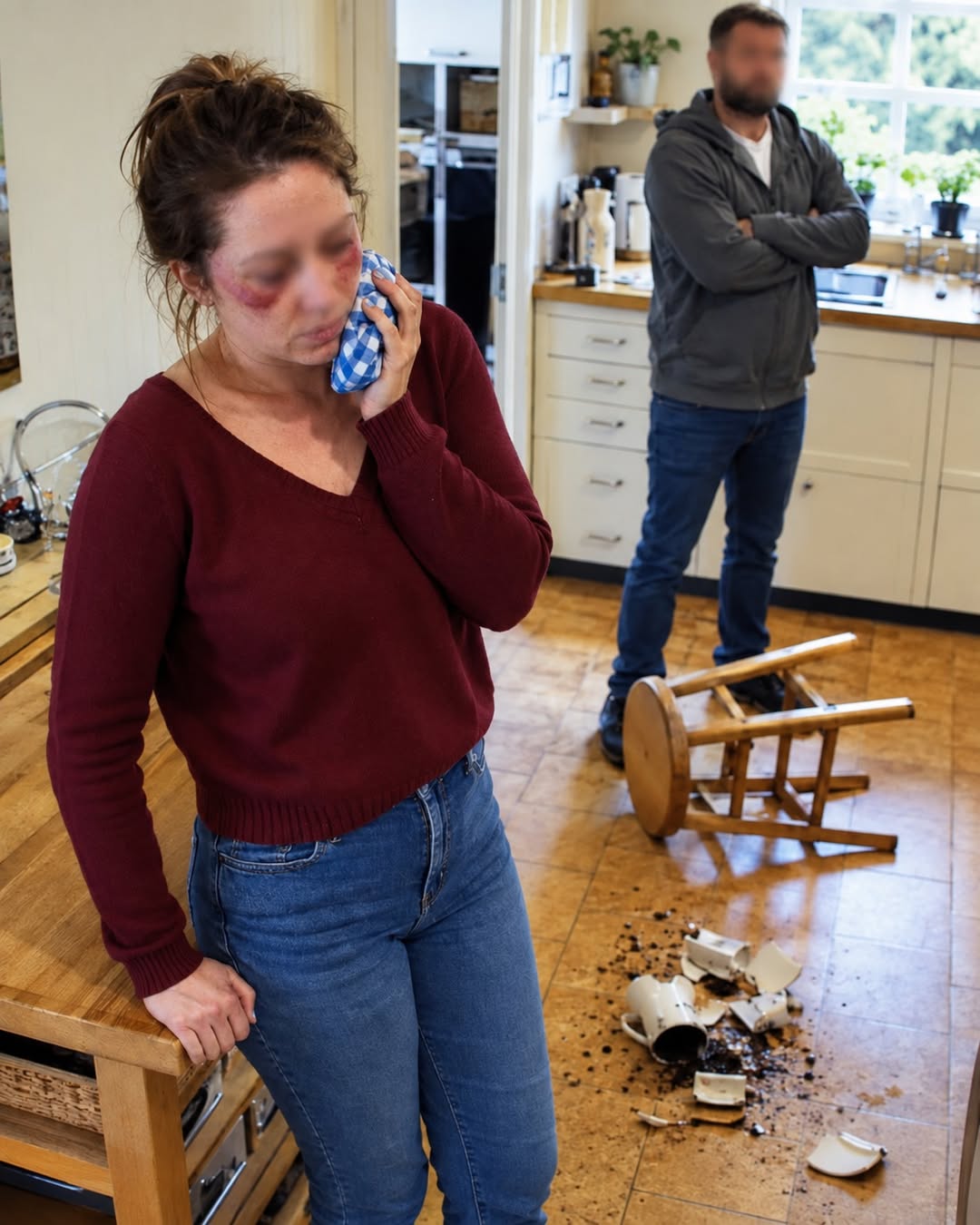
For several seconds, nobody spoke.
Sergio’s smile disappeared first.
Then Rocío’s.
Her eyes moved from me to the officers, then to the boxes stacked beside the doorway.
Finally, they landed on my wedding ring.
“What the hell is this?” Sergio asked.
One of the officers stepped forward before I could answer.
“Señor Lozano?”
Sergio looked at him.
“Yes.”
“We need you to remain calm.”
“This is my home.”
“No,” I said.
Everybody looked at me.
My voice shook.
But only once.
“This is my apartment.”
Sergio turned slowly.
“You really want to do this?”
I looked at the medical report lying beneath my ring.
Then at the faint red swelling still visible along my cheek and neck despite the treatment.
“You already did it.”
Rocío crossed her arms.
“Oh, please. Sergio said you had an argument.”
One of the officers looked at her.
“This is not your conversation.”
She flushed.
“I’m his sister.”
“That changes nothing.”
For the first time in years, someone told Rocío that being Sergio’s sister did not grant her jurisdiction over the entire room.
I almost smiled.
Almost.
Sergio took one step toward me.
The officer moved between us immediately.
“Stay where you are.”
Sergio lifted both hands.
“I’m not doing anything.”
I stared at him.
That sentence.
How many times had I heard versions of it?
I’m not shouting.
I’m not threatening you.
I’m not controlling you.
I’m not forcing you.
You’re too sensitive.
You misunderstood.
It was just coffee.
Except it had never been just coffee.
The coffee was simply the first thing that left evidence on my skin.
Sergio pointed toward the boxes.
“She’s taking everything.”
“No,” I said.
“I am taking my belongings.”
“You can’t empty the apartment.”
“I’m not.”
I had been painfully careful about that.
I took my clothes.
My work equipment.
My personal documents.
Jewelry inherited from my mother.
Items I had owned before the marriage.
Several pieces I could clearly document as mine.
I left the sofa.
Television.
Dining table.
Most kitchen equipment.
His clothing.
His electronics.
Anything that might reasonably become disputed later.
Even the expensive espresso machine I had paid for remained on the counter because I did not want a fight over a coffee appliance to complicate a case involving coffee thrown into my face.
There are moments when winning the object is less important than protecting the record.
I was learning quickly.
Rocío walked toward the bedroom hallway.
“I’m going to see what she took.”
The second officer stepped sideways.
“No.”
She stared at him.
“I said I just want to see.”
“And I said no.”
“But some of those things are mine.”
That caught my attention.
“Which things?”
She hesitated.
“My coat.”
“What coat?”
“The beige one.”
I looked at her.
“That belonged to my mother.”
Rocío rolled her eyes.
“You gave it to me.”
“No.”
“You let me borrow it.”
“Exactly.”
“That was months ago.”
“Borrowing does not become ownership because enough time passes.”
She looked toward Sergio.
He started:
“Elena, don’t be ridiculous—”
The officer cut him off.
“Stop.”
The room went still again.
Rocío stared at me with pure hatred.
Not because she had lost a coat.
Because for the first time, I had used the word mine and nobody in the room had corrected me.
Sergio looked at the medical report.
Then at my face.
Something flickered across his expression.
Not remorse.
Calculation.
“Elena.”
I knew that tone.
Soft.
Controlled.
The one he used when witnesses appeared.
“You know I didn’t mean to hurt you.”
The officer beside me looked at him.
Sergio corrected himself immediately.
“It slipped.”
I almost laughed.
“You threw it.”
“No.”
“You picked up the mug.”
“Elena—”
“You looked directly at me.”
“Stop exaggerating.”
“And then you threw it.”
Rocío muttered:
“She makes everything dramatic.”
I turned toward her.
“I have photographs.”
Silence.
“The hospital has photographs.”
Sergio’s jaw tightened.
“The police have my statement.”
I touched the edge of the report.
“And I am finished arguing about what happened with people who were not there.”
Rocío’s mouth closed.
The officers did not arrest Sergio in the living room for theatrical effect.
They documented.
Asked questions.
Explained what would happen next.
There had already been an initial complaint and medical evidence.
Further decisions would be made through the proper legal process.
I did not control that process.
I did not need to.
What I controlled was whether I stayed.
I had already answered that.
Sergio stared at the half-empty room.
“Where are you going?”
I looked at him.
“That is no longer information you’re entitled to.”
His expression changed.
“Elena.”
“No.”
“You’re my wife.”
“Currently.”
Rocío gasped.
Sergio’s face hardened.
“You’re seriously talking about divorce over one argument?”
“No.”
“Over one cup of coffee?”
“No.”
“Then what?”
I looked at him.
“Over the part where you believed my body, my money, my home, and my belongings were yours to allocate.”
He said nothing.
I continued.
“The coffee only made it visible.”
That night, I stayed with my friend Lucía.
She did not ask me why I had waited so long.
I loved her for that.
She gave me clean sheets.
Tea.
Pain medication according to the hospital instructions.
Then sat outside the guest-room door while I cried in the dark.
Not because I missed Sergio.
That would come later in strange, humiliating waves.
I cried because leaving an abusive relationship does not instantly make your nervous system understand that the danger is over.
My body still expected footsteps.
A raised voice.
A slammed cabinet.
A demand disguised as a conversation.
At 2:30 in the morning, I woke because Lucía dropped a spoon in the kitchen.
I nearly screamed.
That was when I understood how frightened I had actually become.
The next day, I met with a lawyer named Marta Salcedo.
I brought everything.
Apartment purchase documents.
Marriage certificate.
Bank statements.
Medical report.
Photographs.
Messages.
Records of transfers to Rocío.
Screenshots of Sergio telling me things like:
Send her 300. Don’t make this difficult.
Give Rocío the blue dress. She needs it more than you.
Why do you always make me choose between my wife and my sister?
And my favorite:
If you loved me, you would stop counting what is yours and mine.
Marta read that one twice.
Then looked up.
“Did he feel the same way about his salary?”
I laughed for the first time in twenty-four hours.
“No.”
“Interesting.”
The apartment had been mine before the marriage.
That mattered.
It did not mean every question vanished automatically.
Marriage creates financial and occupancy issues more complicated than a sentence like:
I bought it first.
But ownership documentation gave me a strong starting point.
Marta’s advice was precise.
Do not change locks impulsively without confirming what you are legally permitted to do under the circumstances.
Do not throw Sergio’s property into the street.
Do not empty joint accounts.
Do not destroy anything.
Do not communicate by phone if written communication will do.
Preserve everything.
Follow any protective measures ordered by the authorities.
Separate immediate safety from long-term property questions.
It was not satisfying advice.
Which made me trust it.
The first temporary protective measures came quickly.
Not because judges automatically believe every complaint.
Because the medical documentation, my statement, and the surrounding facts were sufficient to justify immediate caution while the matter proceeded.
Sergio was required to respect distance and communication restrictions that applied under the order.
I returned to the apartment under controlled circumstances.
This time, I changed the locks only after confirming I was legally entitled to do so.
I stood in the hallway holding the new key and cried.
Not dramatically.
Quietly.
Because keys become emotional objects when someone has spent years convincing you that ownership is selfish.
The apartment felt enormous without him.
Not physically.
Acoustically.
No television shouting from the living room.
No Sergio calling from another room:
“Elena?”
That tone that never meant:
I love you.
It meant:
Come perform a task.
I walked through every room.
Opened closets.
Closed them.
Moved nothing.
Then went into the kitchen.
His coffee mug was still there.
The one he had thrown had shattered during the incident.
But another from the same set remained in the cabinet.
I picked it up.
Held it.
Then put it in a box marked:
SERGIO — PERSONAL / HOUSEHOLD ITEMS
Not smashed.
Not burned.
Not thrown from a balcony.
Boxed.
Documented.
Boring.
Beautiful.
Rocío began calling from different numbers.
I blocked each one.
Then emails came.
The first was furious.
You destroyed my brother’s life.
The second:
You’ve always hated me.
The third:
At least give back the things Sergio bought you.
That one made me stop.
I forwarded it to Marta.
Then made a list.
Things Sergio had bought me during seven years together.
Perfume.
Shoes.
A bracelet.
Several dresses.
Household items.
Birthday gifts.
Anniversary gifts.
There were also things I bought him.
Watch.
Laptop.
Weekend trips.
Furniture.
Car repairs.
Marriage is not a retail return counter.
Marta told me not to start inventing debts out of ordinary gifts.
Good.
I was angry enough that I needed someone paid to keep anger boring.
Then came the money.
That was where the marriage looked different on paper.
Over three years, I had transferred money to Rocío forty-seven times.
Small amounts mostly.
€80.
€150.
€220.
€400.
Occasionally more.
Total:
€13,860.
I stared at the figure.
Not because it would ruin me.
It would not.
But because I remembered almost every transfer beginning with:
Just this once.
I searched Sergio’s transfers to Rocío during the same period.
€1,240.
I laughed.
Then I cried.
The generosity had always been mine.
The authority had always been his.
That was the arrangement.
The deeper financial review found something worse.
Not theft.
Not a secret emptied account.
Something subtler.
Sergio had been telling Rocío what I earned.
My savings.
My annual bonus.
The approximate balance in my personal account.
He knew because we were married and because I had once shared financial information in good faith.
Then he used that knowledge to decide what I could “afford” to give his sister.
Messages between them later obtained through the legal process showed the pattern.
Rocío:
Ask her for 600. She has it.
Sergio:
She’ll complain.
Rocío:
Then make her.
Sergio:
Leave it to me.
Another:
Rocío:
I want the green handbag.
Sergio:
She never uses it.
Rocío:
Tell her I’m taking it Saturday.
That handbag had been a gift from my mother two months before she died.
I sat in Marta’s office reading that message and felt colder than I had felt when coffee burned my skin.
Not because they wanted a handbag.
Because my grief had become inventory.
There was no single message saying:
We own Elena.
People rarely write the truth that neatly.
But hundreds of smaller messages revealed the same structure.
Her salary.
Her apartment.
Her clothes.
Her card.
Her things.
Her.
Every noun came with implied access.
Sergio’s first formal explanation was predictable.
Stress.
Financial pressure.
Family conflict.
He said the coffee incident had been impulsive.
He denied intentionally trying to injure me.
He expressed regret.
Then, in almost the same statement, he said I had been “provocative.”
Marta circled that word.
“There.”
“What?”
“That is why you do not negotiate emotional truth with him.”
She tapped the paper.
“He is still trying to divide responsibility.”
The criminal matter moved separately from the divorce.
That was another thing people around me struggled to understand.
My aunt called and asked:
“So if you divorce him, does the case disappear?”
“No.”
My cousin asked:
“If you forgive him, can you cancel everything?”
“It isn’t that simple.”
A colleague asked:
“Did the judge give you the apartment?”
“It was already mine.”
People want one courtroom to resolve an entire life.
Reality uses departments.
Files.
Different lawyers.
Different standards.
Different timelines.
Months later, Sergio accepted responsibility through the legal process for conduct arising from the assault.
The outcome included consequences appropriate to the proven facts.
Protective conditions.
Mandatory programs.
Legal penalties.
No cinematic twenty-year prison sentence.
No dramatic judge calling him a monster.
He had caused a burn injury with hot liquid during an argument.
That was serious enough without adding fiction.
My medical recovery was also less dramatic than people expected.
The burn healed.
Mostly.
For months, there was discoloration on my neck.
A small area near my collarbone remained sensitive.
My face healed better than I feared.
The scar I worried about most was not visible.
It was the way I flinched whenever someone lifted a mug too quickly.
That took longer.
Rocío disappeared from my life almost completely.
She sent one final message:
You chose an apartment over family.
I read it twice.
Then replied for the first and last time:
No. I chose safety over access.
Blocked.
Done.
The divorce took fourteen months.
Not because the marriage was valuable.
Because untangling a life takes time.
Furniture.
Accounts.
Tax records.
Insurance.
Personal property.
Legal filings.
Statements.
There were arguments over objects so small they became insulting.
A television.
A dining chair.
A vacuum cleaner.
At one point, Sergio’s lawyer listed my Italian moka pot among disputed household items.
I stared at the document.
Then laughed.
“I bought that at twenty-three.”
“Receipt?” Marta asked.
“I think so.”
I found it in an old email.
€28.90.
Of all the things I lost in the marriage, that was the object I was most determined to keep.
Not because of the price.
Because I bought it with my first paycheck.
Before Sergio.
Before Rocío.
Before I began thinking love required surrender.
The moka pot stayed with me.
Sergio eventually moved into a rented apartment.
Rocío did not move in with him.
That surprised me.
Apparently she liked receiving help more than providing it.
Without my income cushioning his generosity, Sergio began saying no.
Then something almost funny happened.
They started fighting.
Over money.
Constantly.
I learned only because mutual acquaintances could not resist telling me.
Rocío wanted €900 for a dental procedure.
Sergio said he did not have it.
She accused him of selfishness.
He accused her of treating him like an ATM.
When Lucía told me, I stared at her.
Then both of us laughed until we cried.
Not because suffering is funny.
Because sometimes irony does not need assistance.
I did not become wealthy after the divorce.
I was already financially stable.
What changed was that my money stopped leaking into emergencies other adults manufactured.
Within eighteen months, I rebuilt the savings I had depleted supporting Sergio’s family.
I replaced the dining table.
Not because the old one reminded me of him.
Because I wanted something I chose alone.
I painted the bedroom.
Moved my desk beside the window.
Put plants where Sergio said plants looked “cluttered.”
I bought a ridiculous yellow armchair.
He would have hated it.
Excellent.
The apartment slowly became mine again.
That is a strange sentence about a place that had always been legally mine.
But ownership has several layers.
Title.
Possession.
Control.
Emotional permission.
I had retained the first and slowly surrendered pieces of the others.
After the divorce, I took them back.
Not through revenge.
Through repetition.
Locking my own door.
Choosing my own groceries.
Leaving a jacket on a chair without being told Rocío could use it.
Buying perfume without hearing:
“She’d like that too.”
Saying mine without apologizing.
Two years later, I met someone.
His name was Javier.
I nearly ended things after the third date because he asked if he could try my dessert.
That is how sensitive boundaries had become.
He noticed my expression.
“Or not.”
I laughed.
“No, you can.”
“You sure?”
“Yes.”
He took one bite.
Then pushed the plate back.
Such a ridiculous thing.
He asked.
I answered.
He accepted the answer.
No punishment.
No sulking.
No argument about selfishness.
People who have lived too long without consent in small things sometimes cry when they encounter it again.
I did not cry at the restaurant.
I waited until I got home.
Javier eventually learned everything.
Not immediately.
He never asked:
Why didn’t you leave sooner?
He asked:
“What made it hard to leave?”
Different question.
Better man.
We took things slowly.
Very slowly.
He kept his own apartment.
I kept mine.
When he first stayed overnight, he brought his own toothbrush and asked where I wanted him to put it.
I stared at him for five seconds.
“What?”
“Nothing.”
“Did I do something wrong?”
“No.”
“You asked.”
He laughed.
“Where else would I put it?”
Exactly.
I never married Javier.
Not because marriage was ruined for me.
Because neither of us needed marriage to prove seriousness.
Maybe someday.
Maybe never.
The point was choice.
Mine.
His.
Freely renewed.
Five years after the coffee incident, I was cleaning the kitchen when I found the moka pot.
The old one.
Still working.
Scratched.
Handle slightly loose.
I made coffee.
Sat at the table.
Morning sun across the floor.
And suddenly remembered Sergio standing by the counter.
The mug in his hand.
His face after he threw it.
“Maybe now you’ll learn.”
For years, I hated that sentence.
Then I realized something.
I did learn.
Just not what he intended.
He wanted me to learn that saying no had consequences.
Instead, I learned that a relationship in which no carries punishment is not love operating badly.
It is control operating correctly.
I learned that generosity given under pressure is not generosity.
That shared life does not mean shared entitlement.
That marriage does not erase personal property, privacy, bodily autonomy, or the right to refuse.
And that somebody calling you selfish is not proof you have taken too much.
Sometimes it is proof they can no longer take enough.
People who hear the story always ask about the evening Sergio returned with Rocío.
They imagine some huge reveal.
That I sold the apartment.
That I emptied it completely.
That I had changed the locks while he was out.
That his belongings were in the street.
That police arrested both of them while Rocío screamed.
None of that happened.
What was missing from the apartment that evening was much simpler.
My clothes.
My documents.
My work.
My jewelry.
My mother’s things.
My willingness to keep negotiating.
And, most importantly, me.
For years, Sergio treated my presence as permanent.
He believed he could insult me Monday and eat dinner with me Tuesday.
Order me around Wednesday.
Give my possessions away Thursday.
Apologize Friday.
Sleep beside me Saturday.
Then start again.
He thought marriage meant I would always still be there for the next cycle.
That evening, he opened the door expecting the same Elena.
The woman who argued.
Cried.
Eventually forgave.
Paid Rocío.
Made dinner.
Stayed.
Instead, he found boxes.
Police officers.
A medical report.
A wedding ring.
And empty space where my life had been.
That was what stopped him.
Not the missing furniture.
Not money.
Not even the police.
Absence.
For the first time, my no had taken physical form.
I am forty-one now.
I still live in Móstoles.
Still in the same apartment.
People sometimes ask why I did not sell.
Why would I?
Sergio did not own the walls.
He did not own the balcony.
He did not own the morning light.
He did not own the kitchen.
He was simply somebody I had once allowed inside them.
That distinction matters.
The scar near my collarbone faded until only I can really find it.
The legal papers are stored in a folder I rarely open.
My wedding ring is gone.
I sold it eventually.
Not dramatically.
A jeweler weighed it.
Quoted a price.
I accepted.
With part of the money, I bought a new espresso machine.
Lucía laughed when I told her.
“You bought coffee equipment?”
“Yes.”
“Dark.”
“No.”
I smiled.
“Practical.”
The rest went into savings.
Sometimes, when someone asks why I finally left, they expect me to say:
Because he threw coffee at me.
Yes.
That was the immediate reason.
But the deeper answer is:
Because after he hurt me, he still expected service.
Still expected money.
Still expected access.
Still expected me to prepare for Rocío’s arrival like nothing had happened.
That expectation showed me the entire marriage in one morning.
He did not believe the relationship had broken when he burned me.
He believed I had.
And he thought pain would make me easier to manage.
That was his mistake.
Pain made something clear.
I did not need his permission to leave a marriage.
I did not need Rocío’s agreement to keep my own belongings.
I did not need to win an argument before protecting myself.
And I did not need to wait until the next time.
There was never another time.
That is the part I am proudest of.
Not that I was fearless.
I was terrified.
Not that I destroyed Sergio.
I did not.
He went on living.
Working.
Paying bills.
Making choices.
So did Rocío.
My victory was smaller.
And much more important.
He told me:
“Give her your things or get out.”
For years, Sergio had built his power around the belief that I would always choose surrender over leaving.
That morning, for once, I took his ultimatum literally.
I kept my things.
And I got out.
Then I learned that getting out was not losing my home.
It was the first step toward finally coming back to it.