
The gun clicked before anyone spoke. A dry, hollow sound. Metal on metal. The kind that makes a crowd forget how to breathe. Sarah Mitchell was on her knees beside pump number six, cheek pressed against oil stained concrete, the heat of it bleeding through her jeans.
Her wrists were pinned behind her back. Not cuffed yet, just held. Fingers digging into bone. Someone was shouting, but it sounded far away, like it was coming through water. The smell of gasoline burned her throat.
She tasted rust, blood from her lip. She hadn’t moved, hadn’t raised her voice, hadn’t even reached for her bag. And still, the gun was there inches from her temple. “Don’t make this worse, “the deputy said. His voice was calm.
Too calm, like this was routine, like she was already a problem he had solved in his head. Around them, the afternoon stalled. A pickup idled at the far pump, exhaust rattling. A woman froze halfway out of her sedan, one foot still inside, groceries slipping from her arms. A man in a veteran’s cap stared at the ground like the concrete had suddenly become very interesting.
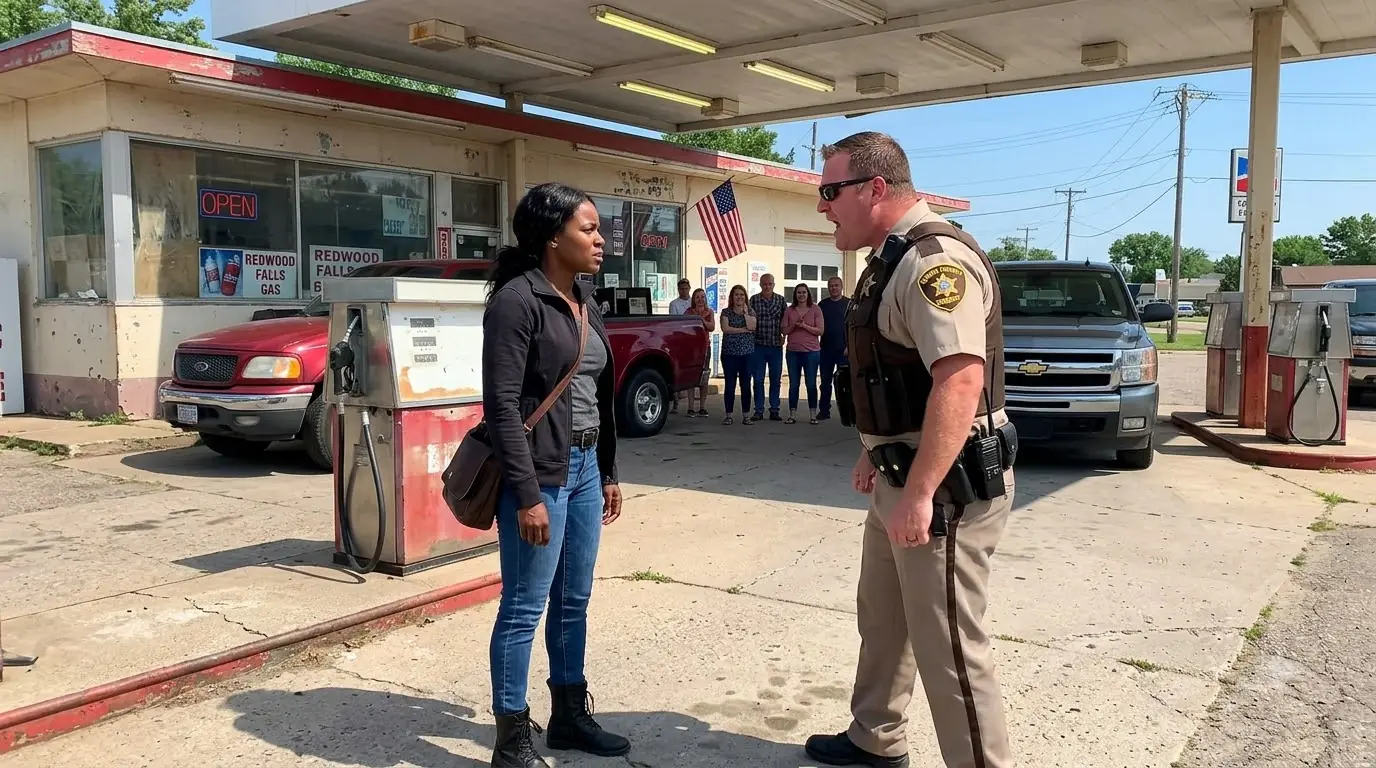
No one filmed. No one spoke. Redwood Falls knew this drill. Sarah’s breathing slowed. In through the nose, out through the mouth.
She counted the cracks in the concrete. 1 2 3. She had learned long ago that panic was expensive. Panic got you sloppy. Panic got you dead.
The deputy shifted his weight. His boot scraped the ground near her shoulder. What’s in the bag? He asked. Personal, Sarah said.
Her voice surprised even her. Steady, almost bored. That was the wrong answer. She felt the pressure increase, a knee between her shoulder blades. Her vision blurred at the edges.
The sky above the station canopy looked painfully blue, too clean for what was happening underneath it. Behind the deputy, Sheriff Daniel Crowley watched in silence. 59 years old, gray at the temples. A man who had won elections by smiling at church picnics and shaking hands at the county fair. He didn’t touch her, didn’t need to.
Power like his didn’t require fingerprints. He adjusted his belt, glanced at the small crowd, then nodded once, barely noticeable. The deputy understood. Turn her over. They rolled her onto her back.
The sun hit her eyes hard. She blinked, squinting past the gun, past the badge, until she saw Crowley’s face clearly. He studied her the way men studied property they were thinking about buying, measuring, calculating. You passing through? Crowley asked.
Or you planning on staying? Sarah didn’t answer right away. She noticed the way his left hand twitched when he waited. Impatience disguised as patience. A man used to being obeyed.
She also noticed the older man near the ice machine, the one with the veteran’s cap. His jaw was tight. His hands were shaking. He wanted to say something. He wouldn’t.
Not here. Not now. I’m just getting gas, Sarah said. Crowley smiled. It wasn’t unkind.
That almost made it worse. Funny thing about gas stations, he said. People think they’re neutral ground. Like nothing bad is supposed to happen where folks buy soda and lottery tickets. He leaned closer, his shadow cutting across her face.
But accidents happen everywhere. The deputy finally cuffed her. The metal bit deep, too tight on purpose. Sarah hissed once before she could stop herself. Crowley noticed.
His smile widened just a fraction. “What’s your name? “he asked. She hesitated. Names mattered. Names opened doors.
Names closed them, too. She gave him the one she had been using for months. The one on the rental agreement. The one on the motel receipt. Sarah Mitchell.
Crowley nodded like he was filing it away. You know why we stopped you, Sarah Mitchell? “No,” she said. “The vehicle matched a description of what?” He straightened. The conversation was over.
Of something we’re looking into. They lifted her to her feet. Her legs wobbled but held. She caught a glimpse of herself in the chrome of the pump. Dirt on her cheek.
Blood drying at the corner of her mouth. Eyes too calm for someone who should be begging. That seemed to bother the deputy. As they walked her toward the cruiser, Sarah’s gaze drifted back to the crowd. The woman with the groceries had started crying silently, hands over her mouth.
The man in the veteran’s cap finally looked up. Their eyes met. For half a second, something passed between them. Recognition, guilt, fear. Sarah held his gaze and gave the smallest shake of her head.
Not now. Not yet. The cruiser door slammed shut, sealing her inside. The smell of old vinyl and stale coffee filled the space. No camera on the dash.
She had already noticed, of course. Outside, Crowley spoke quietly to the deputy. His back turned. A hand rested on the trunk like he owned it, like he owned all of it. As the engine started, Sarah closed her eyes.
Her heart was pounding now, loud and insistent. This was earlier than planned. Much earlier. She had wanted weeks, maybe months. Instead, Redwood Falls had decided to meet her right here under the open sky in front of everyone.
The car pulled away from the pump. In the side mirror, the gas station shrank, life snapping back into motion behind them. People moving, engines starting, silence returning to its proper place. Sarah exhaled slowly. Whatever came next, the line had been crossed.
Not by her, by them, and they had no idea who they had just put in the back seat. The cruiser smelled like bleach and old sweat, the kind of clean that tried to erase things it could not. Sarah sat upright, wrists burning, counting the clicks of the turn signal as they rolled through town. Left, right, slow. Redwood Falls passed by in familiar fragments.
The pharmacy with the faded flag, the diner with the neon rooster, the courthouse lawn trimmed too carefully. She had walked these blocks before, smiling, asking questions, pretending to belong. Now she watched them through a wire screen like artifacts in a museum she might never see again. In the front seat, Deputy Kyle Mercer drove with both hands locked at 10 and two. Early 40s, wedding ring polished thin.
He kept his eyes forward, jaw clenched, breathing shallow. He had not wanted the gun out. She had seen it in his eyes at the pump, the flicker of hesitation when Crowley nodded. Mercer followed orders. He always had.
That was the bargain he made when he put on the uniform and learned how to keep his head down. “You going to tell me what this is about? “Sarah asked. Mercer didn’t answer. The radio crackled, then went quiet.
Someone had switched channels. Someone always did. The cruiser turned behind the courthouse instead of pulling into the public lot. Gravel popped under the tires. The back entrance loomed ahead.
A steel door with chipped paint and a camera mount that held nothing. Sarah felt the first real spike of fear then. Sharp and clean. This was not procedure. This was improvisation.
They stopped. Mercer cut the engine. For a moment, neither of them moved. He stared at the steering wheel like it might give him permission. Don’t make this harder, he said finally without looking back.
I’m not the one doing that, Sarah replied. He opened her door. The heat rushed in heavy and loud. He guided her out with a hand on her elbow, gentler than before, as if that might balance something. Crowley was waiting by the door, speaking softly into his phone.
He ended the call when he saw them, slipping the device into his pocket. Inside, the building swallowed sound. Fluorescent lights hummed. The hallway smelled of paper and dust and something sour that had soaked into the walls years ago. They passed framed photos of past sheriffs.
Crowley’s portrait hung near the end, larger than the rest. He had insisted it be updated every election cycle. The interview room was small, no window, a table bolted to the floor, two chairs. The camera mount was empty here, too. Wires cut clean and tucked away.
Mercer uncuffed her and stepped back, rubbing his wrists like he could feel her pain by proxy. “Sit, “Crowley said. Sarah sat. The chair was cold through denim. Her hands tingled as blood returned, needles of fire up her arms.
She kept her face still. Crowley circled the table slowly, reading her the way he read budgets and ballot returns. “You don’t look like trouble, “he said. “That’s what bothers people. You don’t fit the picture. pictures lie, “Sarah said.
Crowley smiled again. He pulled a folder from under his arm and dropped it on the table. The slap echoed. Inside were printouts, motel receipts, grainy photos, notes from conversations she remembered having. He had done his homework.
Not enough, but more than she liked. “You ask the wrong questions, “he said. “You make people nervous. Then you get mouthy at a gas station. “He leaned in.
That’s how folks get hurt. Mercer shifted by the door. Crowley noticed. He always noticed. Deputy Mercer here thinks we should take you in proper.
Crowley went on. Book you. Let a judge sort it out tomorrow. He shrugged. Judges are slow.
They ask for records. Paperwork spreads. Sarah met Mercer’s eyes. He looked away. What do you want?
She asked Crowley. I want you gone, he said simply. I want this to end without noise. You sign a statement saying you resisted. We write you a citation.
You leave town tonight. Everybody breathes easier. Sarah laughed once. Short, sharp. And if I don’t, Crowley’s smile thinned.
Then we keep you until things cool off. Things have a way of cooling off when people stop stirring them. Silence pressed in. Somewhere down the hall, a door slammed. Mercer swallowed.
He took a step forward, then stopped. Crowley closed the folder. “You’re smart enough to know how this goes, “he said. “Last chance. “Sarah inhaled slow, measured.
She felt the weight of the watch on her wrist, heavier than steel, warm against her pulse. She did not look at it. Not yet. She looked at Crowley instead, at the lines around his eyes, at the certainty that had carried him this far. No, she said, Crowley straightened.
For the first time, something like surprise crossed his face. Then it hardened into resolve. All right, he said. We’ll do this the long way. As Mercer reached for the door, Sarah felt the ground shift.
The room seemed to tilt, not from panic, but from clarity. Whatever plan she had imagined was gone. Whatever came next would be worse. And somewhere in town, people who had stayed quiet for years were about to learn how expensive silence could be. They moved her to a holding room the size of a walk-in closet.
Concrete walls sweating in the heat. A single bench bolted to the floor. The door shut with a final sound that felt heavier than steel. Sarah sat down slowly, testing her balance, letting the room reveal itself. No window, no camera.
A vent high on the wall rattled, pushing air that smelled faintly of burnt dust. Someone had turned the temperature up or turned the air off. Either way, it was deliberate. Minutes stretched, then an hour. She tracked time by the way the fluorescent light buzzed, flickered, steadied, by the distant sounds of phones ringing and being ignored, by the muffled laughter drifting once, twice, then stopping abruptly.
Redwood Falls was close enough to hear, far enough to pretend she was nowhere. Her hands still shook just a little. She pressed them flat against her thighs until they stopped. Panic wanted to creep in now, wearing the mask of reason. You pushed too soon.
You misread him. You are alone. She let the thoughts pass without grabbing them. Thoughts were noise. Facts mattered more.
Crowley hadn’t booked her. Not yet. That meant he was deciding. Men like him hated decisions that left fingerprints. The door opened without warning.
Deputy Mercer stepped in carrying a paper cup of water. He set it on the bench beside her and didn’t meet her eyes. Sweat darkened the collar of his uniform. “You didn’t have to do that, “Sarah said quietly. “I know, “he replied.
His voice was rough. “Drink it. “”She did. “The water tasted faintly metallic, pipes older than the building. When she finished, she held the empty cup between both hands, grounding herself in the small weight of it. “They’re calling it disorderly conduct, “Mercer said, “resisting.
Maybe assault if Crowley feels like pushing. I didn’t touch anyone. “Mercer’s jaw tightened. I saw. Then why am I still here?
He looked at the door, then back at her. Because if he lets you go now, it looks like he blinked. There it was. The truth slipped out sideways. Sarah leaned back against the wall.
You don’t like this. No, he said. I don’t. Then help me. Mercer exhaled sharply.
You don’t understand how this works. I understand exactly how it works, Sarah said. I understand you’ve got a mortgage, kids in school, a father who tells his friends you’re doing God’s work. I understand that one bad note in your file follows you forever. She watched his face as she spoke.
Every word landed. What I don’t understand is how you sleep. Mercer flinched. Just a fraction. Enough.
Crowley’s voice echoed from down the hall. Mercer. Mercer straightened instantly. The mask snapped back into place. I have to go.
Before he turned, Sarah said, “You’re not a bad man. You’re just standing too close to one. “He paused. His shoulders sagged for half a breath. Then he left.
The door shut again. The lock slid home. Another stretch of time passed. The heat grew thicker, pressing against her chest. Sweat traced slow lines down her spine.
Her watch vibrated once, barely noticeable. She let her sleeve cover it. The signal was weak here. The building was old, thick walls. She would get one chance when it mattered.
The door opened again. This time, Crowley entered alone. No folder, no smile. He pulled the second chair out and sat, elbows on the table, hands clasped. “You ever notice, “he said, “how people think justice is loud. sirens, courtrooms, headlines.
He shook his head. Most of it happens quiet in rooms like this. Sarah said nothing. I ran this department when meth tore families apart, Crowley went on. When bodies showed up in irrigation ditches, I buried friends.
I made choices, ugly ones. He leaned forward. And I kept this town standing. You taught it to look away, Sarah said. Crowley’s eyes hardened.
I taught it to survive. Silence fell between them. It was heavier now, loaded. “What are you really? “Crowley asked.
“A reporter doesn’t sit like you. Doesn’t watch the door like that. Doesn’t refuse an out. “Sarah met his gaze. Her heart rate climbed.
“This was the edge, the place where the wrong word collapsed everything. I’m someone who doesn’t scare easy, “she said. Crowley studied her for a long moment, then he stood. We’ll hold you overnight, he said. Paperwork in the morning, judge after lunch.
That’s not legal, he smiled thinly. Neither is a lot of what keeps this place running. As he reached the door, he paused. You should have left town. The door shut.
The lock slid. Sarah closed her eyes. Her pulse hammered now, loud enough to hear in her ears. The watch vibrated again, stronger this time. She shifted her wrist, angling it toward the vent, toward open air, toward anything that could carry a signal.
Somewhere beyond these walls, lines were being crossed, decisions made. Fear traded for loyalty. Sarah breathed through the heat and the doubt and the pain, knowing one thing with absolute clarity. They were about to make a mistake they could never undo. Morning came without mercy.
A pale, washed out light leaked through the narrow window slit near the ceiling of the holding corridor, not into a room, just enough to remind Sarah that time was still moving without her permission. Her throat was dry. Her head ached in slow, deliberate pulses. She had not slept. She had listened.
Every footstep, every door, every voice that rose and fell outside her reach. The watch vibrated again, longer this time. A warning, not an alarm. She shifted her wrist subtly, rolling it so the face angled toward the vent. The metal felt warm now, almost alive, synced to her pulse.
She slowed her breathing, forced her heart rate down. Not yet, too early. The door opened with a groan that scraped along her nerves. Two men stepped in. Deputy Mercer was not one of them.
These were patrol, younger, one chewing gum too loudly, jaw working side to side. The other avoided her eyes, focused on the clipboard in his hands like it was a shield. On your feet, the gum chewer said. Sarah stood. Her legs protested, stiff and heavy, but they held.
She did not ask where they were taking her. Questions gave people power. They walked her down the hall, past the interview room, past Crowley’s office door. It was open now, empty. The lights inside were off, blinds half-drawn like someone had left in a hurry.
They let her into a processing area. A fingerprint scanner sat on the counter, smudged and old. The man with the clipboard cleared his throat. Disorderly conduct, he read, “Detention, failure to comply. That’s not what happened, Sarah said.
He shrugged without looking up. It’s what’s written. They took her prints. The machine beeped, stalled, then accepted her fingers one by one. Each press felt like a small eraser, a data point trying to pin her to a story she had not agreed to tell.
The gum chewer watched her closely now, curiosity creeping in. He had expected tears, anger, something easier to categorize. “You real calm? “he said. “I’ve had practice, “Sarah replied. That unsettled him.
She saw it land. People like him preferred reactions that confirmed their expectations. Calm made them nervous. When they finished, they didn’t put her back in the holding room. Instead, they walked her toward the rear exit.
Sunlight spilled in as the door opened, harsh and blinding. The parking lot beyond was nearly empty. A county truck idled near the fence. No press, no witnesses. Crowley stood by the cruiser.
He looked tired now, the confidence still there, but thinner around the edges. He handed her a folded sheet of paper. “Sign, “he said. “Citation, court date. You’re free to go. “”What changed?
“Sarah asked. “Nothing, “Crowley said. “Everything. “She unfolded the paper slowly. The language was careful, vague.
No admission of guilt, but no acknowledgement of wrongdoing either. A clean exit if she wanted it. And if I don’t, she asked. Crowley leaned closer, his voice dropping. “Then you spend the weekend in a county cell.
You miss whatever ride you came in on. You get remembered. “She looked past him at the road stretching out beyond the lot. Freedom dangled right there, close enough to taste. “That was the trick.
Make leaving feel like mercy. “”I’ll sign, “she said. Crowley relaxed. “Just a touch. Enough to be dangerous. “She signed her name neat controlled.
Then she handed the paper back and met his eyes. You should fix the camera mounts, she said. Empty brackets draw attention. Crowley stiffened. You’ve said your peace.
She turned and walked. No escort, no cruiser tailing her. Just the heat and the hum of cicadas and the sound of her own footsteps carrying her away from the building. She made it half a block before her knees buckled. She caught herself on a lamp post. breath coming fast now, the mask cracking.
She waited until the shaking passed, until her vision cleared. Then she kept going. At the diner on Main Street, she took a booth near the back, ordered coffee she barely touched. The waitress glanced at the bruise on Sarah’s cheek, then looked away. A small mercy.
Sarah wrapped her hands around the mug, letting the warmth steady her. Around her, life continued. Plates clattered. Someone laughed. The television over the counter murmured with a morning news segment that mentioned nothing of last night.
Her watch vibrated strong, continuous. Sarah lowered her wrist beneath the table and pressed her thumb to the edge of the face. A hidden seam responded. The vibration stopped. She did not smile.
This was not victory. This was ignition. Outside, a patrol car rolled past the diner. Slow. too slow. She watched it go, then lifted the mug and finally drank.
The coffee was bitter, grounded, real. They thought they had pushed her out. What they had done was give her room to move. The motel sat at the edge of town, a low strip of doors and faded numbers humming under a broken ice machine. Sarah took a room facing the parking lot, second door from the end.
She paid cash. She chose a spot where the light flickered, where cameras usually failed. Inside, the air smelled of lemon cleaner and something older that never left. She locked the door, slid the chain, then checked the bathroom window. Painted shut.
Good enough for now. She sat on the bed and let the quiet settle. The bruises were coming up fast. Purple at the wrists, yellow already at the jaw. She pressed two fingers beneath her ear and felt the pulse there. steady, stubborn.
Her hands still shook. She hated that. She let them shake until they stopped. The watch lay heavy against her skin. She tapped the face twice.
Nothing obvious, just a dull warmth. The signal would have pushed through now that she was out of the building, bouncing off cell towers and weather stations and whatever else still listened. If anyone was watching, they would see movement. They would see that she was alive. They would not see the room or the fear or the calculus running nonstop behind her eyes.
She showered, hot water first, then cold. She stood there until her breathing slowed until the sound of the water drowned out memory. When she stepped out, she wrapped herself in a thin towel and checked the mirror. The woman looking back at her seemed older than yesterday, not by years, by weight. A knock came, soft, controlled.
Sarah froze. She listened. Footsteps passed. A door opened farther down. Laughter.
Relief flooded in, followed by anger at herself for needing it. She dressed and sat at the small desk, spreading out what little she had left. A notebook with names written sideways, receipts folded into squares, a cheap burner phone she had bought months ago and never turned on. She powered it up now. One bar.
Enough. The phone buzzed almost immediately. A text. No name. You should not have stayed.
She stared at the screen. Her pulse ticked up. She typed back with one thumb. You should not have stopped me. Three dots appeared, then nothing.
The dots vanished. A reply came seconds later. You are making this personal. She laughed under her breath. a sharp sound that surprised her. She typed again.
You already did. She turned the phone off and pulled the battery. Old habit. She set it aside and leaned back in the chair, eyes closed, counting breaths. In out, slow.
Someone was on the move. She could feel it. Crowley did not bluff. He tested, then adjusted. He would be deciding now whether she was worth the trouble.
Men like him hated uncertainty more than exposure. A car door slammed outside, gravel crunched. She stood, moved to the curtain, lifted it a fraction. A county truck idled near the ice machine. Two men stood by the hood.
One smoked, the other laughed too loud. Maintenance, maybe? Or a message? She let the curtain fall. Her phone buzzed again.
This one she recognized. A local number saved under a false name. You free? She hesitated, then answered, “For now. “A pause.
Then I can talk, but not here. Her mind raced. Michael. He had been careful for months. Careful to the point of cruelty.
He never called first. He never texted twice. If he was reaching out now, something had shifted. Where? A reply came slower this time.
Old way station, South Road, 30 minutes. She pictured it. abandoned after the bypass went in. Cracked asphalt, wind through weeds, no cameras. Not smart. Or maybe the only option left.
She typed back. 1 hour. If I do not show, you leave. Agreed. The phone went dark.
Sarah packed quickly. Jacket, notebook. She taped the watch face under her sleeve, shielding it just enough. Before she left, she wrote a note on the motel pad and slid it under the lamp. a name, a number, a time. If someone came looking, they would find it, or they would not.
Either way, she needed an anchor in the world. She drove out of Redwood Falls as the sun dropped, the sky turning the color of old pennies. The road stretched ahead, empty and honest. Her hands steadied on the wheel. Fear settled into focus.
At the weigh station, Michael waited by his truck. 47. Broad shoulders gone soft, grease under the nails that never fully washed out. He stood with his arms crossed, scanning the dark like it might move on its own. When he saw her, his face tightened.
“You should have left, “he said. “So should you, “Sarah replied. He shook his head. “They came by my shop, asked questions they already knew the answers to. Did you tell them anything?
“No, he said, but I saw the look, the one that says this ends bad. They stood there, the wind pushing dust between them. A semi roared past on the highway, then silence rushed back in. I did not call you to be brave, Michael said. I called because I am tired of lying to my kids.
Sarah felt it then. The shift, not courage, exhaustion, the kind that breaks men open. talk, “she said. He swallowed. Crowley keeps a second set of books. Not money.
Names, favors, things people owe, where they work, who needs permits, who needs quiet. It is leverage. He learned it young. Where? Michael glanced at the dark outline of the town.
Not where you think. A sound carried on the wind. An engine. Another. Headlights crested the rise, slow and deliberate.
Michael stepped back. “You should not have stayed, “he said again. “Louder now. “Sarah’s watch warmed against her wrist. She did not look at it.
She looked at the road, at the lights closing in, at the man in front of her making a choice too late. “Get in your truck, “she said. “Now. “The lights grew brighter, closer. Whatever Crowley had decided, he had decided fast.
The first truck slowed, headlights dipping as it rolled onto the cracked asphalt. Then another pulled in behind it, cutting off the road back to town. Engines idled low and patient. Sarah felt the air change, pressure building like a storm before rain. Michael climbed into his cab without another word, hands shaking as he fumbled the door shut.
She stayed where she was, one step forward, two steps from running, measuring distance and angles and breath. Crowley stepped out of the lead truck. No uniform tonight, jeans, work boots, a jacket too light for the wind. He closed the door gently, like manners still mattered. Two other men followed, faces half-lit, familiar enough to be dangerous.
Sarah recognized one from the station, younger, eager. The other kept his hands in his pockets and watched everything. “Evening, “Crowley said. His voice carried easily in the open space. “You picked a bad place to break down. “”We are not broken down, “Sarah said.
He smiled at that. “I figured. “His eyes flicked to Michael’s truck, then back to her. “We told you to go. “”You told me to sign, “she said. “I did, and you stayed, “he replied.
That makes it complicated. Michael cracked his window. You said this would stop. Crowley did not look at him. It will.
Sarah took a step forward. The gravel shifted under her boot. You do not need him, she said. You need me. Crowley’s gaze sharpened.
You think so? I know so, she said. Whatever you keep, wherever you keep it, it ends with me. The wind kicked up, rattling weeds against the fence. One of the men laughed softly.
Crowley raised a hand and the sound died. “You talk like someone who still believes in lines, “Crowley said. “Jurisdiction, process, consequences. “He moved closer, slow and deliberate. “Out here, lines blur.
“Sarah’s watch warmed, then pulsed. Once, twice. She kept her sleeve low. her posture loose. Out here, she said, “Mistakes echo. “Crowley stopped an arm’s length away, close enough to smell diesel and old cologne.
“Last chance, “he said. “Get in your car. Leave tonight. “”And if I do not, “he glanced toward the dark where the highway hummed. “Then this becomes a story no one hears. “Behind him, the eager deputy shifted his weight, his hand twitched near his belt.
The other man watched Sarah’s face, searching for cracks. Sarah felt her heart rate climb. She let it. The watch responded, a deeper heat spreading across her wrist. She raised her chin, meeting Crowley’s eyes.
“You already crossed the line, “she said. “You just do not know how loud. “Crowley’s smile faded. “You are bluffing. “”Am I? “she asked. Michael slammed his horn.
The sound ripped through the night raw and panicked. Headlights flashed on the highway as a driver slowed, curious. Crowley turned, furious. “What did I say about making noise? “Sarah moved, one step back, then another.
The eager deputy lunged. She twisted, his hand grazing her sleeve, fingers missing purchase. Gravel sprayed as she ran for her car, breath burning, lungs screaming. A door slammed, an engine roared. She felt the impact before she saw it.
A hand grabbed her collar, yanking her backward. She went down hard, air punched from her chest. The world narrowed to boots and dust and the taste of copper. “Enough, “Crowley said. Hands pinned her, rough, impatient.
She felt zip ties bite at her wrists, plastic cutting into skin. The watch flared hot then steadied. She angled her wrist, pressing it against the ground, against the thin places where signals slipped through. Her vision blurred at the edges, then sharpened. Crowley crouched face level with hers.
“You had your chance, “he said quietly. Sarah smiled. “It surprised him. So did you. “A sound rose in the distance, faint at first, then clearer.
Sirens far and unsure, weaving through the night like a question finding its answer. The man with his hands in his pockets went still. The eager deputy’s eyes widened. Crowley straightened slowly. He listened.
The sound grew, layered now, a second note joining the first. “No, “he said. Sarah laughed once, breathless. “That is what consequences sound like. “Crowley stepped back, anger flaring, then calculation.
“Move her, “he snapped. “Now they hauled her up, half dragging, half carrying. She stumbled, caught herself, kept her feet. The sirens grew louder, closer, impossible to ignore. Headlights crested the rise beyond the way station.
Blue and red cut through the dark. Strobes painting faces into masks. Someone shouted. Another engine screamed as a truck peeled away. Gravel spraying.
Crowley froze. For the first time, fear cracked his composure. Not panic, recognition. Sarah met his gaze, wrists bound, pulse racing, a calm settling in her chest that felt like gravity finally choosing a direction. “You should have let me leave, “she said.
The sirens swallowed the night. The vehicles arrived in a staggered wave, not rushing, not reckless. “Precision instead of panic. Doors opened in sequence. Voices cut clean through the night, controlled and unmistakable. hands where we can see them.
Step away from her now. Blue and red light washed over the way station, turning dust into glitter, faces into masks. Sarah stood unsteady between two men who no longer knew what to do with their hands. Crowley raised his palms slowly, eyes scanning the perimeter, counting. He saw the way these officers moved, the way they fanned out without speaking, the way no one argued about who took point.
His jaw set. This was not county. This was not state. He knew that much. A woman in a dark jacket approached, calm as a surgeon, mid-50s, short hair, no badge on display.
She stopped an arm’s length from Sarah and looked at the zip ties first, then at Sarah’s face. “Are you hurt? “”Not badly, “Sarah said. Her voice shook now. She did not hide it. The woman nodded and turned slightly.
Cut her loose. A blade flashed. The ties fell away. Blood rushed back into Sarah’s hands. Pain sharp and immediate.
She breathed through it, shoulders sagging as the tension finally cracked. She did not sit. She did not look away. She watched Crowley. Daniel Crowley, the woman said, voice even.
You are being detained for questioning regarding unlawful detention, interference with a federal operation, and assault. Crowley laughed once. You have no idea what you are doing. The woman’s eyes did not change. I know exactly what I am doing.
Michael stepped out of his truck, hands raised, face pale. An officer guided him gently to the side, murmuring reassurances. He kept looking at Sarah like he needed to see that she was real. The eager deputy tried to speak. Someone told him to be quiet.
He went quiet. Crowley’s gaze locked onto Sarah. and sharp and burning. “You set this up, “he said. Sarah flexed her fingers, feeling the sting fade. “You set it up, “she replied.
“Long before I arrived. “The woman in the dark jacket turned to Sarah. “Sarah Mitchell, “she said. “I’m Karen Doyle. We need to move you now to where?
Somewhere safer than this. “Crowley took a step forward. Two officers blocked him without touching him. The boundary was clear. He stopped.
As they walked Sarah toward an unmarked SUV, the noise fell away. The sirens cut, engines idled. The night exhaled. She glanced back once. Crowley stood alone now, framed by light, his authority stripped down to a man in boots with no one listening.
Inside the vehicle, the door closed with a soft final sound. The seat smelled clean, new. Karen sat beside her, passing over a bottle of water. Sarah drank, hands shaking openly. “Now “You did not tell us you would push this far, “Karen said.
“I did not plan to, “Sarah replied. “They forced it. “Karen studied her, then nodded. You triggered your locator. “Yes, good timing.
“Sarah stared out the window as the weigh station slid away. “Michael, he’s being protected, “Karen said. For tonight. For tonight, Sarah echoed. They drove in silence for a while.
The road stretched dark and empty. Sarah’s body began to crash, adrenaline draining fast, leaving behind a bone deep ache. Karen spoke again. “You understand this does not end here. “”I do. “”Crowley has friends, “Karen continued. “Not all of them wear uniforms.
Some sit behind desks, some sign checks. Sarah closed her eyes briefly. I know. Karen shifted in her seat. Then you also understand why you cannot go back.
Sarah opened her eyes. I was never planning to. The SUV turned onto a wider highway. The town lights faded behind them. Sarah felt something loosen in her chest.
Not relief, not victory, but the quiet certainty that there was no return to the way things had been. Not for her, not for Redwood Falls. Karen glanced at her. You ready for what comes next? Sarah thought of the gas station, the concrete, the gun, the silence.
She thought of Michael’s face lined with fear and something like hope. She thought of Crowley’s smile cracking for the first time. “Yes, “she said. I am. The road carried them forward into something larger than a single town, larger than one night.
The consequences stretching ahead like a horizon that refused to stay hidden. They did not take her to a station. They took her to a small medical clinic an hour outside Redwood Falls, the kind that closed early and asked few questions. The lights were low. The parking lot was empty except for the SUV and a nurse’s car.
Sarah sat on an exam table while a nurse cleaned the cut on her lip and checked her wrists. The nurse did not ask how it happened. She had learned long ago which stories were not hers to carry. Karen waited by the door, arms folded, watching the hallway like it might bite. When the nurse left, Karen stepped in and closed the door softly.
“We have a problem, “she said. Sarah nodded. “We have had one for a while. This one is bigger, Karen said. Crowley was not supposed to move tonight.
He jumped the timeline. He felt cornered, Sarah replied. Men like him mistake pressure for insult. Karen exhaled. Someone warned him.
Sarah’s stomach tightened. From where? Karen hesitated just long enough to answer the question Sarah had already asked herself. Not from Redwood Falls. Silence settled.
The hum of the air unit filled the space between them. Sarah slid off the table and pulled her jacket on slowly. Her body hurt now. Every movement reminded her how close the night had come to ending differently. Michael Sarah said he is in a safe house.
Karen replied temporary not ideal. He is scared. He should be. Sarah said they will come at him sideways. Karen nodded.
They will try. They left the clinic just before dawn. The sky was pale, unsure of itself. On the drive, Karen made calls, low and clipped, never using names. Sarah watched the road, replaying moments she had not had time to feel yet.
The grab, the ground, the sirens. She forced herself not to skip ahead. Skipping ahead made you miss the details that mattered. They stopped at a rest area as the sun edged up. Sarah stood by the railing looking out over scrub and road.
Karen joined her holding two paper cups of coffee. “You need to understand something, “Karen said. “We can protect you. We cannot protect the story. “Sarah took the cup.
“The story does not need protection. It needs daylight. “Karen studied her. Crowley’s network is not just local. There are donors, board members, consultants, people who like things quiet.
Quiet is how it survived, Sarah said. Noise is how it ends. Karen’s mouth twitched. Not quite a smile. You are going to force this.
Yes. They drove again. By midmorning, Sarah was in a small office with no windows and a table scarred by old coffee rings. A man waited inside. Late 50s, gray beard trimmed short.
He rose when she entered. Marcus Hill, he said. public integrity. Sarah shook his hand. His grip was firm. Careful.
You were not supposed to be here yet, she said. No, Marcus replied. But here we are. They sat. A recorder sat on the table.
Its red light, dark for now. Marcus folded his hands. Walk me through last night, he said. Sarah did. She spoke plainly.
No embellishment. When she finished, Marcus nodded slowly. Crowley made a mistake. He made several, Sarah said. Yes, Marcus agreed.
This one we can prove. He slid a folder across the table. Inside were stills. Grainy, but clear enough. Trucks at the way station.
Crowley stepping out. A timestamp burned into the corner. Traffic camera, Marcus said. County line. He crossed it.
Sarah leaned back. That gives you kidnapping. It gives us leverage, Marcus replied. Charges come later. And Michael, Marcus’s expression tightened.
We are working on relocation. Working? Sarah echoed. Marcus met her gaze. You want to push now?
I want to push before they bury this, Sarah said. Before they decide a story about a dangerous woman is easier than the truth. Marcus was quiet for a moment. Then he reached over and turned on the recorder. The red light blinked to life.
“All right, “he said. “Then we do it clean. You testify. We move public. No back rooms.
No favors. “Sarah felt the weight of it settle in her chest. “Fear, yes, but also something steadier. “”Good, “she said, “because I am done being quiet. “Outside, the day moved on. Cars passed, radios played.
In Redwood Falls, people opened shops and poured coffee and told themselves last night had been an anomaly. They were wrong. By the time the recorder clicked off, the sun was high, and the line between private and public had thinned to nothing. Sarah stood sore and resolute, knowing that what came next would not be neat or fast. It would be loud, and it would be necessary.
The first story broke quietly. A paragraph buried below weather and traffic posted midafternoon by a regional outlet that still believed in slow verification. No headline in all caps. No photo of sirens, just facts, names, dates. A way station outside Redwood Falls.
An elected sheriff detained for questioning. An unnamed federal agent hospitalized overnight and released. By evening, the phones started ringing. Sarah sat in a borrowed office, blinds half-drawn, listening to the building breathe around her. Karen stood by the window, arms crossed, watching the parking lot.
Marcus paced, stopping every few steps to answer another call. Each voice carried the same question, dressed differently every time. Can you confirm? Can you deny? Can you keep this contained?
It was already past containment. Local news wants a statement, Marcus said, covering the receiver. They have Crowley’s campaign donors on screen. Give them the basics, Sarah said. Nothing exclusive.
Not yet. Karen glanced back. They are circling Michael. Sarah’s jaw tightened. How school?
Karen said. Someone asked his daughter’s teacher if she felt safe. The room went still. Move them, Sarah said. Now we are, Karen replied.
But he is resisting. He will not if you tell him the truth, Sarah said. Tell him they will not stop. Karen nodded and stepped out. Phone already at her ear.
By nightfall, Redwood Falls had become a name instead of a place. Cable panels argued. Former officials tweeted condolences to no one in particular. A photo from the gas station surfaced, grainy and incomplete, showing Sarah on the ground. a deputy’s knee near her shoulder. It spread faster than the facts because it looked like something people already knew how to recognize.
Marcus shut the door and lowered his voice. They are preparing a counter story. I know, Sarah said. Unstable, he continued. Overzealous, acting alone, disciplinary review pending.
Sarah nodded once. They will make it about me. They always do, Marcus said. She stood and walked to the window, pulling the blind aside just enough to see the street below. Ordinary people passed.
A man walking his dog. A woman balancing groceries on her hip. Life insisting on itself. Then we make it about patterns, she said, not personalities. The next morning, the second story hit harder. documents leaked, campaign finance irregularities, county vehicles logged outside jurisdiction, a timeline that did not lie.
The comments turned sharp. The calls turned angry. Redwood Falls officials issued statements that said nothing and said it loudly. Michael called just afternoon. His voice shook, but it held.
“They are gone, “he said. “We left before sunrise. “”Where are you? “Sarah asked. on the road, “he replied. “My kids think this is a trip. “Sarah closed her eyes.
“It will be, “she said. “Just not the kind they expected, “he swallowed. I almost backed out. “I know, but then I saw the picture, “he said. “The one at the gas station. “”And I thought, if I let them do that to you, what do I teach my son?
“Sarah felt the weight of it then, heavy and clean. You teach him this, she said. That fear is loud, but it does not get the last word. That afternoon, Marcus laid out the plan. Press conference, not grand, controlled.
Names attached to documents, video with timestamps, no speculation, no commentary. Let the record speak. They will try to stop it, Karen said. They already tried, Sarah replied. The night before, Sarah did not sleep.
She sat with her jacket folded beside her, hands resting on her knees, breathing slow. Messages came in from numbers she did not recognize, some threatening, some grateful. One from the man with the veteran’s cap. Just two words. Thank you.
In the morning, the room filled. Reporters took seats, cameras adjusted. The low hum of anticipation settled like weather. Marcus stepped to the podium and spoke briefly, then stepped aside. Sarah walked forward.
The lights were bright, the air dry. She felt every bruise, every ache. She welcomed it. “My name is Sarah Mitchell, “she said. “I am a federal investigator.
What happened to me was not an accident. It was not a misunderstanding. It was a pattern. “She did not raise her voice. She did not hurry.
She told them what happened at the gas station, at the way station, what it meant when lines were crossed quietly. When power learned it could. As she spoke, faces changed. Skepticism gave way to attention. Attention to recognition.
Outside, Redwood Falls listened. Some with anger, some with relief, some with a long, careful silence. When it was over, Sarah stepped back, heart steady, knowing this was not an ending. It was a turning. The kind that left marks.
The kind that could not be undone. The town did not collapse. It adjusted. That was the part people never showed on television. No sirens every hour.
No mobs in the street. Just doors closing more carefully, voices lowering, eyes lifting when they had learned to look down for years. Redwood Falls woke up the morning after the press conference and found itself heavier, like a truth had settled into the ground and would not be shaken loose. Sarah walked the courthouse steps alone at sunrise, the stone still cool, the flag above her catching the first light. She did not feel victorious.
She felt emptied. Justice did that sometimes. It took everything you had and gave you nothing flashy in return. Inside, files were being cataloged. Phones rang and rang again.
Lawyers argued about language. Judges asked for timelines. The machine had started moving. Slow but irreversible. Crowley was no longer a presence you felt without seeing.
He was a name on paper now, a face on a screen. His power reduced to schedules and hearings and dates circled in red. Some people defended him out of habit. Others stayed quiet. A few older than most, finally spoke.
Not loudly, not all at once, but enough. Michael sent a photo that afternoon, a rest stop somewhere north, his kids eating fries on the hood of the truck, laughing at nothing important. He wrote one line. We are okay today. Sarah stared at it longer than she needed to, then saved it.
At the gas station, pump number six had been repainted. Fresh concrete, no mark where she had knelt. That felt right and wrong at the same time. The man with the veterans cap came by once, nodded at her without stopping. It was enough.
The woman with the groceries opened a small bakery down the street months later. Sarah went once, paid cash, left a tip that felt excessive and necessary. When the assignment ended, there was no ceremony, just a flight booked under her real name and a seat by the window. As the plane lifted, the town shrank into patterns of roads and fields and choices. She thought of all the places like it.
All the quiet lines people learned not to cross. All the moments where someone decided silence was safer than truth. She knew better now. Silence cost more. It always had.
Sarah closed her eyes as the clouds rolled beneath her. Not to rest, but to breathe without bracing. Somewhere ahead was another town, another story that would try to stay buried. She would be ready.