
The crash happened before Meredith understood the real damage it would leave behind.
The twisted metal, the hospital lights, and the pain were terrifying.
But the moment that stayed with her was not the accident.
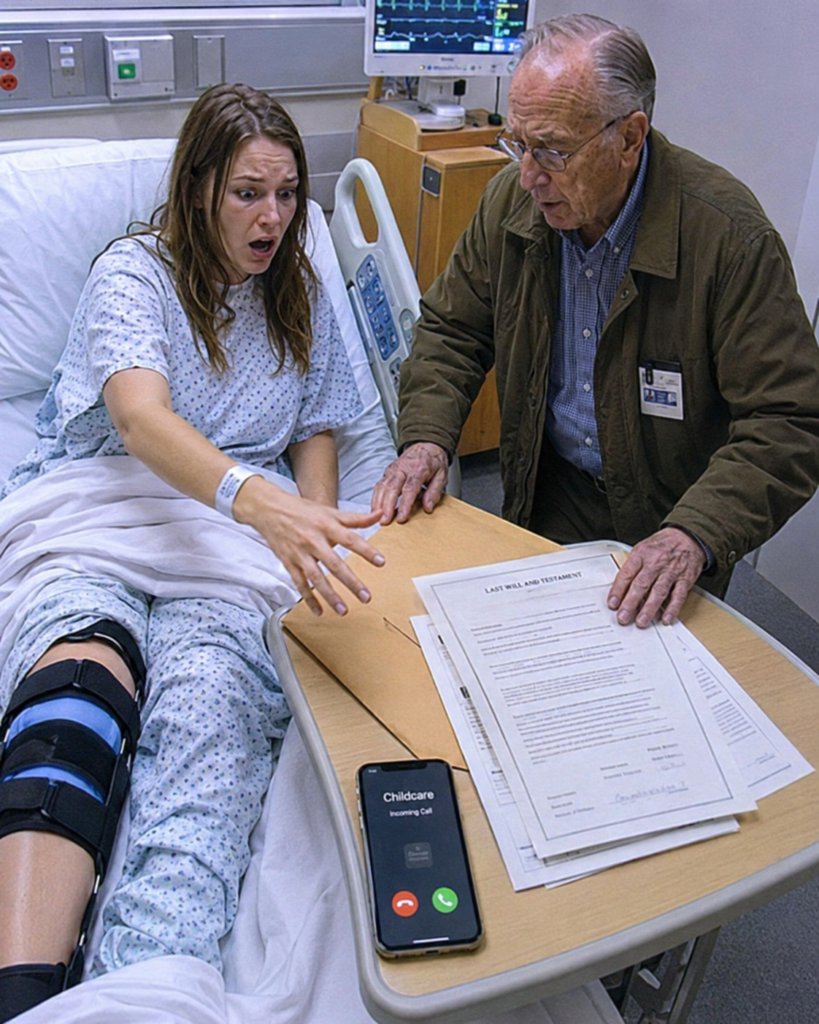
It was hearing her newborn daughter cry through the phone while her own mother explained why she would not come.
Meredith had always believed family meant showing up.
She had built her life around that belief.
For nine years, she had sent her mother $4,500 every month.
Rent.
Bills.
Repairs.
The expenses that started as temporary help and slowly became something everyone expected.
Nobody asked how much it cost her.
Nobody asked what happened when she was the one who needed support.
That answer came from a hospital bed.
After the accident, Meredith was unable to care for six-week-old Lily by herself.
She did the only thing she could think of.
She called her mother.
She expected hesitation, maybe inconvenience, maybe a complaint.
She never expected a suitcase in the background.
Her mother was preparing for a Caribbean cruise.
When Meredith begged her to take Lily for only two days, the response was simple.
Her sister Claire never had emergencies like this.
That sentence changed something inside Meredith.
She had spent years believing she was the dependable one.
The person who could handle everything.
The person who did not need anyone.
But strength had slowly turned into being taken for granted.
From the hospital bed, Meredith made a decision that affected everyone around her.
She hired professional care for Lily.
Then she contacted her attorney.
The monthly support stopped.
For the first time in nine years, her mother would have to face life without Meredith quietly fixing every problem.
The reaction was immediate.
The calls started.
The questions started.
But Meredith did not change her mind.
Hours later, her grandfather arrived.
He did not come with anger.
He came with something much heavier.
The truth about a family pattern Meredith had spent years trying not to see.
He placed an old envelope beside her hospital paperwork.
Inside was a reminder that her father had noticed everything.
He had noticed how often Meredith carried responsibility.
He had noticed how easily others accepted her sacrifices.
And he had worried that one day she would confuse being loved with being useful.
The envelope did not solve everything.
It did something more important.
It confirmed that Meredith was not imagining the imbalance.
Her pain had a history.
Her exhaustion had a reason.
And her decision to stop paying was not about money alone.
It was about finally protecting the person who had always been last on her list.
Herself.
When her mother called about the missing payment, Meredith expected another argument.
Instead, she heard something that revealed how deeply the family had depended on her silence.
The conversation forced everyone to confront a question they had avoided for years.
Was Meredith valued because she was loved, or because she was always willing to carry the burden?
The answer changed the way she looked at every holiday, every request, and every promise that had come before.
For the first time, she chose her daughter, her recovery, and her own future before the expectations placed on her.
And that choice became the moment her family had to decide whether they wanted Meredith herself—or just everything she provided.

Part 3
The phone call with my mother did not last long, but every second felt heavier than the hospital monitor beside my bed.
“You can’t just cut us off, Meredith,” my mother hissed through the speaker, her voice tight with panic rather than concern. “Claire’s lease renewal is in two weeks. And my insurance payment goes through on the first. You know how stressful this is for us!”
For nine years, those exact words had been my cue to fold. I would apologize, reassure her, and transfer the extra funds before the hour was over. I would work an extra weekend, skip a rest day, or take on another high-pressure project just to make sure the machinery of our family kept running smoothly.
This time, I didn’t flinch.
“Then Claire can finally figure out her own lease,” I said, my voice steady despite the lingering pain in my ribs. “And you can find out how much a Caribbean cruise actually costs when you have to pay your own bills. I am done.”
“You selfish—!”
I hung up.
The screen went dark, reflecting my own pale, tired face staring back at me. My hands were trembling slightly, but inside, a strange, terrifying calm had settled over me. I wasn’t the safety net anymore. The net was gone, and whoever was standing on the high wire would finally have to learn how to catch themselves.
Grandpa watched me quietly from the vinyl chair beside the bed. He didn’t smile, but there was a deep, fierce pride in his weathered eyes that I had never seen before.
“Your father tried to warn me,” Grandpa said softly, breaking the silence. “He told me years ago that if you kept building bridges out of your own bones, you’d eventually have nothing left to stand on. I thought he was just being protective. I thought letting you carry the weight would make you strong.”
He reached out and tapped the edge of the old envelope on the table.
“It did make you strong, Meredith. Too strong. Strong enough to carry everyone else while they forgot how to walk.”
Before I could answer, the hospital door swung open again.
This time, it wasn’t a nurse. It was Claire.
She looked breathless, wearing her designer travel clothes, her face twisted in a mixture of fury and disbelief. She hadn’t come to check on my leg, my concussion, or her six-week-old niece. She had come because her lifeline had just been severed.
Part 4
“Are you out of your mind?” Claire shrieked, marching straight to the side of my hospital bed. Several nurses passing in the hallway turned to look, but Claire didn’t care. “Mom is beside herself! She’s sitting in a departure lounge crying because her card was declined, and you’re just lying here playing the victim!”
I stared at my sister. Really stared at her.
For years, I had excused her behavior. I told myself she was fragile, that she needed a softer touch, that someone had to keep the peace. But looking at her now—flustered, angry, and entirely unconcerned that I had nearly died in a car crash—I saw the absolute truth of what my father’s letter had described.
Claire wasn’t fragile. She was simply accustomed to a lifestyle funded by my absence from my own life.
“My car was crushed by a semi-truck, Claire,” I said, my voice dangerously quiet. “I spent the last six hours wondering if I was going to live to watch my daughter grow up. And you flew down here—not to see if I was breathing—but because your allowance stopped.”
Claire flushed, crossing her arms defensively. “That’s different! You always have money. You’re the one who’s successful, you’re the one who has her life together. Why shouldn’t you help your own family?”
“Because help is something you offer when someone is struggling,” Grandpa spoke up, his voice cutting through the sterile room like cold steel. He stood up from his chair, towering over Claire despite his age. “What you and your mother have been doing for nine years isn’t family, Claire. It’s extortion disguised as tradition.”
Claire turned on him, her eyes wide with shock. “Grandpa! Whose side are you on?”
“I’m on the side of the only person in this room who nearly died today,” Grandpa replied firmly. “And the only person who has spent the last decade bleeding herself dry to fund your laziness.”
Claire looked between Grandpa and me, realizing for the first time that the dynamic had permanently shattered. There was no negotiation left. No guilt trip powerful enough to make me rebuild the bridge I had just blown up.
“You’ll regret this,” Claire spat, backing toward the door. “When Mom and I cut you out completely, don’t expect us to ever speak to you again.”
“Promise?” I whispered.
She slammed the door on her way out.
Part 5
Three weeks later, I was finally discharged and back home.
The house was quieter, but it didn’t feel lonely anymore. It felt safe. A licensed postpartum nurse helped me settle into a sustainable routine with Lily, and for the first time in my adult life, every dollar I earned stayed under my own roof.
My mother didn’t call for the first two weeks. She assumed, I suppose, that I would eventually break down and crawl back. When she finally did try to reach out—sending a text demanding money for a broken refrigerator—I didn’t answer. I simply blocked her number.
It wasn’t easy. The guilt didn’t vanish overnight; old habits of emotional responsibility run deep. But every time I looked down at Lily sleeping peacefully in her crib, the phantom weight on my shoulders lifted a little more.
Grandpa came over every Sunday. We didn’t talk much about my mother or Claire. Instead, we sat on the porch, drank coffee, and watched the sun set over a life I was finally building for myself.
The accident had nearly taken everything from me.
Instead, it gave me back my life.
I was no longer the bank, the safety net, or the permanent fix for other people’s carelessness. I was just Meredith—a mother, healing, standing firmly on her own two feet, and protecting the only world that truly mattered.